
CAN YOU USE HOUSEHOLD BLEACH IN A SWIMMING POOL? HERE IS THE TRUTH
By Achtwoo Pool | Professional Pool Cleaning Services
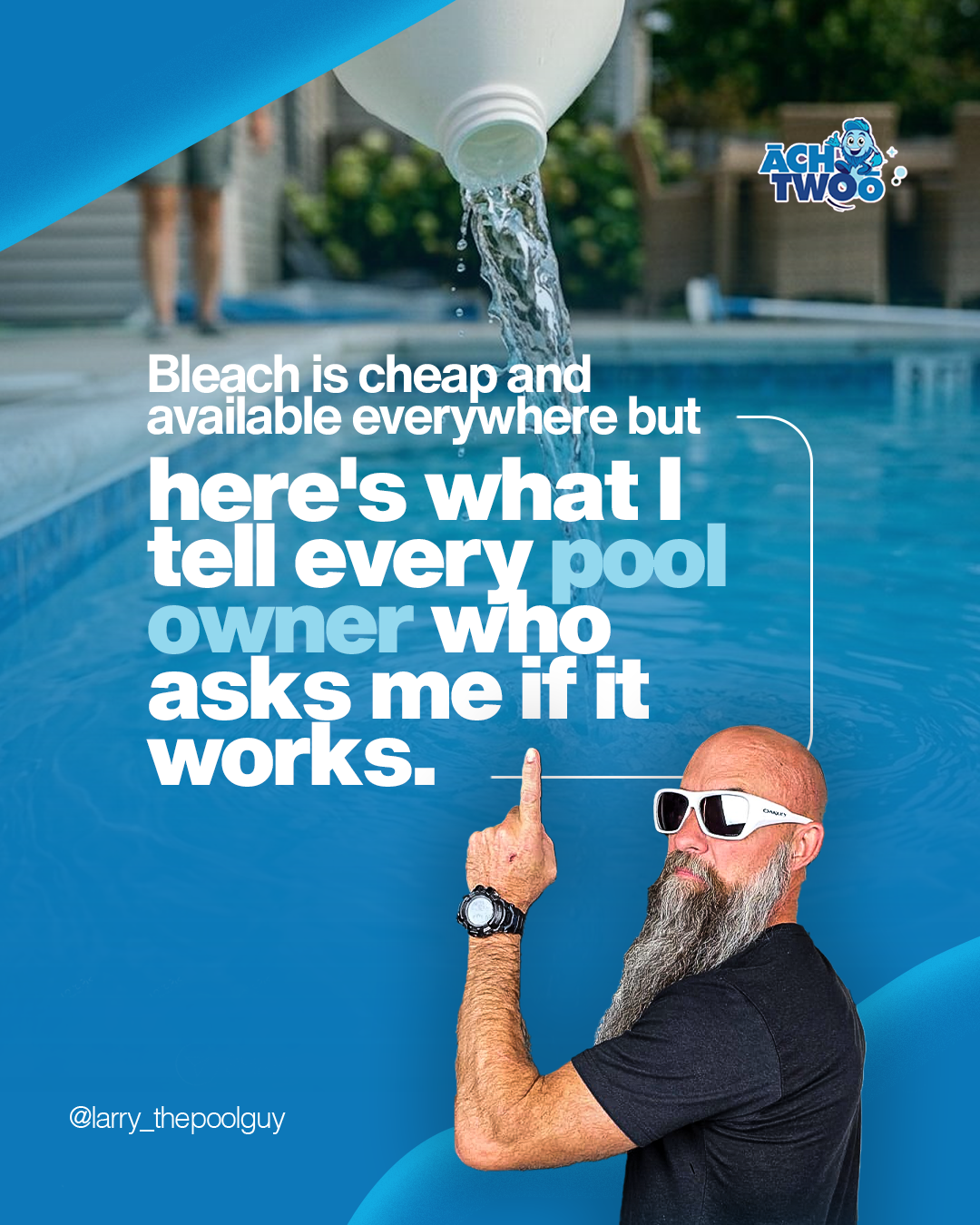
Bleach is cheap, it's available at every grocery store, and it contains chlorine. So why not use it in your pool? It's a question that comes up more than you'd expect and the honest answer is more nuanced than a flat yes or no. Here's what actually happens when you put bleach in your pool, and why pool-grade chlorine exists for good reason.
TABLE OF CONTENTS
Why Pool Owners Reach for Bleach in the First Place
Does Bleach Actually Contain Chlorine?
The Real Problem With Using Bleach in a Pool
What Chlorine Instability Actually Looks Like in Practice
What Pool-Grade Chlorine Does Differently
The Hidden Cost of Cutting Corners on Sanitiser
What a Properly Sanitised Pool Actually Feels Like
Stop Guessing; Get Your Pool on a System That Works
WHY POOL OWNERS REACH FOR BLEACH IN THE FIRST PLACE
It's an understandable impulse. You walk past the cleaning aisle, spot a large jug of household bleach for a fraction of the price of pool chlorine, and the logic seems sound; bleach is bleach, chlorine is chlorine, the pool needs sanitising. Why pay more for a product that appears to do the same thing?
The appeal is strongest during peak pool season when you're going through sanitiser quickly, when pool supply stores are picked clean, or when the budget is tight and a cheaper solution is sitting right there on the shelf. Pool owners who've tried it will tell you it seemed to work at first. The pool didn't immediately turn green.
The water didn't smell obviously bad. But over the following days, the results started sliding, and the problems started stacking up in ways that weren't immediately obvious.
Understanding why requires knowing what bleach actually is compared to what pool-grade chlorine is and why those differences matter enormously in a pool environment.
DOES BLEACH ACTUALLY CONTAIN CHLORINE?
Yes and that's where the comparison ends being favourable to bleach.
Standard household bleach is sodium hypochlorite at a concentration of around 3 to 8 percent, depending on the brand and formulation. Pool-grade liquid chlorine is also sodium hypochlorite, but at a concentration of 10 to 12 percent. That difference in concentration matters, but it's not the most important distinction.
The more significant issues are what household bleach contains beyond the sodium hypochlorite, and how it's formulated. Most household bleach products include stabilisers, thickeners, fragrances, and other additives designed for cleaning surfaces; not for treating a body of water that people will swim in. These additives are not inert in pool water. Some affect pH. Some contribute to foaming. Some interact with other pool chemicals in ways that compromise water quality and create their own set of problems to troubleshoot.
Pool-grade chlorine is formulated specifically and exclusively for water treatment. No additives, no fragrances, no surface-cleaning agents, just the active ingredient at the concentration and purity required to sanitise pool water effectively.
THE REAL PROBLEM WITH USING BLEACH IN A POOL
The concentration and additive issues are real, but the deepest problem with bleach in a pool environment is one that pool owners rarely anticipate: bleach without cyanuric acid stabiliser degrades almost immediately under sunlight.
Unstabilised chlorine which is exactly what household bleach is, is destroyed by UV radiation at a remarkable rate. Studies on chlorine photodegradation show that in direct sunlight, unstabilised chlorine can lose the majority of its effective concentration within a couple of hours of exposure. In a pool that sits in full sun, which describes the vast majority of residential pools during summer, the chlorine you add in the morning may be functionally depleted by midday.
This creates a cycle that looks something like this: you add bleach, chlorine spikes briefly, UV destroys it within hours, levels crash, the pool is left under-protected, and you add more bleach to compensate. You're testing constantly, adjusting constantly, and spending far more time and product trying to hold a stable sanitiser level than you would with pool-grade chlorine that is either stabilised itself or supported by appropriate cyanuric acid levels in the water.
In the meantime, between the chlorine spikes and crashes, your pool is cycling through periods of inadequate sanitisation. That's the window algae and bacteria need. It doesn't take a long window. A pool that's consistently under-protected for even a few hours each day will accumulate problems faster than any amount of catch-up dosing can address.
WHAT CHLORINE INSTABILITY ACTUALLY LOOKS LIKE IN PRACTICE
Pool owners who have run their pools on household bleach for any extended period tend to report the same pattern of frustration. The pool seems difficult to keep clean. Algae appears regularly despite frequent chemical additions. The water goes from acceptable to problematic quickly after any period of heavy use or hot weather. Testing shows chlorine readings that are all over the place; high right after dosing, then low or undetectable within a day or two.
The cause, in almost every case, is the same: inconsistent chlorine levels create an environment where sanitisation is unreliable. A pool with stable, consistent chlorine levels at the correct concentration actively suppresses algae growth, neutralises bacteria continuously, and maintains water quality between service visits. A pool running on unstable, rapidly-degrading chlorine does none of these things reliably.
There's also a pH consequence worth knowing. Household bleach is highly alkaline, typically with a pH between 11 and 13. Adding it to pool water in the quantities needed to compensate for rapid degradation pushes pH upward repeatedly. High pH reduces chlorine effectiveness further, which means you need even more chlorine to maintain protection, which pushes pH even higher. It's a reinforcing cycle of inefficiency.
WHAT POOL-GRADE CHLORINE DOES DIFFERENTLY
Pool-grade chlorine products, whether liquid chlorine at higher concentration, granular chlorine, or stabilised tablet form are engineered for the specific demands of pool water treatment.
Stabilised pool chlorine, such as trichlor tablets or dichlor granules, contains cyanuric acid built into the product. The cyanuric acid bonds with free chlorine in the water and shields it from UV degradation, dramatically extending its effective working life. Instead of losing most of its potency within hours of sunlight exposure, stabilised chlorine maintains a consistent residual level in the water throughout the day.
That consistency is the foundation of everything else. Stable chlorine levels mean continuous sanitisation rather than intermittent protection. They mean algae doesn't get the window it needs to establish. They mean pH changes more predictably and is easier to maintain. They mean testing reveals accurate baselines rather than erratic readings that are difficult to act on meaningfully.
Pool-grade liquid chlorine, while unstabilised itself, is used in conjunction with an established cyanuric acid level in the pool and at a concentration high enough to provide meaningful dosing without the additive issues of household bleach. It is the product of choice for shock treatments and for pools where cyanuric acid is already well-maintained.
The practical outcome of using the right product is straightforward: you test less frequently because levels hold. You adjust less often because the system is stable. You spend less on product over a season because you're not perpetually compensating for rapid degradation. And you have a pool that's consistently safe to swim in, not occasionally so between top-ups.
THE HIDDEN COST OF CUTTING CORNERS ON SANITISER
The appeal of household bleach is the upfront price. That calculation changes significantly when you account for what bleach-based pool maintenance actually costs over a season.
First, the volume required. Because bleach is weaker and degrades faster, you need significantly more of it to maintain the same effective chlorine level as pool-grade product. The price per unit of active chlorine, when calculated honestly, is rarely as favourable as it appears on the shelf.
Second, the time cost. Constant testing, constant adjusting, and the troubleshooting that comes with unstable sanitiser levels; algae treatments, clarifier purchases, repeated shock doses; all add up in time and product spend.
Third, and most significantly, the consequence cost. Algae blooms that develop because sanitiser levels were inconsistently maintained require treatment that is far more expensive than the chlorine that would have prevented them. A green pool needs shock treatment, algaecide, extended filtration runs, and often professional intervention. The cost of a single algae remediation service will exceed the savings from a season of using cheaper bleach.
Cutting corners on sanitiser is one of those maintenance decisions that appears to save money until the bill arrives and in pool maintenance, the bill for inconsistent sanitisation has a way of arriving suddenly and at scale.
WHAT A PROPERLY SANITISED POOL ACTUALLY FEELS LIKE
There's a standard that well-maintained pools hold to and once you've experienced it, the difference is immediately obvious.
Water that is properly sanitised with stable, appropriate chlorine levels doesn't have a strong chemical smell. That smell, as mentioned earlier, is chloramines; the byproduct of chlorine that has been consumed by contaminants. A pool with genuinely good chemistry has little to no odour. The water is clear without being harsh on eyes or skin. Swimmers get out comfortable rather than red-eyed and itchy.
Stable chemistry also means the pool recovers quickly after heavy use. A well-maintained pool can handle a pool party and be back in balance within 24 hours with minimal intervention. A pool running on inconsistent bleach-based sanitisation takes days to restabilise after any significant bather load, and the window of instability is exactly the window where problems develop.
Consistent pool-grade chlorine, properly applied and properly supported by balanced pH and alkalinity, is what makes a pool genuinely enjoyable not just nominally clean but reliably, predictably safe from one week to the next.
STOP GUESSING! GET YOUR POOL ON A SYSTEM THAT WORKS
Still relying on quick fixes that aren't holding up? The good news is that getting your pool onto a proper sanitisation system is simpler than troubleshooting the consequences of an inconsistent one.
At 409 Pool, we set pools up with chemistry systems that hold; the right products, the right concentrations, the right balance of stabiliser to keep chlorine working in the conditions your pool actually operates in. Less guessing, less adjusting, fewer problems, and a pool that stays genuinely clean between service visits.
If your pool has been a constant battle this season; algae that keeps coming back, chlorine levels that won't hold, water that looks acceptable one day and questionable the next, the problem almost certainly isn't how often you're treating it. It's what you're treating it with. A pool that's sanitised with the wrong product will always demand more time, more money, and more frustration than one that's set up correctly from the start. You shouldn't have to work this hard to keep water clean.
At Achtwoo Pool, we don't just treat symptoms, we set pools up with chemistry systems that hold. The right sanitiser, the right stabiliser levels, the right balance that keeps your water genuinely protected from one week to the next without the constant guesswork. One proper setup saves more time and money over a season than any number of quick fixes ever will.
We serve Orange, Texas | Southeast Texas | Southwest Louisiana
Orange, Texas; Call: +1 409-734-7665
Beaumont, TX; Call: 409-734-POOL
Lake Charles, LA; Call: 337-333-POOL
Visit www.409pool.com or click the link in our bio.
A pool that stays clean shouldn't feel like a second job. Let's set yours up so it doesn't.