
DO YOU ACTUALLY NEED ANTIFREEZE WHEN CLOSING YOUR INGROUND POOL?
By Achtwoo Pool | Professional Pool Cleaning Services | Orange, Texas | Southeast Texas | Southwest Louisiana
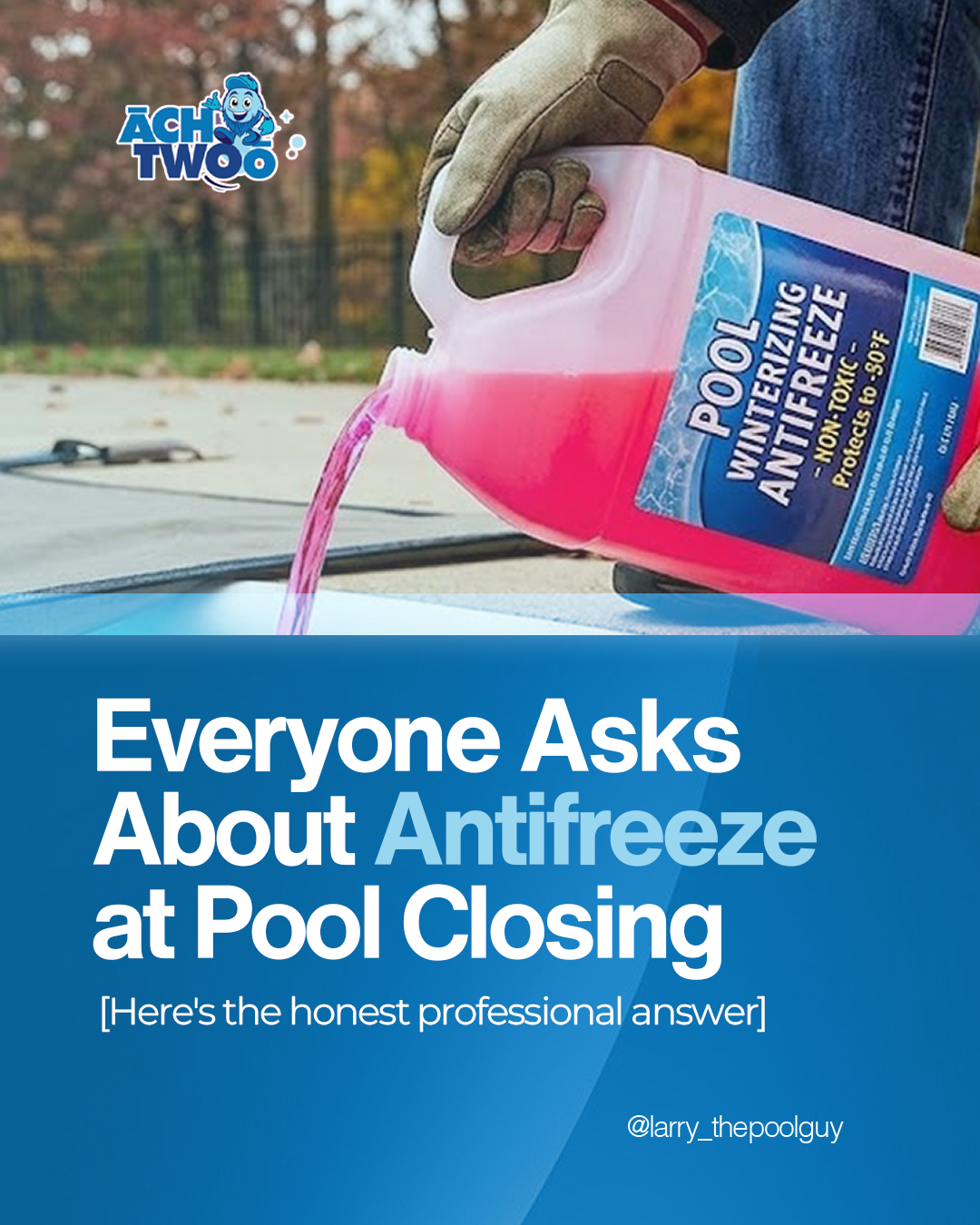
Everyone asks about antifreeze at pool closing. It has become one of those seasonal rituals that pool owners perform more out of habit than understanding buying a few gallons, pouring them in, and assuming the pool is protected for winter. Here is the honest professional answer to whether you actually need it and what the decision really depends on.
Table of Contents
The Question That Comes Up Every Single Closing Season
What Antifreeze Is Actually Designed to Do
The One Thing That Determines Whether You Need It
If Your Lines Have Been Properly Blown Out: You Don't Need It
What Blowing Out Pool Lines Actually Involves
How to Know If Your Lines Were Cleared Completely
If Your Lines Were Not Blown Out: Antifreeze Is Not Optional
How Much Antifreeze You Actually Need
The Rule That Is Non-Negotiable: Pool-Grade Only
Why Automotive Antifreeze Must Never Enter a Pool System
The Closing Decision That Protects Your Investment All Winter
Not Sure Whether Your Lines Are Properly Cleared for Winter?
The Question That Comes Up Every Single Closing Season
Every autumn, without fail, the same question arrives from pool owners preparing to close for the season. It comes in slightly different forms; "Do I need antifreeze?" "How much antifreeze should I use?" "Is the antifreeze I have from last year still good?" but it is always the same underlying question: am I doing enough to protect the plumbing over winter?
It is a reasonable question. Frozen pipes are one of the most costly and inconvenient outcomes of an improperly closed pool. When water inside underground plumbing lines freezes, it expands. The expansion creates pressure that cracks fittings, splits pipes, and damages equipment that was functioning perfectly when the pool was closed. The repair costs in spring excavating to reach buried lines, replacing cracked fittings, addressing damage to the filter and pump can run into thousands of dollars that a properly executed closing would have prevented entirely.
But antifreeze is not the only answer to that risk, and it is not always the right answer. Whether you need it depends entirely on a single factor that determines the risk itself and understanding that factor is the starting point for making the correct closing decision.
What Antifreeze Is Actually Designed to Do
Pool antifreeze is a propylene glycol-based solution specifically formulated to lower the freezing point of water in pool plumbing lines. When introduced into the pipes, it mixes with any residual water present and creates a solution that freezes at a significantly lower temperature than water alone typically around minus 50 degrees Fahrenheit in standard pool antifreeze formulations, far below any temperature that residential pool plumbing in Southeast Texas or Southwest Louisiana would ever experience.
The protection it provides is straightforward: if water is present in the pipes, antifreeze prevents that water from freezing and expanding. It does not eliminate water from the lines. It does not clean the lines. It does not protect equipment that was not included in the antifreeze application. What it does, specifically and exclusively, is prevent the freezing damage that would otherwise occur to water-filled lines during sustained cold temperatures.
That specificity is important because it means antifreeze is a solution to one particular problem. And that problem only exists if its prerequisite condition is present.
The One Thing That Determines Whether You Need It
The decision about whether pool antifreeze is necessary reduces to a single question: have the equipment lines and underground plumbing been completely cleared of water using a compressed air blow-out?
If yes, if an air compressor has been connected to the pool plumbing and used to force every drop of water out of the lines, through the return jets, out of the skimmer lines, and from every section of underground pipe then there is no water in the lines to freeze. Antifreeze protects against the freezing of standing water in pipes. Remove the water, and the risk antifreeze addresses no longer exists.
If no, if the lines have not been blown out, or if you are not certain whether the blow-out was complete then water may remain in the plumbing. In that case, antifreeze is not a precaution. It is the essential protection that stands between the residual water in those lines and the freeze damage that will result from leaving it untreated through winter.
The distinction is that clean and simple. Blown out completely: antifreeze is unnecessary. Not blown out or uncertain: antifreeze is non-negotiable.
If Your Lines Have Been Properly Blown Out: You Don't Need It
This is the part of the antifreeze conversation that rarely gets said clearly enough: a pool whose lines have been properly blown out with a commercial air compressor at closing does not need antifreeze. The risk it is designed to address has been eliminated by the blow-out process.
Many pool owners add antifreeze as a habit or as an additional precaution even after a proper blow-out. It doesn't hurt the pool, pool-grade antifreeze is non-toxic and will dilute into the pool water at spring opening without significant effect. But it is an unnecessary expense and step when the lines are genuinely free of water.
The money and time spent on antifreeze in this scenario is better directed at confirming the quality of the blow-out itself which is the actual protection the plumbing needs.
What Blowing Out Pool Lines Actually Involves
A proper pool line blow-out uses a commercial air compressor typically with a minimum capacity of at least one to two horsepower connected to the pool's plumbing system through the equipment pad. Air is forced through every section of the plumbing circuit under pressure, pushing residual water out through the return jets, the skimmer lines, and any other open endpoints.
The process requires working through the lines systematically: closing off each section after it has been cleared, moving through the circuit until every line that contains water has been blown clear. Return jets are plugged as they are cleared, skimmer lines are blown out and plugged or capped, and the main drain line is addressed according to the specific pool configuration.
A complete blow-out requires experience and the right equipment to execute correctly. It is one of the closing tasks most worth having a professional perform, because the consequences of an incomplete blow-out cracked lines and damaged fittings discovered at spring opening are significantly more expensive than the cost of the service itself.
How to Know If Your Lines Were Cleared Completely
If a professional pool service performed your closing, they should be able to confirm that a compressed air blow-out was completed and which lines were cleared. If you performed the closing yourself or are uncertain about what was done, the honest answer is that uncertainty should be treated as an incomplete blow-out for the purposes of the antifreeze decision.
Visual confirmation is limited, you cannot see inside buried plumbing lines to verify they are dry. If there is any doubt about whether the blow-out reached every section of the plumbing, particularly underground lines where confirmation is difficult, treating the closing as incomplete and applying antifreeze is the appropriate precaution.
The cost of antifreeze applied when it turns out to be unnecessary is modest. The cost of a cracked line discovered in spring because antifreeze was skipped when it was needed is significantly higher.
If Your Lines Were Not Blown Out: Antifreeze Is Not Optional
For pools that are closed without a compressed air blow-out whether because the equipment wasn't available, because the closing was performed quickly without the full process, or because the pool owner wasn't aware that a blow-out was part of the correct procedure; antifreeze is the protection that prevents winter freeze damage to water-filled lines.
In this scenario, antifreeze is introduced directly into the plumbing lines through the skimmer or dedicated access points, where it mixes with the residual water present and lowers its freezing point. The protection covers the lines that contain the antifreeze-water mixture throughout the winter, preventing the expansion damage that would otherwise occur if temperatures drop far enough to freeze the standing water.
How Much Antifreeze You Actually Need
The correct quantity of antifreeze for a pool closing is calculated based on the length of underground plumbing present in the system, not the pool volume. The standard guideline is one gallon of pool-grade antifreeze for every 25 feet of underground plumbing line.
Before purchasing antifreeze for a pool closing, measure or estimate the total length of underground plumbing that will be treated. Include the skimmer lines, the main drain line, and any return lines that run underground between the equipment pad and the pool. Add up the lengths and divide by 25 to determine the number of gallons required.
Purchasing insufficient antifreeze and under-treating the lines defeats the purpose of the application. The antifreeze concentration in the remaining sections of pipe that weren't fully treated may not be high enough to provide freeze protection through the coldest periods of winter. Measure before purchasing and ensure you have sufficient product to cover the full line length.
The Rule That Is Non-Negotiable: Pool-Grade Only
One instruction belongs in every pool closing antifreeze discussion, without qualification or exception: only ever use pool-grade, non-toxic antifreeze in a pool system. This is not a preference or a professional recommendation based on optimal results. It is a safety and compatibility requirement.
Pool-grade antifreeze is formulated with propylene glycol, a compound that is non-toxic to humans and animals, chemically compatible with pool equipment and plumbing materials, and safe to dilute into pool water at spring opening without harmful effects on swimmers or the pool system.
Why Automotive Antifreeze Must Never Enter a Pool System
Automotive antifreeze is formulated with ethylene glycol; a compound that is toxic to humans and animals, chemically incompatible with pool equipment materials, and not safe for introduction into a swimming pool under any circumstances.
The products can look similar on a shelf. They may even be in the same section of a hardware store. The difference between them is not a matter of quality or preference, it is a fundamental chemical incompatibility that makes automotive antifreeze actively dangerous in a pool context. A pool treated with automotive antifreeze requires professional remediation before it is safe to use. The contamination is not reversible through standard water treatment.
There is no scenario in which automotive antifreeze is an acceptable substitute for pool-grade antifreeze. If pool-grade antifreeze is not available, the correct response is to source it from a pool supply retailer not to use automotive antifreeze as an available alternative.
The Closing Decision That Protects Your Investment All Winter
A properly closed pool whether protected by a complete compressed air blow-out, correctly applied pool-grade antifreeze, or a combination of both where partial blow-out warrants additional precaution arrives at spring opening in the condition it was left in. The plumbing is intact. The equipment is undamaged. The pool can be opened and filled without the discovery of winter damage that turns a standard opening into an emergency repair.
The closing decision is made once per year. Getting it right costs far less than getting it wrong.
Not Sure Whether Your Lines Are Properly Cleared for Winter?
Uncertainty about the completeness of a pool line blow-out is exactly the kind of situation where a professional closing service removes the risk entirely. At Achtwoo Pool, we perform complete compressed air blow-outs, apply pool-grade antifreeze where the lines and conditions warrant it, and close pools across Orange, Texas, Southeast Texas, and Southwest Louisiana with the confidence that comes from doing it correctly rather than assuming it was done adequately.
We serve Orange, Texas | Southeast Texas | Southwest Louisiana
Orange, Texas; Call: +1 409-734-7665
Beaumont, TX; Call: 409-734-POOL
Lake Charles, LA; Call: 337-333-POOL
Visit www.409pool.com or click the link in our bio.
Not sure whether your lines are properly cleared for winter? Let's close your pool correctly and protect it through the season so spring opening is a celebration, not a repair bill.