
HOW OFTEN YOUR POOL DECK ACTUALLY NEEDS PRESSURE WASHING
By Achtwoo Pool | Professional Pool Cleaning Services | Orange, Texas | Southeast Texas | Southwest Louisiana
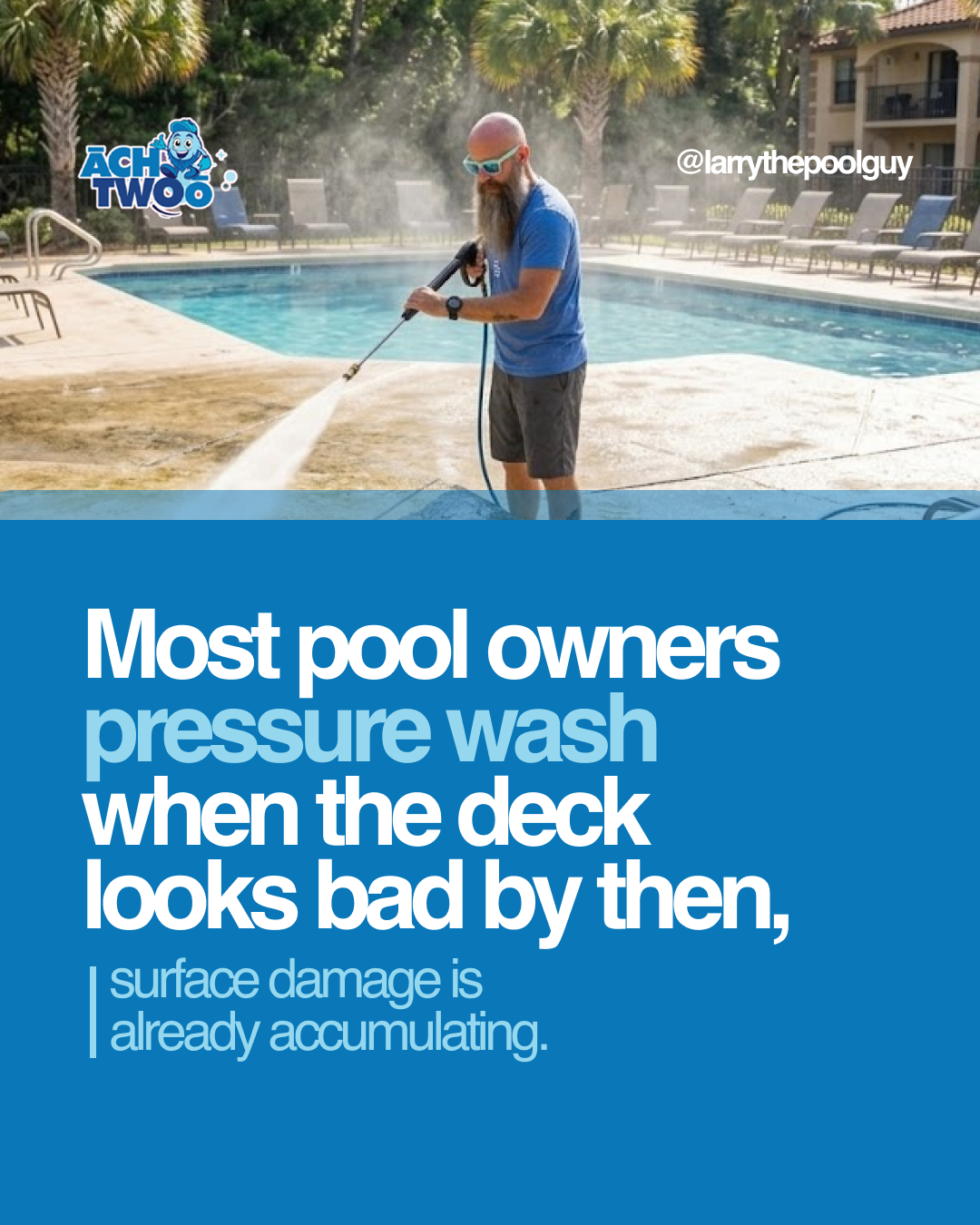
Most pool owners run their deck on the same schedule: they pressure wash it when it looks bad. It seems reasonable, even responsible. The problem is that by the time a deck looks bad enough to clean, surface damage is already accumulating underneath the grime, and you are cleaning in reaction to a problem instead of preventing one. A pool deck has a maintenance rhythm that has nothing to do with when it finally looks dirty, and knowing that rhythm is what keeps a deck looking good for decades instead of slowly degrading a season at a time. Here is how often your deck actually needs attention, and why the answer depends on what it is made of and where you live.
TABLE OF CONTENTS
WHY "WHEN IT LOOKS BAD" IS THE WRONG SCHEDULE
CONCRETE, STONE, AND PAVERS: ONCE OR TWICE A YEAR
WHY SOUTHEAST TEXAS PUSHES YOU TO THE HIGHER END
PAVER DECKS: PROTECT THE JOINTS
WOOD DECKS: THE MOST CAUTIOUS SCHEDULE OF ALL
SEALING IS HALF THE MAINTENANCE STORY
PREVENTION ALWAYS COSTS LESS THAN RESTORATION
WANT YOUR DECK ON A PROFESSIONAL SCHEDULE?
WHY "WHEN IT LOOKS BAD" IS THE WRONG SCHEDULE
Waiting until a deck looks dirty feels like common sense, but it gets the timing exactly backward. Algae, mold, and organic buildup do not wait politely on the surface until you notice them. They work into the material, and the discoloration you finally see is the late stage of a process that has been going for a while. By the time the deck looks bad, damage is already accumulating.
Maintenance on a schedule flips that around. Instead of reacting to visible grime, you clean before the buildup has time to establish and start degrading the surface. The deck rarely looks bad, because you never let it get there, and the surface underneath stays sound because nothing was allowed to sit and eat into it. This is the difference between maintaining a deck and rescuing one, and the schedule is what separates the two.
CONCRETE, STONE, AND PAVERS: ONCE OR TWICE A YEAR
For the hard surfaces most pool decks are built from, concrete, stone, and pavers, the baseline is once or twice a year. That range exists because how often a given deck needs washing depends heavily on its environment, and the two ends of the range suit very different situations.
A deck in a drier setting with little surrounding vegetation and light organic load can often do well on the lower end, a single thorough wash per year. A deck facing more moisture, more shade, and more plant matter around it needs the higher end to stay ahead of what is landing on it. The material can handle the cleaning at that frequency without trouble; the question is simply how much your specific surroundings are throwing at it, and that is what places you within the once-or-twice range.
WHY SOUTHEAST TEXAS PUSHES YOU TO THE HIGHER END
Here in Southeast Texas, most pool decks belong at the top of that range, and the climate is the reason. In humid climates like ours, with the heavy surrounding vegetation so many local properties have, algae and mold accumulate faster than they would in a drier place. The moisture feeds them, the vegetation supplies a constant stream of organic matter, and the two together create ideal conditions for buildup.
That is why the higher end of the once-or-twice-a-year range is the professional recommendation here rather than an optional extra. A schedule that might be plenty in a dry climate leaves a Southeast Texas deck falling behind, because our conditions grow algae and mold faster than a once-a-year wash can keep up with. Matching your cleaning frequency to your actual climate is the whole point, and in this region that means leaning toward twice a year for hard surfaces rather than once.
PAVER DECKS: PROTECT THE JOINTS
Paver decks deserve a specific word of caution, because they have a vulnerability the solid surfaces do not. The sand in the joints between pavers is what holds them in alignment, and too much pressure disturbs that joint sand and undermines the very thing keeping the deck stable and even.
So pavers call for special care. Use medium pressure rather than coming at them with everything a hard surface can take, and complement your annual washing with regular sweeping to keep organic matter from settling down into the joints in the first place. That routine sweeping does a lot of quiet work, because organic matter that never gets the chance to settle between the joints is organic matter you never have to blast out later with pressure that risks the joint sand. Treat the joints as the weak point to protect, wash at medium pressure, and keep up the sweeping between washes, and a paver deck stays both clean and structurally sound.
WOOD DECKS: THE MOST CAUTIOUS SCHEDULE OF ALL
Wood decks need the most cautious approach of any surface, both in how often they are washed and how. The ceiling for wood is a maximum of every one to two years, using low PSI to prevent splintering. That is not a target to hit as often as possible; it is a limit not to exceed, because every wash puts more stress on wood than it does on stone or concrete.
There is also a step for wood that is not optional: always seal the wood immediately after washing. This matters enormously. Unsealed wood warps, absorbs moisture, and develops mold significantly faster than sealed wood, so a wash that is not followed promptly by sealing can leave the deck worse off than if you had left it alone. The washing opens the wood up, and the sealing is what closes it back against the moisture that would otherwise get in and do damage. Wash a wood deck no more than every one to two years, keep the pressure low, and seal it right after every single time.
SEALING IS HALF THE MAINTENANCE STORY
Pressure washing frequency is only one half of deck maintenance. The other half is sealing, and it runs on its own schedule. Reseal your pool deck every two to three years, depending on sun exposure and traffic, because those two factors are what wear a sealer down and determine how quickly it needs renewing.
In high-UV climates like ours, do not simply wait out the full two to three years and hope. Inspect the deck annually and reseal before the surface begins absorbing water again. That last part is the trigger to watch for, because a sealer that has worn through stops protecting the surface, and once the deck starts drinking in water, the material underneath is exposed to exactly the moisture damage the sealer existed to prevent. Catching that point early and resealing before it arrives keeps the protection continuous. Sun and traffic set the pace; an annual inspection makes sure you reseal on time rather than after the window has already passed.
PREVENTION ALWAYS COSTS LESS THAN RESTORATION
Every part of a smart deck schedule comes back to one principle: prevention always costs less than surface restoration. A deck washed on schedule and resealed before it wears through is a deck you maintain with routine, affordable care. A deck run until it looks bad, cleaned too aggressively, or left unsealed until it starts absorbing water is a deck you eventually have to restore, and restoration is always the expensive path.
The whole schedule, the once-or-twice-a-year washing tuned to our climate, the medium pressure and sweeping for pavers, the cautious frequency and immediate sealing for wood, the resealing every two to three years with an annual check, exists to keep you permanently on the cheap side of that line. None of it is difficult. It simply has to happen on the surface's timeline rather than in reaction to how the deck looks on a given afternoon.
WANT YOUR DECK ON A PROFESSIONAL SCHEDULE?
Keeping a deck on the right rhythm, matched to its material, its climate, and its sealing needs, is exactly the kind of ongoing care worth handing to people who track it for you so nothing slips past the point where prevention turns into restoration. At Achtwoo Pool, our team across Orange, Texas, Southeast Texas, and Southwest Louisiana cleans and seals pool decks on a professional schedule built for our region's humidity and vegetation, so your deck stays ahead of the buildup instead of chasing it.
Want your pool deck cleaned and sealed on a professional schedule? Let us keep it on track.
WE SERVE ORANGE, TEXAS | SOUTHEAST TEXAS | SOUTHWEST LOUISIANA
ORANGE, TEXAS; Call: +1 409-734-7665
BEAUMONT, TX; Call: 409-734-POOL
LAKE CHARLES, LA; Call: 337-333-POOL
Visit www.409pool.com or click the link in our bio.