
WHY YOUR SALTWATER POOL'S pH KEEPS RISING AND WHAT TO DO ABOUT IT
By Achtwoo Pool | Professional Pool Cleaning Services | Orange, Texas | Southeast Texas | Southwest Louisiana
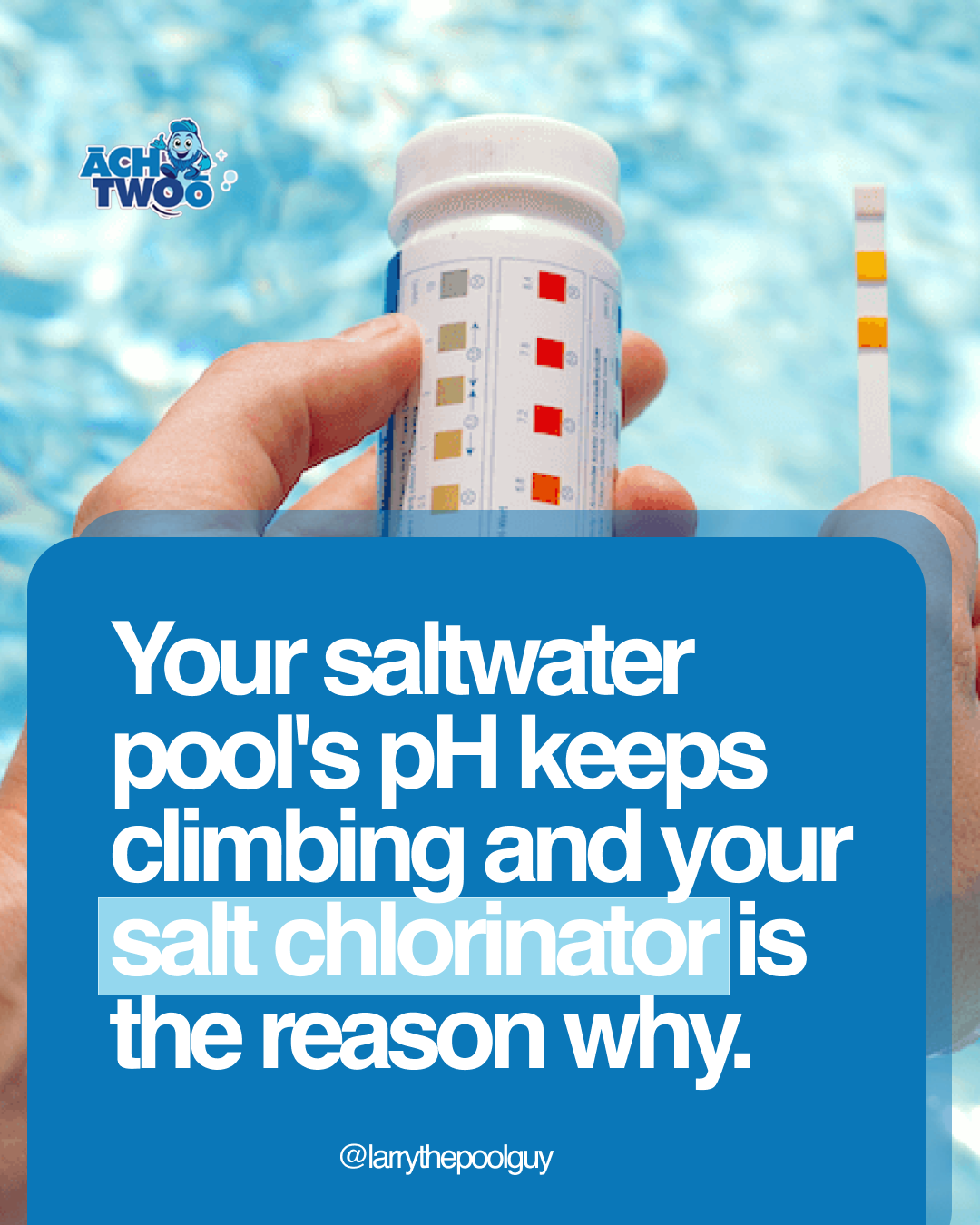
You bought the saltwater pool partly for the promise of easier chemistry, and in most ways it delivered. But there is one number that refuses to cooperate. You correct your pH, it behaves for a few days, and then it starts climbing again, and no matter how carefully you dose it, it keeps drifting back up. You are not doing anything wrong, and you are not imagining it. Your salt chlorinator is the reason, and once you understand why, the whole problem becomes something you can manage instead of chase. Here is what is actually happening and exactly what to do about it.
TABLE OF CONTENTS
THE ONE NUMBER THAT WON'T STAY PUT
WHY ELECTROLYSIS PUSHES YOUR pH UPWARD
THE MORE YOUR GENERATOR RUNS, THE HIGHER IT CLIMBS
WHAT HIGH pH IS ACTUALLY DOING TO YOUR POOL AND YOUR BODY
HOW HIGH pH COMPOUNDS EVERY OTHER PROBLEM AT ONCE
WHY WEEKLY TESTING IS NON-NEGOTIABLE FOR SALTWATER
HOW TO BRING YOUR pH BACK INTO RANGE
THE MONTHLY HABIT THAT PROTECTS YOUR SALT CELL
WANT YOUR SALTWATER CHEMISTRY HANDLED PROPERLY?
THE ONE NUMBER THAT WON'T STAY PUT
Talk to enough saltwater pool owners and a pattern emerges. They love the water, they appreciate the reduced hands-on chlorine handling, and they all have the same complaint. The pH will not sit still. It climbs, they knock it back down, and within days it is climbing again. It is the single most common and most persistent chemical issue in saltwater pools, and it frustrates owners precisely because everything else about the pool feels so low-maintenance by comparison.
The important thing to understand is that this is not a flaw in your pool and it is not a failure on your part. Rising pH is a built-in characteristic of how a saltwater pool makes its chlorine. Once you see the mechanism, you stop treating high pH as a mysterious recurring emergency and start treating it as a known, predictable condition you simply stay ahead of.
WHY ELECTROLYSIS PUSHES YOUR pH UPWARD
A saltwater pool does not skip chlorine. It manufactures it. Your salt chlorinator, also called a salt cell or generator, takes the dissolved salt in your water and runs an electrical current through it in a process called electrolysis, which converts the salt into chlorine right there in the plumbing. That is the whole appeal of the system, a steady supply of chlorine generated on demand instead of poured in from a bucket.
The catch is that electrolysis does not only produce chlorine. It naturally raises pH as a byproduct of the reaction. So the very process keeping your pool sanitized is, at the same time and by its own nature, pushing your pH upward. This is not occasional and it is not avoidable. Every hour your cell generates chlorine, it is also nudging your pH higher. That is why the correction you made never seems to hold, and why still pools without a generator do not fight this battle the same way.
THE MORE YOUR GENERATOR RUNS, THE HIGHER IT CLIMBS
Because the upward pH push is tied directly to chlorine generation, it scales with how hard your system works. The longer your generator runs, the more consistently pH gets driven up. In the middle of a Southeast Texas or Southwest Louisiana summer, when heat, sunlight, and heavy swimmer use all demand more chlorine, your cell runs longer to keep up, and your pH climbs faster as a direct result.
This is why the problem so often feels worst exactly when your pool is being used most. It is not a coincidence. Peak season means peak generator run time, and peak generator run time means peak upward pressure on pH. Understanding that link lets you anticipate the problem instead of being surprised by it. When you know your cell is working hard, you know your pH is climbing, and you can test and correct before it gets away from you.
WHAT HIGH pH IS ACTUALLY DOING TO YOUR POOL AND YOUR BODY
Left unattended, high pH is not a harmless quirk. Once pH climbs above 7.6, real consequences begin. Swimmers start to feel it as eye and skin irritation, the kind of discomfort that turns people off the pool without them quite knowing why. That alone is worth preventing, but the chemistry consequences run deeper.
High pH reduces the effectiveness of your chlorine. The sanitizer is still in the water, but at elevated pH it simply does not work as well, so a pool can test as having chlorine present while still struggling to stay genuinely clean. On top of that, high pH accelerates calcium scaling, the chalky, crusty buildup that forms on surfaces and, critically, on the plates inside your salt cell. Scaling on those cell plates is one of the most damaging things that can happen in a saltwater pool, because the cell is the expensive heart of the whole system.
HOW HIGH pH COMPOUNDS EVERY OTHER PROBLEM AT ONCE
The reason high pH deserves priority attention is that it does not stay in its own lane. Left uncorrected, it makes everything else worse simultaneously. Your chlorine becomes less effective, so your water quality slips. Your scaling risk climbs, so your equipment and your cell are under threat. Your swimmers are uncomfortable, so the pool gets used less and enjoyed less.
It becomes a situation where you are fighting several battles at once, all of them rooted in a single number you let drift too high. This is what separates high pH from a minor nuisance. It is a compounding problem, and the longer it runs uncorrected, the more of your pool's chemistry and equipment it drags down with it. Control the pH and a whole cluster of downstream problems simply never gets the chance to develop.
WHY WEEKLY TESTING IS NON-NEGOTIABLE FOR SALTWATER
Here is the single most important habit for a saltwater pool, and it is one many owners get wrong. Test your pH every single week, without exception. Not every two weeks, not whenever the water looks off, not when you happen to remember. Every week.
Owners who stretch their testing to every two weeks are applying a still-pool rhythm to a pool that generates its own upward pH pressure continuously. In the gap between tests, the generator keeps running and the pH keeps climbing, and by the time they finally test, the number has already sailed past 7.6 and started doing damage. Weekly testing exists precisely because the upward push is constant. It is the cadence that matches the mechanism. A saltwater pool is a low-effort pool in almost every respect, but this is the one place where you do not get to relax the schedule, and the owners who accept that have far fewer problems than the ones who fight it.
HOW TO BRING YOUR pH BACK INTO RANGE
Correcting high pH is straightforward once you are testing on the right schedule. When your weekly test shows pH creeping up, add muriatic acid or a dry pH decreaser to bring it back down into the target range of 7.4 to 7.6. That range keeps your chlorine working efficiently, keeps swimmers comfortable, and keeps you clear of the scaling threshold.
The key is timing, not heroics. The goal is to catch the rise and correct it before scaling begins on your salt cell plates, not to wait until the pool is clearly out of balance and then make a large, dramatic correction. Small, regular adjustments made off the back of weekly tests keep your pool sitting quietly in range with almost no drama. Large corrections made after weeks of neglect are stressful, less precise, and only necessary because the problem was allowed to run.
THE MONTHLY HABIT THAT PROTECTS YOUR SALT CELL
There is one more protective habit specific to saltwater ownership, and it is one of the most cost-effective moves you can make. Once a month, add a scale inhibitor to your pool. Its job is to prevent calcium deposits from forming on your cell plates and equipment surfaces even during the brief windows when pH is elevated between your corrections.
No testing schedule is perfect, and there will always be short stretches where pH is running high before you catch and correct it. A monthly scale inhibitor is your insurance for exactly those windows. It protects the most expensive component in your system, the salt cell, from the slow, cumulative scaling that shortens its life. For the small cost of the product and a few minutes each month, you are protecting a part that is genuinely expensive to replace. Among all the habits specific to saltwater pools, this is one of the highest returns on the least effort.
WANT YOUR SALTWATER CHEMISTRY HANDLED PROPERLY?
Rising pH is manageable, but it is relentless, and it rewards consistency far more than intensity. If keeping up with weekly testing, timely acid dosing, and monthly scale protection is more than you want to take on through a long swim season, that is exactly the kind of ongoing care worth handing to people who do it every day. At Achtwoo Pool, our team across Orange, Texas, Southeast Texas, and Southwest Louisiana keeps saltwater chemistry in range and salt cells protected, so the system you bought for easier pool ownership actually delivers on it.
Saltwater pool pH that won't stay in range? Let us keep it handled.
WE SERVE ORANGE, TEXAS | SOUTHEAST TEXAS | SOUTHWEST LOUISIANA
ORANGE, TEXAS; Call: +1 409-734-7665
BEAUMONT, TX; Call: 409-734-POOL
LAKE CHARLES, LA; Call: 337-333-POOL
Visit www.409pool.com or click the link in our bio.