
HOW TO CHOOSE THE RIGHT POOL CHEMICALS AND STOP WASTING MONEY ON ONES THAT DON'T WORK
By AchtwooPool | Professional Pool Cleaning Services | Orange, Texas | Southeast Texas | Southwest Louisiana
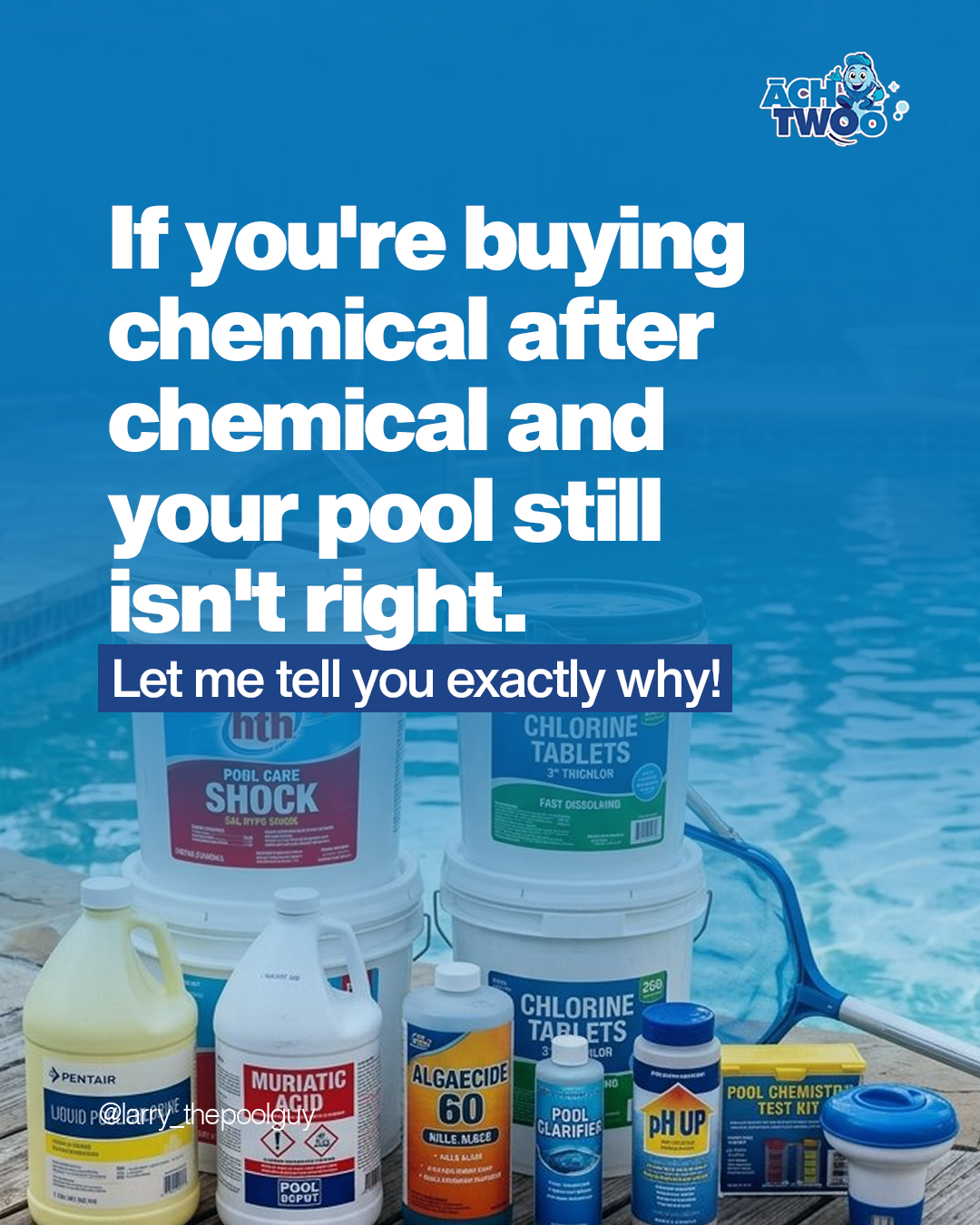
If you're buying chemical after chemical and your pool still isn't right, the problem isn't that you're not trying hard enough. It's that the system underneath those chemicals isn't balanced and no amount of product fixes an unbalanced system. Here's how to stop reacting and start maintaining a pool that actually stays clear.
Table of Contents
- Why More Chemicals Don't Equal a Better Pool
- The Real Reason Your Pool Isn't Responding to Treatment
- How Unbalanced Chemistry Wastes Every Chemical You Add
- The Three Parameters That Change Everything
- Why pH Is the Most Important Number in Your Pool
- What Alkalinity Does and Why It Comes First
- Choosing the Right Sanitiser for Your Pool and Situation
- The Chemicals You Actually Need vs. the Ones You're Probably Buying
- What a Stable, Low-Cost Pool Maintenance System Looks Like
- Spending Too Much and Still Not Getting Results?
Why More Chemicals Don't Equal a Better Pool
Walk into any pool supply store during pool season and you'll find aisle after aisle of products promising crystal clear water, algae prevention, enhanced sanitisation, water clarification, scale prevention, and stain removal. It's easy to leave with a trolley full of bottles and a significant receipt, convinced that between all of them, at least one will solve the problem.
The frustrating reality that most pool owners discover eventually is that more products don't produce better water. In many cases, they produce worse water or at least water that costs significantly more to maintain without any meaningful improvement in clarity or safety.
The reason has nothing to do with the quality of the products. It has to do with the system they're being added to. A pool that isn't properly balanced at its chemical foundation will neutralise, cancel out, or fail to benefit from almost any product added to it. You're not getting poor results because of what you're buying. You're getting poor results because what you're buying has nowhere stable to work.
The Real Reason Your Pool Isn't Responding to Treatment
When pool owners describe a pool that won't respond to treatment, the description usually follows a familiar pattern: chlorine is added but doesn't hold. Algaecide is used but algae keeps returning. Clarifier is added but the water stays hazy. Shock is applied but the results last only a day or two before the pool slides back toward the same problem.
In almost every case, the root cause is one or more of the three foundational parameters being out of range: pH, total alkalinity, or the chlorine level itself. These three parameters form the chemistry foundation that every other product depends on to work. When the foundation is off, products don't fail, they're simply unable to perform in the conditions they've been added to.
A clarifier added to water with a pH of 8.2 cannot clear haze caused by calcium precipitation in alkaline water because the clarifier doesn't address the cause. An algaecide added to water with inadequate free chlorine will suppress algae growth temporarily but cannot eliminate established colonies the way sufficient chlorine at the correct pH can. Shock added to water with low alkalinity and acidic pH is partially neutralised before it can raise chlorine to the levels where it becomes fully effective.
The products aren't the problem. The sequence and the foundation are.
How Unbalanced Chemistry Wastes Every Chemical You Add
There are two specific ways that unbalanced pool chemistry causes you to waste money on chemicals that should be working.
The first is direct neutralisation. Some pool chemicals actively counteract each other when added without considering the current state of the water. Acid added to lower pH in water that already has low alkalinity will drive alkalinity even further down, creating a more unstable system than before the adjustment. Shock added to acidic water with a pH below 7.2 is significantly less effective because hypochlorous acid; the active sanitising form of chlorine operates at peak efficiency only within the 7.2 to 7.6 pH range. Outside that range, the same chlorine dose delivers a fraction of the sanitising power.
The second is treating symptoms rather than causes. Clarifier doesn't balance chemistry; it helps filter particles that are already in the water. Algaecide doesn't fix low chlorine; it supplements sanitisation in a pool that already has adequate chemistry. When these products are used as primary treatments rather than supplementary ones, they address the visible symptom while the underlying imbalance continues to generate new symptoms. You keep buying product to treat consequences rather than addressing what's creating them.
The cost of this approach compounds over a season. Month after month of shock treatments, algaecide doses, clarifier additions, and pH adjusters bought reactively, rather than the smaller, more targeted adjustments a balanced pool requires.
The Three Parameters That Change Everything
Achieving a pool that stays clear and safe without constant intervention comes down to consistently maintaining three parameters within their target ranges: pH, total alkalinity, and free chlorine. These are not three items on a longer list of equally important factors. They are the foundation that determines whether everything else in your pool system works as it should.
When all three are in range simultaneously, chlorine sanitises effectively, the filtration system can do its job, and the water remains stable between weekly adjustments. Most of the supplementary products that pool owners spend money on become largely unnecessary in a pool where these three parameters are consistently maintained. The water manages itself between service visits rather than requiring constant reactive treatment.
Why pH Is the Most Important Number in Your Pool
pH is the single parameter with the most direct impact on chlorine effectiveness, swimmer comfort, and equipment longevity. The target range of 7.2 to 7.6 is narrow for a reason. Within this band, free chlorine operates at between 50 and 75 percent of its maximum sanitising capacity; effective, comfortable, and protective. Outside it, the consequences compound quickly in both directions.
At pH above 7.6, chlorine efficiency drops sharply. At 8.0, chlorine has lost roughly 80 percent of its sanitising power. A pool owner adding chlorine to a high-pH pool is spending money on sanitiser that is largely ineffective and the pool remains under-protected despite the investment. The fix isn't more chlorine. It's correcting the pH so the chlorine already in the water can do its job properly.
At pH below 7.2, the water becomes corrosive. It attacks pool surfaces, irritates swimmers' eyes and skin, and corrodes metal equipment components. Low-pH water also consumes chlorine faster than balanced water, accelerating the depletion problem rather than resolving it.
Test and adjust pH weekly during pool season. It is the adjustment that makes every other aspect of pool chemistry work more effectively and costs less to maintain.
What Alkalinity Does and Why It Comes First
Total alkalinity is frequently misunderstood as simply another parameter to keep in range alongside pH. It is more accurately understood as the parameter that determines whether pH corrections hold or drift.
Alkalinity is the buffering capacity of the water; its resistance to pH change. Water with adequate alkalinity between 80 and 120 ppm holds its pH position after correction. Water with low alkalinity is unstable: pH shifts with every rain event, every chemical addition, and every bather load change, drifting out of range almost as quickly as it is adjusted. This is why pools with chronically bouncing pH are almost always pools with inadequate alkalinity, the pH can't hold because the buffer that stabilises it isn't strong enough.
Always correct alkalinity before adjusting pH. Add the right alkalinity, and pH becomes significantly easier and cheaper to maintain. Ignore alkalinity and chase pH directly, and you will spend more product, more time, and more money than the alkalinity correction would have cost.
Choosing the Right Sanitiser for Your Pool and Situation
Chlorine is the sanitiser of choice for the overwhelming majority of residential pools, but it comes in several forms that are not interchangeable without understanding the trade-offs.
Trichlor tablets are stabilised chlorine; they contain cyanuric acid which protects the chlorine from UV degradation. They are slow-dissolving, convenient, and well-suited to maintaining a residual chlorine level between service visits. The limitation is that long-term exclusive use of trichlor tablets gradually accumulates cyanuric acid in the water to levels that can cause chlorine lock, a condition where chlorine is present but chemically unable to sanitise effectively.
Calcium hypochlorite granules and liquid chlorine are unstabilised forms, effective for shock treatments and for pools where cyanuric acid is already well-established. They raise chlorine levels quickly without adding to stabiliser accumulation.
The right approach for most residential pools is to use stabilised trichlor as the baseline sanitiser supplemented by calcium hypochlorite shock every one to two weeks during pool season. Monitoring cyanuric acid quarterly prevents the accumulation that leads to chlorine lock which is itself one of the most common causes of pools that appear to have adequate chlorine but continue to struggle with algae and clarity problems.
The Chemicals You Actually Need vs. the Ones You're Probably Buying
A properly balanced pool requires a surprisingly short list of products to maintain in good condition throughout pool season.
The essentials are pH increaser and pH decreaser for pH correction, sodium bicarbonate for alkalinity adjustment, calcium hypochlorite for shock treatment, a stabilised chlorine product for ongoing sanitisation, and a cyanuric acid test kit to monitor stabiliser accumulation. Calcium hardness increaser belongs on this list for pools where fill water is naturally soft.
The supplementary products; algaecide, clarifier, phosphate remover, enzyme treatments, sequestering agents have legitimate uses in specific situations but are not regular maintenance requirements for a pool with properly balanced foundational chemistry. They become necessary when the foundation is off, which is precisely why pool owners who haven't established the foundation spend heavily on them.
Phosphate remover is worth adding to the regular rotation in areas where pool water is exposed to significant runoff from fertilised lawns and gardens, as phosphates are algae's primary food source. But it is a targeted tool for a specific situation, not a substitute for chlorine and pH management.
What a Stable, Low-Cost Pool Maintenance System Looks Like
A pool that costs the least to maintain over a season is one that receives small, accurate, timely chemistry corrections based on reliable weekly test data. The adjustments are minor because the chemistry never drifts far enough to require large corrections. The products used are the right ones for the specific readings, added in the right order, in the right amounts.
This system uses less product than reactive pool maintenance. It requires less time because problems don't compound between visits. Equipment lasts longer because the water chemistry is consistently within the range that protects surfaces and components rather than attacking or scaling them. And the pool is genuinely enjoyable; clear, safe, and ready to use rather than a source of ongoing frustration and unplanned expense.
Getting there requires establishing the foundation correctly first: alkalinity in range, pH in range, chlorine at an effective level and supported by appropriate stabiliser. Once the foundation is right, maintenance becomes straightforward. Before it is, no product will compensate for what the chemistry itself isn't doing.
Spending Too Much and Still Not Getting Results?
If you are regularly buying products and still not getting the pool you want, the investment you need to make isn't in more chemicals. It's in a proper diagnosis of what is actually driving the problem and a correction that addresses the cause rather than the latest visible symptom.
At 409 Pool, our approach to pool chemistry starts with accurate testing and ends with a balanced system that requires less intervention, less product, and less of your time to maintain. Because a pool that is properly set up costs less to run and delivers better results than one that is perpetually being treated reactively.
We serve Orange, Texas | Southeast Texas | Southwest Louisiana
Orange, Texas; Call:
Beaumont, TX; Call:
Lake Charles, LA; Call:
Visit www.409pool.com or click the link in our bio.