
HOW TO FIX A GREEN POOL WITHOUT DRAINING IT IN 2026: THE PROFESSIONAL METHOD POOL OWNERS NEED TO KNOW
By 409 Pool | Serving Orange, Texas | Southeast Texas | Southwest Louisiana
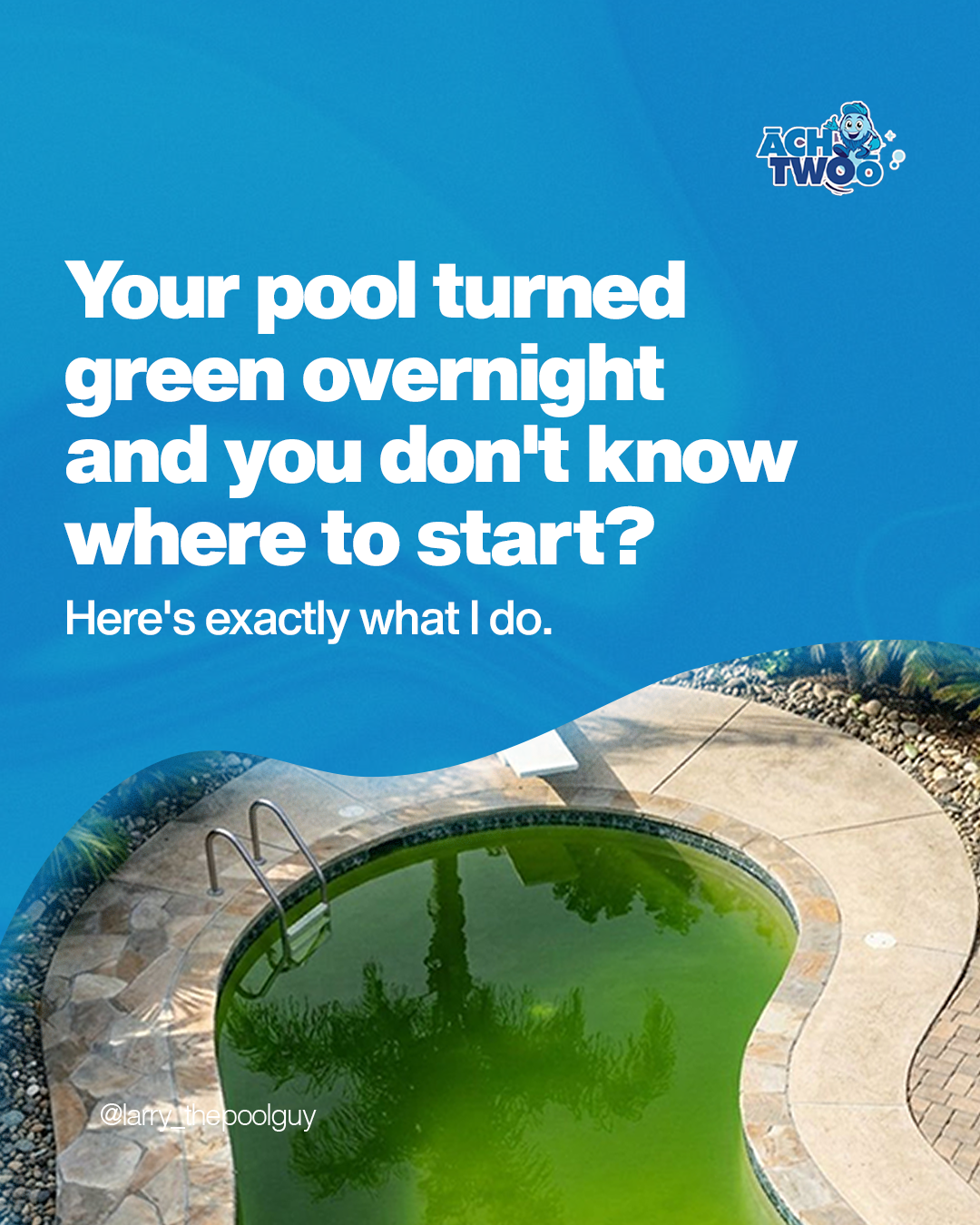
Your pool has turned green. Your first instinct is to drain it and start over. Here's why that instinct will cost you more than the problem itself and what professional pool technicians do instead to restore a green pool safely, completely, and without wasting a single drop of water.
TABLE OF CONTENTS
Why Draining a Green Pool Is Usually the Wrong Call
What Draining Actually Does to Your Pool Structure
The Professional Alternative: Restore, Don't Replace
Step 1: Diagnose the Root Cause First
Step 2: Shock the Pool and Let the Chemistry Work
Step 3: Let Particles Settle, Then Vacuum to Waste
Step 4: Deep Clean the Filter
Step 5: Balance the Chemistry Once the Water Clears
Why This Method Produces Lasting Results
Green Pool Restoration in Orange, Beaumont, and Lake Charles
WHY DRAINING A GREEN POOL IS USUALLY THE WRONG CALL
It's one of the most common decisions pool owners in make every summer; the pool turns green, nothing seems to be working, and draining it feels like the cleanest solution. Start fresh. Clean slate. New water.
The problem is that draining doesn't fix what caused the green water. It hides it. That brand new water is sitting in the same system; the same filter, the same pump, the same circulation patterns, the same environmental conditions that caused the problem in the first place. Within weeks, sometimes less, the same issues return.
Every pool that turns green has an underlying cause: poor circulation, a compromised filter, high phosphate levels, a cyanuric acid buildup that has rendered chlorine ineffective, or insufficient sanitizer running in water that's being pushed to its limits by Southeast Texas heat. None of those causes leave the pool when the water does. Drain-and-refill is the most expensive way to temporarily disguise a problem that hasn't been solved.
WHAT DRAINING ACTUALLY DOES TO YOUR POOL STRUCTURE
Before deciding to drain a pool, every owner should understand the structural risks involved because they're real, and they're rarely part of the conversation in the moment of frustration.
Fiberglass pools depend on the weight of the water inside them to maintain structural integrity. That inward water pressure counterbalances the outward pressure of the surrounding soil and groundwater. Remove the water, and the shell loses its support. In areas with high groundwater which includes much of Southeast Texas and Southwest Louisiana; a drained fiberglass shell can crack, shift, or physically lift out of the ground as subsurface water pressure pushes upward from below. This is not a minor issue. It is a structural failure that can void manufacturer warranties and cost tens of thousands of dollars to repair.
Vinyl liner pools face a different but equally serious risk. Vinyl liners are engineered to remain wet. When a liner dries out after draining, it loses elasticity, shrinks, and can crack or pull away from the pool wall. A water quality problem becomes a liner replacement problem; a significant expense that a proper restoration would have made entirely unnecessary.
Beyond structural risk, there's the practical cost of refill. A standard residential pool holds 10,000 to 20,000 gallons of water. Add the full chemical start-up cost; chlorine, pH adjusters, alkalinity balancers, calcium hardness, and stabilizer and you're spending several hundred dollars before you've addressed the underlying cause of the green water. In a region where summer drought conditions and water conservation are increasingly relevant, that waste is also worth considering.
Draining should be a genuine last resort reserved for extreme cyanuric acid accumulation causing complete chlorine lock, severe contamination that cannot be resolved chemically, or necessary structural repairs. For the vast majority of green pools, there is a smarter and safer path.
The Professional Alternative: Restore, Don't Replace
The professional approach to a severely deteriorated pool is methodical, targeted, and built around fixing the actual cause rather than covering it with fresh water.
This process takes more time than a drain-and-fill. A pool that's been green for weeks won't become crystal clear in 24 hours and anyone who promises that is setting you up for disappointment.
What the restoration process delivers is clean, properly balanced water with zero structural risk, no water waste, and a genuine resolution to whatever caused the deterioration. Once it's done correctly, maintaining that clarity going forward becomes straightforward because the root problem has been identified and resolved, not just hidden under a fresh refill that will face the same battle again in a few weeks.
Step 1: Diagnose the Root Cause First
The most common mistake made with green pools by owners and inexperienced technicians alike is starting treatment before identifying the cause. This is exactly how pools stay green for months despite repeated chemical additions. You're treating a symptom without addressing what's driving it.
Before any chemicals go in, perform a full water test and record every parameter: pH, free chlorine, total alkalinity, calcium hardness, cyanuric acid, and ideally phosphate levels.
High pH; anything above 7.8 is one of the first things to look for. Chlorine loses most of its sanitizing power at elevated pH, meaning adding more chlorine to a high-pH pool is expensive and ineffective. The pH must come down before any shock treatment will work properly.
Elevated cyanuric acid above 80 to 100 ppm causes what's known as chlorine lock; a condition where chlorine is present in the water but chemically unable to sanitize effectively. This is a common hidden problem in Southeast Texas pools that have used stabilized chlorine tablets for multiple seasons without any water dilution between them.
High phosphates are the fuel that feeds algae. Phosphates enter pools through rainfall, fertilizer runoff, and organic debris; all extremely common in Southeast Texas and Southwest Louisiana. A pool with elevated phosphates will grow algae relentlessly regardless of how much chlorine is added. Removing phosphates is often the single step that permanently breaks a recurring algae cycle.
Poor circulation must also be identified before treatment begins. A filter that's clogged, a pump running too few hours, or dead zones in the pool where water barely moves, all of these allow algae to establish in under-treated areas regardless of the overall chemical readings. This diagnosis shapes every subsequent step. Without it, you're guessing and guessing is expensive.
Step 2: Shock the Pool and Let the Chemistry Work
With the baseline chemistry understood and any fundamental imbalances particularly pH and phosphates corrected, it's time to deliver a heavy shock treatment to begin killing algae at scale.
For standard algae blooms, a double or triple dose of calcium hypochlorite shock is the professional standard. Unlike stabilized chlorine products, calcium hypochlorite delivers a powerful free chlorine hit without adding further cyanuric acid to already-elevated levels making it the right choice for pools that are already struggling with accumulated stabilizer.
Timing matters significantly here. Always shock in the evening or at night. Southeast Texas and Southwest Louisiana UV intensity is extreme; unstabilized chlorine can lose up to 90% of its potency within two hours of direct sunlight exposure. Shocking after sunset gives the treatment a full night of uninterrupted work before UV exposure begins the next morning.
Run the pump continuously throughout the treatment period. If the filter pressure gauge rises 8 to 10 PSI above its baseline reading at any point, backwash or clean the filter immediately. A clogged filter during algae treatment recirculates dead algae back into the pool rather than capturing it, undoing the progress of the shock treatment.
Within 24 to 48 hours of a properly executed shock treatment, green water begins transitioning from dark green to lighter green, then to a grey or cloudy appearance as the algae dies off. That cloudiness is actually a positive sign. It means the chlorine is doing its work. The dead algae now needs to be physically removed from the water, which is where the next step becomes critical.
Step 3: Let Particles Settle, Then Vacuum to Waste
This is where professional pool restoration separates itself from amateur attempts and it's the technique that produces genuine, lasting clarity rather than a temporary improvement.
After the shock treatment has killed the algae, the dead material needs time to settle fully to the pool floor. Allow 8 to 24 hours after treatment before vacuuming begins. To accelerate the process, a pool flocculant can be added to the water. Flocculant causes suspended particles; dead algae cells, fine sediment, organic debris to clump together and drop to the floor significantly faster than gravity alone. This reduces clearing time and sets up a cleaner, more effective vacuum pass.
Once particles have settled, the next step is vacuuming to waste; one of the most effective and underused techniques in residential pool maintenance, and the one that makes the single biggest difference to the outcome of a green pool restoration.
Vacuuming to waste means switching the multiport valve on the filter system to the "Waste" position. This routes water pulled up through the vacuum hose directly out through the waste line, completely bypassing the filter. The debris-laden water exits the system entirely; it is not processed through the filter, not returned to the pool, and given no opportunity to recirculate back into the water you're trying to clear.
The reason this matters so much is that when a filter is compromised, clogged with algae, overwhelmed by dead organic matter, or simply operating at reduced efficiency, standard vacuuming doesn't remove debris from the pool. It moves it. Fine algae particles pass through an overtaxed filter and return to the pool through the return jets. Vacuuming to waste removes everything it pulls up permanently from the system, which is why the results are so much more definitive than standard vacuuming through a struggling filter.
A few practical points to keep in mind when vacuuming to waste: fill the pool to its maximum water level before starting, as you will lose water during the process. Keep a garden hose running into the pool throughout to compensate for what's being removed. Vacuum slowly in deliberate overlapping strokes moving too quickly stirs debris up rather than capturing it. If the water level drops far enough that the skimmer begins pulling air, stop, allow the pool to refill, and then continue.
This single technique, combined with a properly executed shock treatment, is responsible for more successful green pool restorations in Southeast Texas and Southwest Louisiana than any chemical product on the market.
Step 4: Deep Clean the Filter
After vacuuming to waste, the filter needs dedicated attention. A filter that has been processing a green pool for any period of time carries significant contamination of its own, and continuing to run water through a dirty filter will reintroduce contaminants into water you've just worked hard to clean.
For sand filters, perform a thorough backwash followed by a rinse cycle to flush loosened debris out before returning to filter mode. For pools coming out of a severe algae bloom, consider a dedicated filter cleaner product designed to break down organic matter lodged deep in the sand bed that backwashing alone won't fully clear.
For DE filters, backwash and add fresh diatomaceous earth powder through the skimmer after each backwash cycle. DE filters provide the finest filtration available in residential pools capturing particles down to 2 to 5 microns making them particularly effective for clearing the residual fine particles that remain in the water after a restoration treatment.
For cartridge filters, remove the cartridge completely and rinse it thoroughly with a garden hose, working top to bottom between the pleats. For a pool coming out of a serious algae bloom, soak the cartridge overnight in a diluted filter cleaning solution to dissolve the organic buildup that rinsing alone won't reach.
Once the filter is clean, run the system continuously as close to 24 hours as possible until the water clears completely. In Southeast Texas and Southwest Louisiana summer conditions, this typically means 12 to 24 hours of uninterrupted circulation following the restoration treatment.
Step 5: Balance the Chemistry Once the Water Clears
Chemistry rebalancing is the final step of the restoration process, and it belongs at the end; not before the physical cleaning is complete. Adjusting chemistry before cleaning gives you inaccurate baseline readings and wastes product on water that still contains organic matter competing for the sanitizer you're adding.
Once the water is visually clear; bright and blue with a visible pool floor perform a full test and bring all parameters into range. For pH, the target is 7.2 to 7.6. Free chlorine should sit between 1 and 3 ppm, maintained closer to 3 ppm during the peak of Southeast Texas summer heat. Total alkalinity belongs between 80 and 120 ppm, calcium hardness between 200 and 400 ppm, and cyanuric acid between 30 and 50 ppm. Phosphate levels should be brought below 100 ppb.
Why This Method Produces Lasting Results
The difference between a drain-and-refill and a professional restoration comes down to one thing: what actually gets fixed.
A drain-and-refill treats the symptom, bad water. A professional restoration treats the system; the chemistry, the filtration, the circulation, and the root cause that allowed the problem to develop. Once a pool has been properly restored, maintaining its clarity becomes genuinely easy. The filter is clean and functioning. Chemistry is balanced from an accurate baseline. Phosphates have been stripped from the water. The underlying cause has been identified and addressed, not covered up.
That knowledge also makes every subsequent service call more effective. Whether the cause was an underpowered pump running too few hours, a filter that had never been properly cleaned, cyanuric acid built up over multiple seasons of tablet use, or the high phosphate loading common in Southeast Texas and Southwest Louisiana due to regional rainfall and organic debris knowing the cause means preventing the recurrence, not just cleaning up after it.
A pool that's been properly restored is set up for success. It doesn't just look clean. It's been returned to a state where consistent maintenance is straightforward, predictable, and genuinely effective which is exactly the standard every pool in this region deserves.
GREEN POOL RESTORATION IN ORANGE, BEAUMONT, AND LAKE CHARLES
If your pool has turned green this season or if it keeps turning green despite regular treatment; it almost certainly isn't beyond saving. It's a pool that needs a proper diagnosis and a controlled restoration process, not a drain-and-refill that will face the same problem again by next month.
At 409 Pool, the vacuum-to-waste method and systematic restoration process described in this guide is the standard we hold every cleanup service to. It takes more time and skill than draining and refilling, but it produces clean, properly balanced water with zero structural risk and a genuine long-term result.
We serve:
Orange, Texas — Call: +1 409-734-7665
Beaumont, TX — Call: 409-734-POOL
Lake Charles, LA — Call: 337-333-POOL
Visit www.409pool.com or click the link in our bio.
Let's restore it the right way without draining a drop.