
HOW TO KNOW IF YOUR POOL LINER REALLY NEEDS REPLACING (BEFORE YOU SPEND THOUSANDS FINDING OUT THE HARD WAY)
By AchtwooPool | Professional Pool Cleaning Services | Orange, Texas | Southeast Texas | Southwest Louisiana
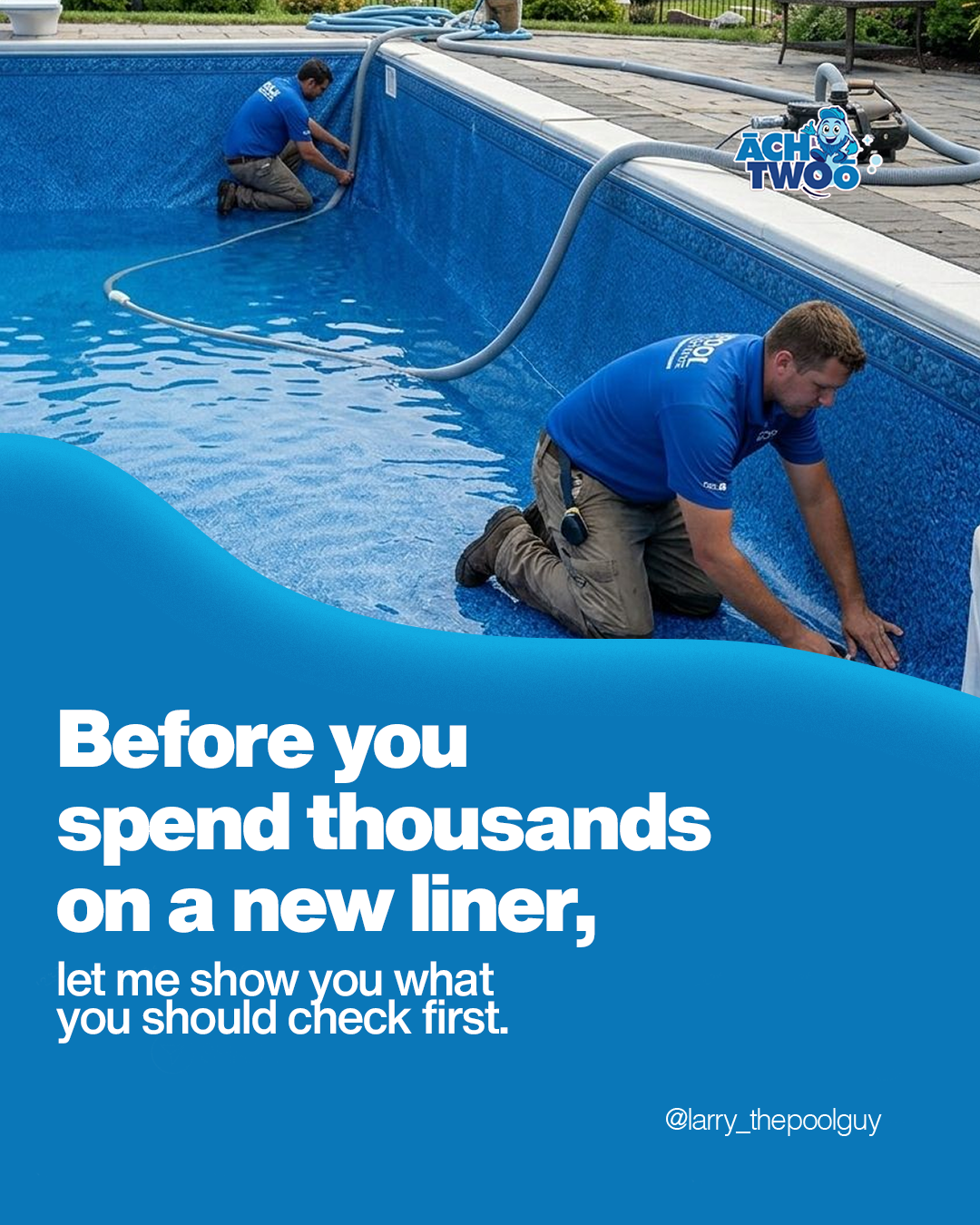
Before you spend thousands on a new liner, there are several things you should check first because in a significant number of cases, the liner isn't the problem. The problem is the system the liner sits in. Replace the liner without fixing the system and you've bought yourself temporary relief, not a real solution.
Table of Contents
Why Liner Replacement Is So Often the Wrong First Step
How Pool Chemistry Destroys a Liner From the Inside
What Low pH Does to a Vinyl Liner Over Time
The Truth About Pool Liner Wrinkless
Signs That Indicate a Liner Genuinely Needs Replacing
Signs That Look Like Liner Failure but Aren't
How Long Should a Pool Liner Actually Last?
Why the Right Diagnosis Upfront Saves Thousands
What a Proper Liner Assessment Involves
Not Sure If Your Liner Genuinely Needs Replacing?
Why Liner Replacement Is So Often the Wrong First Step
A pool liner that looks bad; wrinkled, faded, stained, or rough to the touch is an obvious target for replacement. It's visible, it's tangible, and replacing it feels like a decisive solution to a problem that's been developing for months. Pool liner replacement is also a significant expense, typically running into several thousand dollars including materials, labour, and the disruption of draining and refilling the pool.
What makes liner replacement the wrong first step in many cases is that a liner doesn't deteriorate in isolation. It deteriorates in response to the environment it sits in the water chemistry it's constantly in contact with, the way the pool is maintained, and the structural conditions surrounding it. A liner that has been damaged by consistently unbalanced water chemistry will continue to deteriorate after replacement if the water chemistry isn't corrected. A liner with wrinkles caused by groundwater infiltration will develop the same wrinkles in a new liner if the drainage or installation issue causing the water infiltration isn't addressed.
In both of these scenarios which together account for a large proportion of liner replacement consultations; the liner itself is the casualty, not the cause. Replacing it without identifying and addressing the actual cause is not a repair. It is a delayed repetition of the same problem at the same cost.
How Pool Chemistry Destroys a Liner From the Inside
Of all the environmental factors that affect liner longevity, water chemistry is the most significant and the most controllable. The chemical composition of pool water is in constant contact with the vinyl liner, and when that chemistry runs outside the acceptable range for extended periods, it degrades the liner material in ways that are progressive, cumulative, and eventually irreversible.
Vinyl is a durable material when maintained in properly balanced water. It is significantly less durable when exposed to water that is chronically acidic, chronically over-chlorinated, or chemically imbalanced in other ways that attack the polymers in the vinyl compound. The degradation doesn't happen overnight, which is part of why pool owners frequently don't connect the liner's deteriorating condition to the water chemistry. By the time the damage is visible, it has been developing for months or years.
Understanding the specific ways that chemistry attacks liner material is the foundation of understanding whether a liner's current condition reflects genuine wear and age, or whether it reflects a correctable chemistry problem that has been allowed to run long enough to leave visible marks.
What Low pH Does to a Vinyl Liner Over Time
Consistently low pH; water that runs below 7.2 for extended periods is one of the most destructive chemistry conditions a vinyl liner can be exposed to. Acidic water attacks the plasticisers in vinyl that give it flexibility and elasticity. As these compounds are leached out of the liner material over time, the vinyl becomes progressively stiffer and more brittle. It loses the ability to flex with temperature changes, water level fluctuations, and the movement that normally occurs in a functioning pool system without cracking or tearing.
The visual signs of this process include a liner that has taken on a faded, chalky appearance, surfaces that feel rough or stiff rather than smooth and flexible, and small cracks or tears developing particularly at stress points like around fittings, at corners, and along the floor-to-wall junction. Pool owners frequently interpret these signs as a liner that has simply reached the end of its life and needs replacing. In many cases they are looking at chemistry damage in a liner that still has years of serviceable life ahead of it if the underlying chemistry problem is corrected.
A liner assessment that doesn't include a thorough review of the pool's historical water chemistry or at minimum a current comprehensive water test is an incomplete assessment. The liner cannot be evaluated independently of the water it has been sitting in.
The Truth About Pool Liner Wrinkles
Wrinkles in a pool liner are among the most misdiagnosed liner issues encountered on service calls. They are almost universally assumed by pool owners to indicate that the liner has stretched, aged, or failed in some way that requires replacement. In the majority of cases, wrinkles are caused by something entirely different and replacing the liner without addressing it produces a new liner with the same wrinkle problem within months.
The most common cause of pool liner wrinkles is water infiltrating behind the liner. This happens when groundwater pressure from the surrounding soil pushes moisture between the liner and the pool shell, causing the liner to lose contact with the surface it's meant to sit against and buckle into folds and wrinkles. The condition is a drainage or water table issue, not a liner quality issue. It requires investigation of the surrounding drainage, the condition of the pool shell beneath the liner, and potentially the installation of a sump or improved perimeter drainage, not a liner replacement.
A less common but equally important cause of wrinkles is improper initial installation. A liner that wasn't stretched and seated correctly during installation will develop wrinkles as the vinyl settles and the pool fills. These wrinkles typically appear shortly after installation and tend to be distributed in a pattern that reflects the installation rather than the random distribution associated with groundwater infiltration.
In both cases, the liner itself is not the problem. Identifying the actual cause before making any replacement recommendation is the only way to ensure that the money spent on any subsequent work actually resolves the problem.
Signs That Indicate a Liner Genuinely Needs Replacing
Not every liner problem is a misdiagnosis. There are conditions that represent genuine liner failure rather than chemistry damage or structural issues, and recognising them accurately is as important as recognising the misdiagnosed ones.
A liner that has developed tears or holes that cannot be patched effectively either because of their size, their location, or because multiple patches have already been applied and are failing has reached the point where replacement is the appropriate recommendation. The liner's primary function is to contain water, and a liner that can no longer do so reliably has failed at its core purpose.
A liner with extensive UV degradation characterised by deep, widespread fading, surface cracking across large areas rather than at specific stress points, and material that has become rigid and brittle throughout rather than just at isolated zones has exhausted its useful life. UV degradation is a slow process that typically takes a decade or more in a well-maintained pool and less in one where chemistry damage and sun exposure have combined over the liner's lifespan.
A liner that has separated from the bead channel it sits in the track along the pool wall that holds the liner in position and cannot be reseated without tearing, has structural damage that replacement is the appropriate solution for.
In each of these cases, the liner has genuinely failed. But even here, the water chemistry and structural conditions should be assessed before replacement, to ensure that the replacement liner is installed into a system that will support its longevity rather than repeat the degradation cycle.
Signs That Look Like Liner Failure but Aren't
Several conditions that pool owners and even inexperienced technicians identify as liner failure are actually symptoms of correctable problems.
Staining that has penetrated the liner surface is often assumed to be irreversible liner damage. Metal staining from iron, copper, or manganese in the pool water can typically be treated with a sequestering agent and adjusted chemistry without liner replacement. Organic staining from algae and debris responds to shock treatment and enzymatic cleaners. Only staining that has genuinely altered the liner material itself rather than sitting on its surface is likely to be permanent.
Fading is expected over time and is not in itself a reason for replacement. A faded liner that is structurally intact and free of tears, wrinkles, and chemical degradation damage is a liner that still has functional life remaining, regardless of how it looks compared to its original colour.
Roughness to the touch is frequently a consequence of calcium scale deposition on the liner surface rather than liner degradation. Scale can be treated with appropriate acid washing and chemistry correction without replacing the liner.
How Long Should a Pool Liner Actually Last?
A vinyl pool liner that is correctly installed and maintained in properly balanced water should last between 10 and 15 years in most residential applications. Some liners in well-maintained pools exceed 20 years of serviceable life. At the other end, liners in pools with chronically unbalanced chemistry can show significant degradation within five years of installation.
The liner's quality matters. But the quality of the system it sits in the water chemistry, the maintenance consistency, the structural conditions surrounding the pool matters equally. A premium liner installed in a pool with chronically acidic water will not outperform an average liner installed in a properly balanced, well-maintained pool.
This is why any conversation about liner longevity that doesn't include a conversation about water chemistry is an incomplete one.
Why the Right Diagnosis Upfront Saves Thousands
The cost of a proper pre-replacement assessment a thorough inspection of the liner condition, a comprehensive water chemistry test, an evaluation of the structural conditions surrounding the pool, and an honest determination of whether the liner or something else is the actual cause of the problem is a fraction of the cost of an unnecessary liner replacement.
More importantly, a correct diagnosis means that any work done addresses the actual problem. A liner replaced because of wrinkles caused by groundwater infiltration, without addressing the drainage issue, will develop the same wrinkles. A liner replaced because of chemical degradation, without correcting the pH management that caused it, will degrade again. The money spent on replacement without correct diagnosis doesn't solve the problem, it restarts the clock on the same problem at full cost.
The right diagnosis upfront is not a formality. It is the single most cost-effective step in the entire process.
What a Proper Liner Assessment Involves
A proper liner assessment covers the condition of the liner material across the full pool not just the obvious problem areas. It includes a current comprehensive water chemistry test, a review of the pool's maintenance history where possible, an inspection of the pool shell beneath and around the liner for structural issues, an evaluation of the surrounding drainage conditions, and an honest determination of whether the liner's condition reflects genuine end-of-life failure or a correctable underlying cause.
The recommendation that follows this assessment may be liner replacement. It may be chemistry correction and a re-evaluation in six months. It may be drainage work before any liner decision is made. What it will be is accurate based on what is actually causing the problem rather than what the problem looks like on the surface.
Not Sure If Your Liner Genuinely Needs Replacing?
A liner consultation that starts with a proper assessment rather than a replacement recommendation is the only kind that reliably serves the pool owner's interests. At 409 Pool, we assess before we recommend because an unnecessary liner replacement that doesn't address the actual cause is a cost our clients shouldn't have to bear twice.
We serve Orange, Texas | Southeast Texas | Southwest Louisiana
Orange, Texas; Call: +1 409-734-7665
Beaumont, TX; Call: 409-734-POOL
Lake Charles, LA; Call: 337-333-POOL
Visit www.409pool.com or click the link in our bio.
Before you spend thousands on a new liner, let's find out whether that's actually what your pool needs. The right diagnosis now costs far less than the wrong solution later.