
HOW TO SAFELY DRAIN AN INGROUND POOL WITHOUT DESTROYING IT
By Achtwoo Pool | Professional Pool Cleaning Services | Orange, Texas | Southeast Texas | Southwest Louisiana
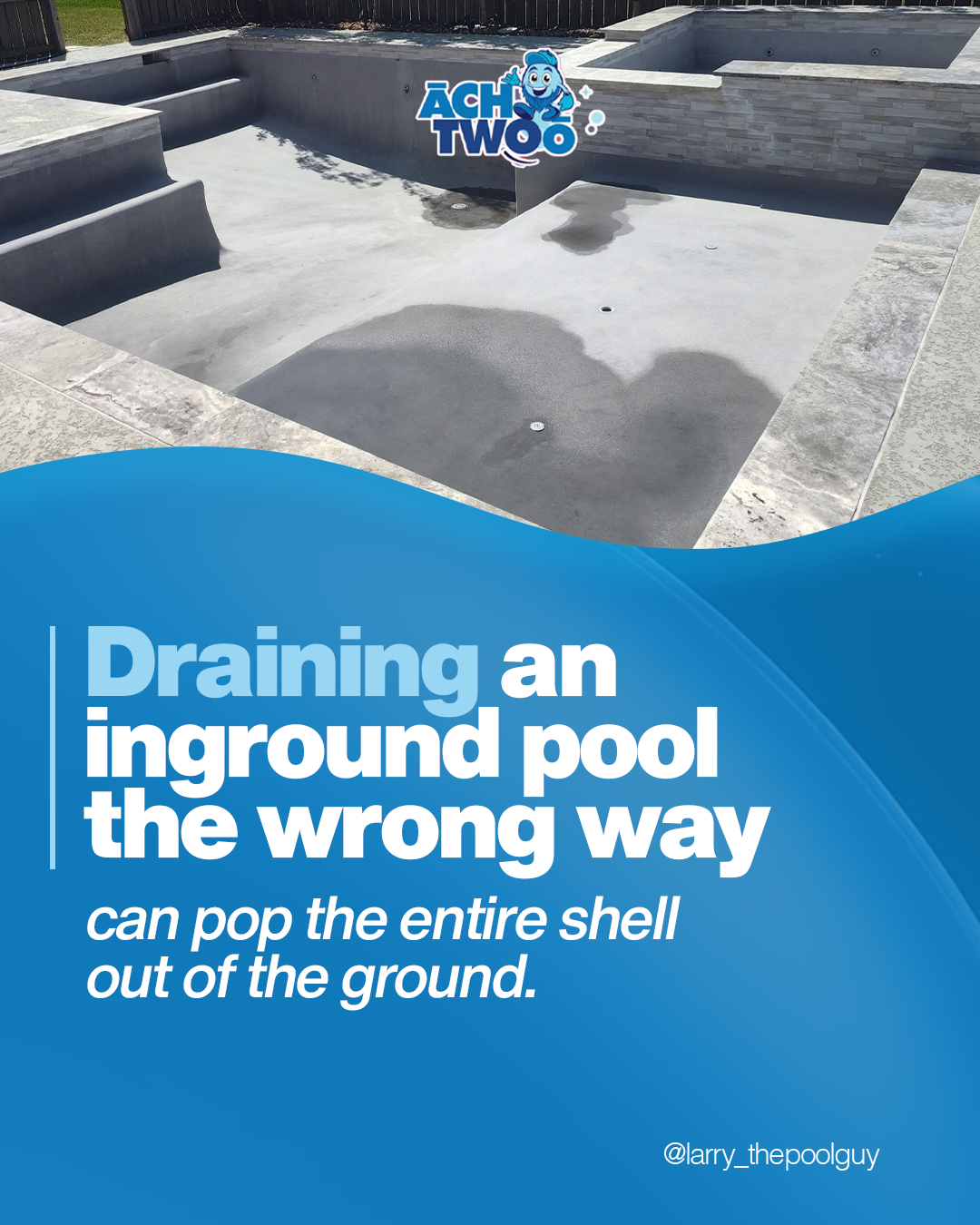
Draining an inground pool the wrong way can pop the entire shell out of the ground. That is not an exaggeration, and it is not a rare outcome. It is a predictable consequence of ignoring one specific factor and it happens to pool owners who drained their pool successfully before and assumed the same conditions applied this time.
TABLE OF CONTENTS
THE MOMENT EVERYTHING GOES WRONG
WHY AN INGROUND POOL SHELL IS MORE VULNERABLE THAN IT LOOKS
HYDROSTATIC PRESSURE: THE FORCE THAT CAN LIFT YOUR ENTIRE POOL
THE ONE CONDITION THAT MAKES DRAINING GENUINELY DANGEROUS
NEVER DRAIN AFTER HEAVY RAIN. THIS IS WHY
HOW TO CHECK YOUR GROUNDWATER LEVEL BEFORE DRAINING
HYDROSTATIC RELIEF VALVES: WHAT THEY DO AND WHEN THEY FAIL
WHEN DRAINING IS GENUINELY NECESSARY: THE CORRECT METHOD
WHY THE BACKWASH PORT IS THE WRONG TOOL FOR A FULL DRAIN
WHERE TO DISCHARGE THE WATER AND WHY IT MATTERS
THE RESTORATION ALTERNATIVE THAT AVOIDS THE RISK ENTIRELY
THINKING YOUR INGROUND POOL NEEDS TO BE DRAINED?
THE MOMENT EVERYTHING GOES WRONG
It was a warm Saturday in late spring. A pool owner had spent the previous two weeks battling water that wouldn't balance after a rough winter. The pool was green, the chemistry was well beyond what chemical treatment had managed to address, and he had decided that draining and refilling was the only practical solution. He had drained the pool once before, several years ago, with no problems.
He connected the backwash port, set the valve, and left it running overnight. By Sunday morning the pool was empty. By Sunday afternoon, he was looking at something that none of his previous pool experience had prepared him for: his fibreglass shell had lifted partially out of the ground at one end. The pool that had sat perfectly in position for twelve years was visibly displaced.
There had been heavy rainfall the week before. The ground was saturated. The hydrostatic pressure from the water-logged soil surrounding the pool had been held in check for twelve years by the weight of the water inside it. The moment that counterbalancing weight was removed, the pressure had nowhere to go but upward and the shell went with it. The repair cost more than the pool's original installation.
WHY AN INGROUND POOL SHELL IS MORE VULNERABLE THAN IT LOOKS
An inground pool looks like a fixed, permanent structure, concrete or fibreglass set into the ground in a position that appears immovable. In reality, the stability of an inground pool shell is maintained by a continuous balance of forces, and water is the most important component of that balance.
The water inside an inground pool exerts significant downward pressure against the pool shell and the surrounding soil. A standard 20,000-gallon residential pool contains water weighing over 160,000 pounds. This mass creates constant downward pressure that contributes to the pool's stability in the ground and counteracts the upward forces that the surrounding soil and groundwater exert against the shell.
Remove that water, and you remove the downward counterforce. What remains are the upward forces and in conditions where the soil surrounding the pool is saturated with water, those upward forces are significant.
HYDROSTATIC PRESSURE: THE FORCE THAT CAN LIFT YOUR ENTIRE POOL
Hydrostatic pressure is the pressure exerted by a fluid at rest due to gravity. In the context of an inground pool, the relevant fluid is the groundwater saturating the soil surrounding and beneath the pool shell.
When soil is fully saturated after heavy rainfall, after sustained wet weather, when the regional water table is high, the water content of the surrounding soil creates outward and upward pressure against whatever structure is embedded in it. For a pool shell that still contains its water, the inward and downward pressure of the pool water counterbalances the hydrostatic pressure from the soil. The forces meet. The shell stays in position.
For a pool shell that has been emptied, the counterbalancing force is gone. The hydrostatic pressure from the saturated soil acts unopposed against the shell. For fibreglass shells which are lighter and have less inherent resistance to uplift than concrete, the result can be physical displacement from the ground: the shell floats upward, cracking the surrounding concrete decking, pulling plumbing connections free, and in severe cases tilting or partially emerging from the excavated space it was set into.
For concrete pools, the risk is different but equally serious. Concrete shells have greater mass and resist uplift more effectively, but saturated soil exerts lateral pressure against the walls that can cause cracking, bowing, or inward displacement of the shell walls when the pool is empty.
THE ONE CONDITION THAT MAKES DRAINING GENUINELY DANGEROUS
The factor that determines whether draining an inground pool is safe or dangerous is not the condition of the water, not the method of drainage, and not the speed of drainage. It is a single environmental factor: the current level of the water table and the degree of saturation of the soil surrounding the pool.
In dry conditions, with a low water table and unsaturated surrounding soil, an inground pool can be safely drained with significantly lower hydrostatic risk. The soil exerts limited upward pressure. The risk is manageable.
In wet conditions particularly within days or weeks of significant rainfall, during periods of sustained wet weather, or in areas with a naturally high water table, the same pool cannot be safely drained without significant structural risk. The soil is saturated. The hydrostatic pressure is high. The counterbalancing weight of the pool water is the only thing keeping those forces in check.
In Southeast Texas and Southwest Louisiana, where seasonal rainfall is heavy and soil saturation following rain events is significant, this factor is not a theoretical concern. It is a consistent regional reality that makes groundwater assessment a non-negotiable step before any inground pool drain is undertaken.
NEVER DRAIN AFTER HEAVY RAIN. THIS IS WHY
The pattern that produces the most costly pool draining incidents is straightforward: heavy rainfall creates a chemistry disruption, the pool owner decides draining is the solution, and the drainage is performed in the days immediately following the rain event, when soil saturation is at its peak and hydrostatic pressure is at its highest.
The chemistry crisis created by the rain is real. Green water, pH disruption, depleted sanitiser, all of these are genuine problems that need addressing. But they don't need addressing by draining a pool into saturated soil. And the timing of the drain; days after heavy rain, with the soil maximally saturated creates the worst possible hydrostatic conditions for a pool drainage.
Waiting two to three weeks after a significant rain event before draining allows the soil to dry and the water table to drop. The hydrostatic pressure reduces. The risk of shell displacement drops significantly. If draining is genuinely necessary, timing it correctly is as important as executing it correctly.
HOW TO CHECK YOUR GROUNDWATER LEVEL BEFORE DRAINING
Assessing the groundwater level before draining does not require professional equipment or specialist knowledge. A simple method that pool owners can perform themselves provides a reliable indication of current water table conditions.
Dig a test hole in the soil adjacent to the pool outside the pool deck, in the lawn or garden area to a depth of approximately 18 to 24 inches. Leave the hole open for 30 minutes to an hour. If water seeps into the hole and begins to pool at the bottom, the water table is currently high and the soil is saturated. Draining the pool in these conditions carries significant hydrostatic risk and should be postponed.
If the test hole remains dry over the observation period, the water table is lower and the soil is not fully saturated. This does not eliminate hydrostatic risk entirely, but it indicates conditions where drainage is significantly less risky than in the saturated scenario.
This simple test takes an hour and costs nothing. The information it provides is worth considerably more than the cost of discovering through experience that the conditions weren't safe.
HYDROSTATIC RELIEF VALVES: WHAT THEY DO AND WHEN THEY FAIL
Many inground pools are equipped with hydrostatic relief valves devices installed at the pool's lowest point, typically in the main drain, that are designed to open automatically when hydrostatic pressure from groundwater reaches a level that exceeds the pool's ability to resist uplift. When the valve opens, groundwater can enter the empty pool shell, providing a counterbalancing weight that reduces the net upward force on the shell.
The limitation that pool owners must understand is that hydrostatic relief valves only function as intended when they are in working order. Valves that have not been serviced, that have become clogged with debris, or that have failed mechanically may not open under the conditions they were installed to address. A pool owner who assumes the hydrostatic relief valve will protect the shell during drainage without verifying that the valve is operational is relying on a safety mechanism that may not function.
Before draining, confirm the hydrostatic relief valve is operational. If the condition of the valve is unknown or uncertain, have it inspected by a professional before proceeding with drainage.
WHEN DRAINING IS GENUINELY NECESSARY: THE CORRECT METHOD
There are situations where draining an inground pool is the correct and necessary course of action; severe chemical accumulation that cannot be resolved by dilution, structural repairs that require access to the shell surface, or resurfacing work. In these situations, the drainage should be performed using a submersible pump, not the pool's backwash port.
The backwash port drains water at a rate determined by the pump's flow capacity and the backwash valve's opening, which is not designed or controlled for the process of safely emptying a pool. A submersible pump allows control over the drainage rate and can be stopped, adjusted, or moved in response to conditions observed during the process.
Drain during dry weather conditions, after verifying that groundwater levels are low. Monitor the pool shell throughout the drainage process for any signs of movement, cracking of the surrounding decking, or plumbing that is being pulled under tension. If any of these signs appear, stop drainage immediately and allow the pool to refill partially to restore counterbalancing water weight before assessing next steps.
WHY THE BACKWASH PORT IS THE WRONG TOOL FOR A FULL DRAIN
Using the backwash port as the primary drainage method for a full pool drain creates two specific problems beyond the control issue.
The first is speed or rather the lack of it. Backwash drainage removes water more slowly than a submersible pump appropriate for the pool volume. Slower drainage means more time with a partially empty shell exposed to hydrostatic pressure during the transition from full to empty, a prolonged period of intermediate structural vulnerability.
The second is the inability to stop the process easily once it is underway. A submersible pump can be switched off at any point. The backwash port requires manipulation of the multiport valve to interrupt, a slower and less controllable intervention if conditions observed during drainage require an immediate stop.
THE RESTORATION ALTERNATIVE THAT AVOIDS THE RISK ENTIRELY
The most important information for any pool owner considering draining as a solution to water quality problems is this: in the majority of cases, cloudy, green, or severely chemically imbalanced pools can be fully restored without any draining at all.
Reverse osmosis filtration, a mobile filtration service that processes pool water through a semi-permeable membrane, removing dissolved solids, metals, and accumulated chemical compounds resolves many of the water quality conditions that pool owners assume require a full drain. The water is filtered and returned to the pool without draining, without structural risk, and at lower cost than a full drain-and-refill in many situations.
Correct chemical treatment; shock treatment, algaecide, phosphate removal, and sequential chemistry correction resolves algae blooms and water balance problems that cause pool owners to reach for the drain valve. These situations almost never require draining. They require the right treatment applied in the right order.
Before any drain decision is made, a professional assessment of whether the water quality problem can be resolved without drainage is the step that protects both the pool structure and the budget.
THINKING YOUR INGROUND POOL NEEDS TO BE DRAINED?
Let us assess it before the risk is taken. At 409 Pool, we evaluate water quality problems across Orange, Texas, Southeast Texas, and Southwest Louisiana to determine whether drainage is genuinely necessary or whether restoration without draining is the safer, lower-cost solution. In most cases, it is.
WE SERVE ORANGE, TEXAS | SOUTHEAST TEXAS | SOUTHWEST LOUISIANA
ORANGE, TEXAS; Call: +1 409-734-7665
BEAUMONT, TX; Call: 409-734-POOL
LAKE CHARLES, LA; Call: 337-333-POOL
Visit www.409pool.com or click the link in our bio.
Thinking your inground pool needs to be drained? Let us assess it before you take that risk. The answer is usually safer and cheaper than the drain.