
HOW WATER FEATURES AFFECT YOUR INGROUND POOL CHEMISTRY AND EQUIPMENT
By Achtwoo Pool | Professional Pool Cleaning Services | Orange, Texas | Southeast Texas | Southwest Louisiana
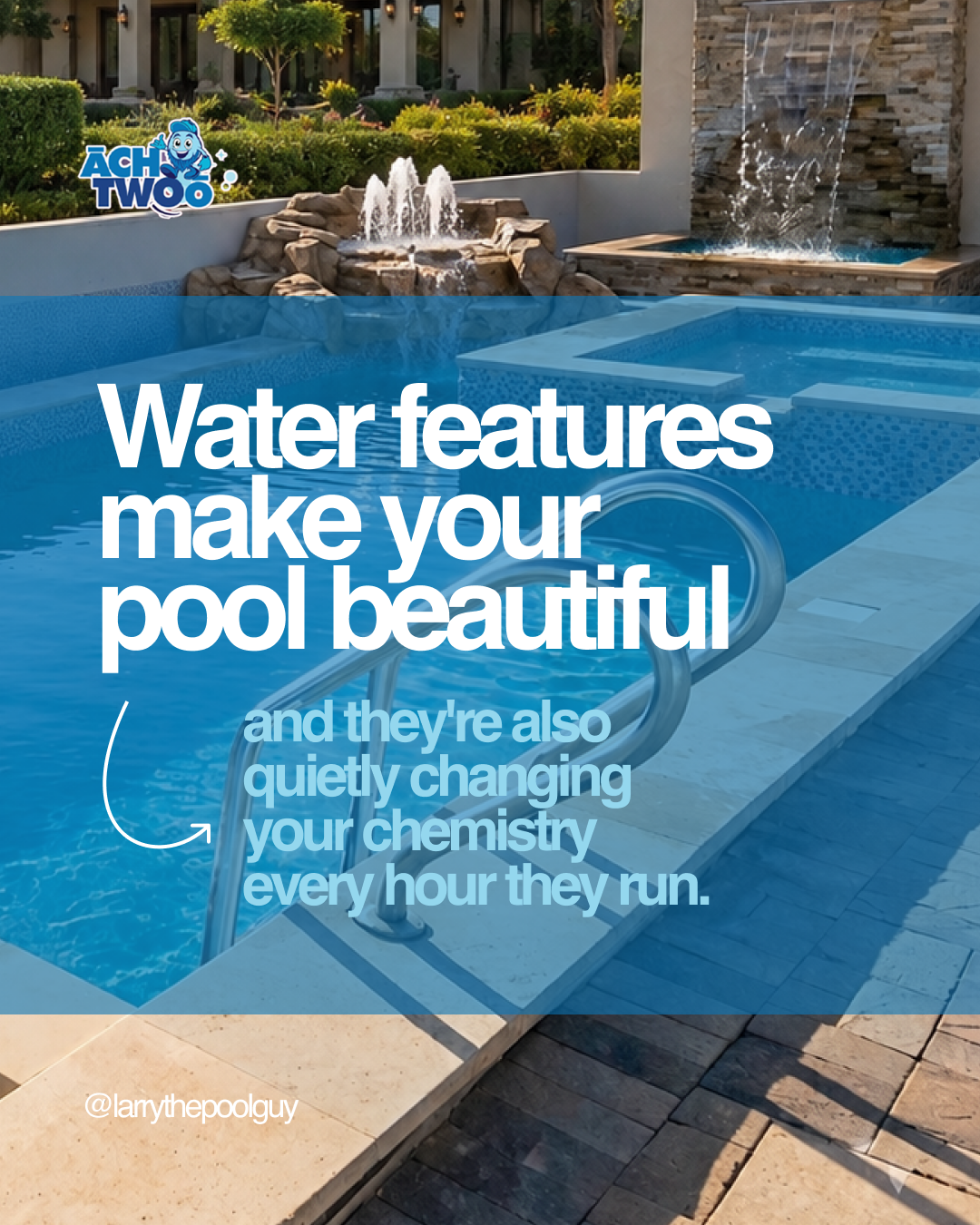
The waterfall was the whole reason you built the pool the way you did. The sound of it in the evening, the way it catches the light, the fact that it turns an ordinary backyard into something that feels like a resort. Nobody warns you that the same feature you love is quietly editing your water chemistry every single hour it runs. Here is what is actually happening behind that beautiful moving water, why it matters more than it looks, and exactly how to stay ahead of it.
TABLE OF CONTENTS
THE BEAUTY THAT QUIETLY RESHAPES YOUR CHEMISTRY
WHY MOVING WATER PUSHES YOUR pH UP
THE EVAPORATION PROBLEM WATER FEATURES ACCELERATE
WHY YOUR CHEMICAL LOSS TRACKS WITH YOUR WATER LOSS
THE PUMP MOST OWNERS FORGET THEY HAVE
WHAT REDUCED OUTPUT IS REALLY TELLING YOU
THE MONTHLY HABIT THAT PREVENTS A BURNED-OUT MOTOR
WANT YOUR WHOLE POOL SYSTEM MAINTAINED PROFESSIONALLY?
THE BEAUTY THAT QUIETLY RESHAPES YOUR CHEMISTRY
Most pool owners think of their water features as decoration. They are, but they are also equipment, and they are also a chemistry variable. A fountain, a waterfall, a set of deck jets, or a spa spillover is not a passive ornament sitting on top of a stable pool. It is a machine that moves water, exposes it to air, and changes the conditions your sanitizer is trying to hold steady.
The frustrating part is that the effect is invisible at the moment. You run the waterfall for a few hours in the evening, the pool looks perfect, and nothing seems to have changed. But run that feature day after day through a Southeast Texas summer and the cumulative effect on your pH and your water level becomes something you have to actively manage, not something you can assume away. A pool with running water features and a pool without them are two different maintenance situations, even if they hold the same amount of water.
WHY MOVING WATER PUSHES YOUR pH UP
Here is the mechanism nobody explains at the point of sale. Every water feature aerates your pool while it runs. Aeration simply means the water is being churned, sprayed, and exposed to air, and that constant contact with air drives carbon dioxide out of the water. When carbon dioxide leaves, the pH rises.
This is not an occasional fluke. It is a continuous, one-directional push. As long as the feature is running, it is nudging your pH upward, hour after hour, in a way a still pool surface never does. That is why pools with active fountains and waterfalls consistently run higher on pH than their owners expect, and why the correction they made last week does not seem to hold.
The practical takeaway is straightforward. If you run water features regularly, you cannot test pH on the same relaxed schedule as a still pool and expect the same results. You need to check pH more often and correct it more often, because you have a mechanism working against you around the clock. High pH is not a sign you are doing something wrong. It is the predictable byproduct of a feature you deliberately installed, and it is fully manageable once you know to watch for it.
THE EVAPORATION PROBLEM WATER FEATURES ACCELERATE
The second thing moving water does is evaporate faster. A still pool loses water off a flat, calm surface. A waterfall, fountain, or jet takes that same water and throws it into the air, spreads it across a far larger surface area, and hands it to the heat and the breeze to carry away.
In our climate, that difference is not small. Southeast Texas and Southwest Louisiana already push evaporation hard through the summer. Add a feature that is actively aerosolizing your water for hours at a time and the rate at which your level drops climbs noticeably. Owners who run features heavily and only check the water level occasionally are often surprised by how quickly the pool needs topping off, and how easy it is to let the level drift down far enough to starve the skimmer or the feature pump.
The fix is simple attention. When your features are running regularly, check your water level more frequently than you would for a still pool. Do not wait for the pool to look low. Get in the habit of a quick visual check so the level never has the chance to drop to a point where it threatens circulation or pump function.
WHY YOUR CHEMICAL LOSS TRACKS WITH YOUR WATER LOSS
This is the connection that costs owners money without them ever tracing it. When water evaporates, the water leaves but the demand does not disappear with it. As you top the pool off with fresh water, you are diluting the sanitizer and balancing chemicals that were dissolved in the water you just lost. Every top-off is a small reset that pulls your carefully balanced chemistry off its mark.
So a pool with heavy water feature use is not just losing water faster. It is effectively losing and re-diluting its chemistry faster, which means more frequent testing and more frequent correction to hold the same numbers a still pool would hold with far less effort. If you have ever felt like your feature-heavy pool needs constant chemical attention while your neighbor's plain pool seems to look after itself, this is a large part of why.
Account for it deliberately. When you run features, plan for increased chemical loss alongside the increased water loss, and build your testing rhythm around that reality rather than fighting it after the fact.
THE PUMP MOST OWNERS FORGET THEY HAVE
Now to the equipment side, because water features are not only a chemistry story. Many inground pools run their features on a dedicated pump that is entirely separate from the main circulation pump. That is by design. The feature pump has its own job, its own duty cycle, and its own set of failure modes, and it rarely gets the attention the main pump does.
That is exactly why it fails quietly. The main pump is central to everything, so owners notice when it struggles. The feature pump lives off to the side, runs when you want the waterfall on, and gets forgotten the rest of the time. Impeller wear and bearing problems develop gradually inside it, and because nobody is listening for them, the first real signal often arrives as a failure rather than a warning.
Build the feature pump into your routine. Inspect it monthly. Give it a genuine listen while it runs, because your ears will catch a developing problem long before your eyes do. Grinding, whining, rattling, or any unusual sound is the early language of an impeller or bearing issue starting to develop, and catching it at that stage is the difference between a small repair and a replacement.
WHAT REDUCED OUTPUT IS REALLY TELLING YOU
The single most important warning sign to never ignore is weak flow. If your fountain used to arc and now dribbles, if your waterfall used to sheet and now trickles, that reduced output is not a cosmetic quirk. It is a symptom.
Weak flow from a feature means water movement is being restricted somewhere in that circuit, and restricted flow places extra strain on the dedicated pump driving it. A pump fighting against a restriction is a pump working harder than it was built to, and a motor under that kind of sustained overload is a motor moving toward burning out. The weak waterfall you have been meaning to look at is the pump quietly telling you it is under strain.
Treat reduced output as an instruction, not an annoyance. Address it promptly, find the restriction, and relieve the strain before the motor pays for it. A feature that has lost its output is far cheaper to investigate today than a pump motor is to replace after it has burned out.
THE MONTHLY HABIT THAT PREVENTS A BURNED-OUT MOTOR
None of this requires expertise or expensive tools. It requires a rhythm. Once a month, look at your feature pump and listen to it. Once a week, when features are running, glance at your water level. Test pH more often than you would for a still pool, and correct it before it climbs into the range that irritates swimmers and undermines your chlorine. And the moment a feature loses its output, stop treating it as background noise and deal with it.
Do those few things consistently and your water features stay what they were meant to be, the best part of your backyard, instead of becoming the reason your chemistry drifts and your equipment fails early. The owners who struggle with features are almost never the ones who understood them and stayed ahead of them. They are the ones who assumed a beautiful feature was a passive one.
WANT YOUR WHOLE POOL SYSTEM MAINTAINED PROFESSIONALLY?
Water features are one of the clearest examples of why pool care is a system, not a checklist. The chemistry, the water level, and the equipment behind that beautiful moving water are all connected, and managing one while ignoring the others is a strategy that always falls short. At Achtwoo Pool, comprehensive service across Orange, Texas, Southeast Texas, and Southwest Louisiana covers the full pool environment, features and pumps included, because the parts that make your pool beautiful should not be the parts that quietly break it.
Water features causing chemistry or equipment issues? Let us handle the whole system.
WE SERVE ORANGE, TEXAS | SOUTHEAST TEXAS | SOUTHWEST LOUISIANA
ORANGE, TEXAS; Call: +1 409-734-7665
BEAUMONT, TX; Call: 409-734-POOL
LAKE CHARLES, LA; Call: 337-333-POOL
Visit www.409pool.com or click the link in our bio.