
HOW WATER TEMPERATURE SILENTLY CHANGES YOUR POOL CHEMISTRY EVERY SINGLE DAY
By AchtwooPool | Professional Pool Cleaning Services | Orange, Texas | Southeast Texas | Southwest Louisiana
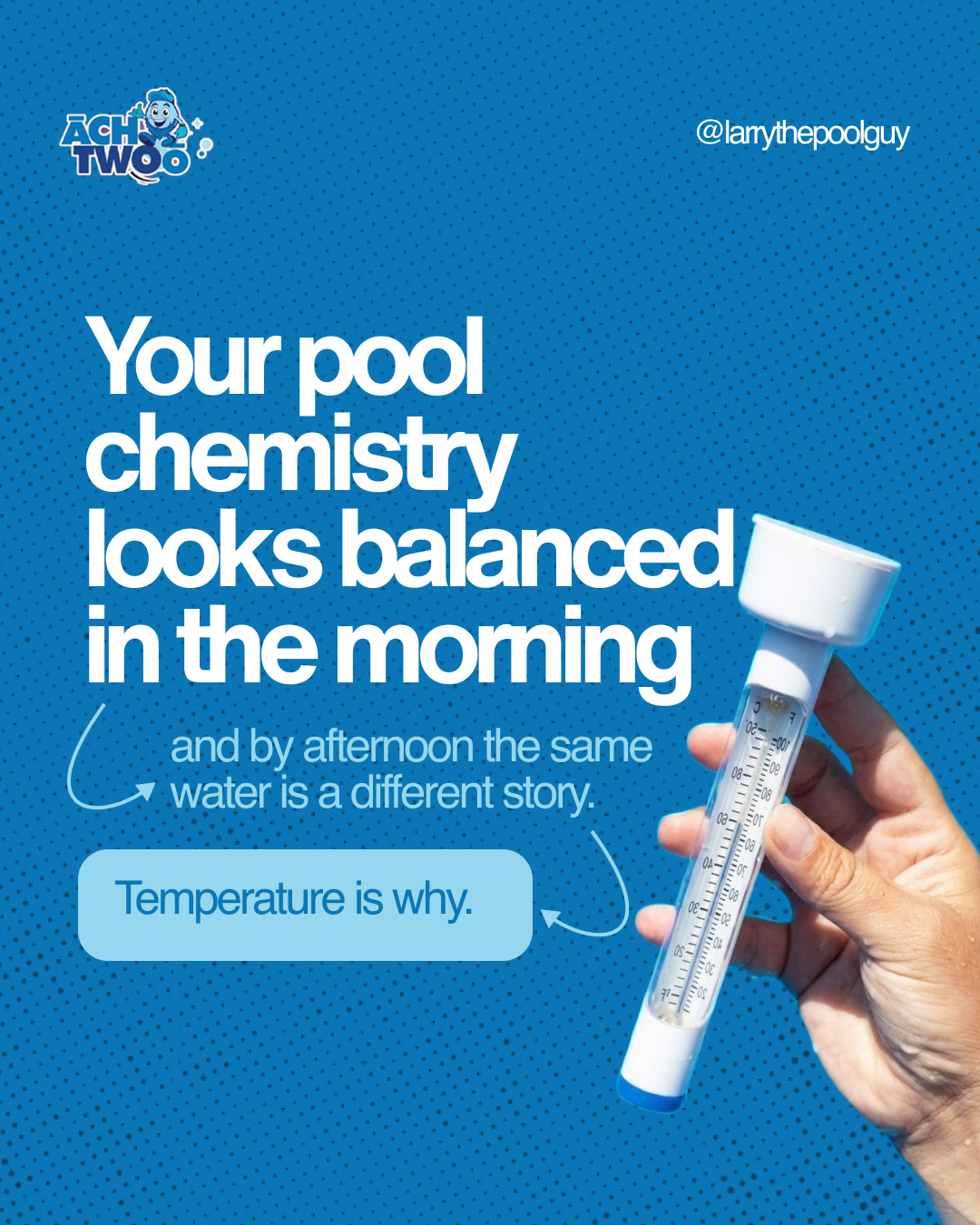
You tested your pool this morning and the numbers looked good, so you closed the kit and went about your day. By evening the water somehow felt off; a little cloudy, a little sharp on the eyes and you found yourself wondering what changed in eight hours when you never added a thing. Here is what changed: the temperature. It is the one variable almost every homeowner ignores, and in the Southeast Texas and Southwest Louisiana heat it quietly rewrites your pool chemistry from sunrise to long after sunset.
TABLE OF CONTENTS
THE MORNING TEST THAT LIED BY EVENING
THE VARIABLE THAT NEVER PRINTS ON A TEST STRIP
WHY WARM WATER DEVOURS YOUR CHLORINE
THE STABILIZER THAT DECIDES WHETHER CHLORINE SURVIVES THE AFTERNOON
HOW RISING TEMPERATURE PUSHES YOUR pH UPWARD
WHY HIGH pH QUIETLY WRECKS EVERYTHING ELSE
THE HIDDEN MATH OF WATER BALANCE: WHERE TEMPERATURE HIDES
SCALE AND CORROSION: THE DAMAGE THE TEST KIT NEVER SHOWS
WHY A SINGLE MORNING READING CAN'T SPEAK FOR THE WHOLE DAY
HOW TO TEST AND ADJUST FOR THE HEAT YOU ACTUALLY LIVE IN
IS YOUR CHEMISTRY DRIFTING WITH THE TEMPERATURE?
THE MORNING TEST THAT LIED BY EVENING
A pool owner in Lake Charles told us he had stopped trusting his own test kit. He would test first thing in the morning, get numbers that were textbook; chlorine in range, pH where it should be and feel completely confident heading into the day. By the time his family got in after work, the water felt harsh, their eyes stung, and the clarity had slipped. He assumed his kit was faulty.
His kit was fine. What he was missing was that the reading he took at seven in the morning described a pool that no longer existed by three in the afternoon. Between those two moments, the water had absorbed a full day of Southeast Texas sun, climbed well past 85 degrees, burned through a chunk of its chlorine, and let its pH drift upward, all without a single chemical being added or removed.
Once he understood that his morning number was a snapshot and not a forecast, everything clicked. He was not managing a pool with unstable chemistry. He was managing a pool whose chemistry moved with the temperature all day long, and testing it as if the heat changed nothing.
THE VARIABLE THAT NEVER PRINTS ON A TEST STRIP
When most people picture pool chemistry, they picture the numbers they can measure: chlorine, pH, alkalinity, calcium hardness, stabilizer. What almost nobody pictures is temperature, because no test strip prints it and no one talks about it. Yet temperature is the invisible hand pushing every one of those numbers around all day.
Water balance is not a fixed target. The same chlorine level, the same pH, the same calcium reading can be perfectly balanced in cool morning water and out of balance by mid-afternoon, without anyone touching a single chemical. The heat did it. And because the change is gradual and invisible, it slips right past the homeowner who tested once, saw good numbers, and trusted them to hold through the day. They almost never do.
WHY WARM WATER DEVOURS YOUR CHLORINE
Start with the sanitizer, because this is where the daily damage shows up first. Chlorine works harder and disappears faster as water warms. Warm water speeds up the chemical reactions your chlorine drives, and it is a far friendlier home for the algae and bacteria that chlorine has to fight. So on a hot day your pool is burning chlorine faster and generating more demand for it at the same time.
That is why a free chlorine level of 2 to 4 ppm that holds comfortably in spring can fall short in the peak of summer, when nudging the range toward 3 to 5 ppm is often what it takes to stay ahead. Let it slide toward 1 ppm on a hot afternoon and your protection becomes unreliable exactly when the pool needs it most. The chlorine you added at eight in the morning is not lost to mystery. It is lost to temperature.
THE STABILIZER THAT DECIDES WHETHER CHLORINE SURVIVES THE AFTERNOON
Chlorine has one real defender against the summer sun, and that is your stabilizer. Cyanuric acid, held in the 30 to 50 ppm range, shields free chlorine from the ultraviolet light that would otherwise strip it out of warm, sunlit water by early afternoon.
When that stabilizer drifts low, the heat and the sun team up against you. Warm water is already accelerating chlorine loss, and without cyanuric acid to slow the UV burn-off, the two effects compound, your chlorine can be gone hours before you would ever suspect it. This is why keeping stabilizer in range matters so much more in a Southeast Texas summer than it does in a mild climate. It is the buffer that lets the chlorine you paid for survive the hottest part of the day instead of vanishing into the sky.
HOW RISING TEMPERATURE PUSHES YOUR pH UPWARD
Chlorine is not the only casualty. Temperature also drags your pH around, and pH is the number that quietly decides whether the rest of your chemistry even works.
As water warms, it holds dissolved carbon dioxide less easily, and that gas escapes into the air. When carbon dioxide leaves the water, pH tends to climb. So the same pool that tested at a comfortable 7.4 to 7.6 in the cool of the morning can drift upward as the day heats up. It is a slow, invisible push that happens on every hot day, and it is one of the most common reasons an evening swim feels harsh in water that tested perfectly at breakfast.
WHY HIGH pH QUIETLY WRECKS EVERYTHING ELSE
A rising pH matters far more than it sounds, because once pH pushes past 7.6, your chlorine becomes noticeably less effective at sanitizing. The sanitizer is still there on paper, but it is not pulling its weight so you can have a chlorine reading that looks fine and water that is not actually being protected.
High pH is also where you start getting cloudy water, scale formation, and the eye and skin irritation that has everyone climbing out early. This is the trap of the afternoon pH climb: it weakens the chlorine you have left at the exact moment the heat is driving chlorine demand to its highest. The two problems feed each other, and a pool that looked balanced at sunrise ends the day under-protected and uncomfortable to swim in.
THE HIDDEN MATH OF WATER BALANCE: WHERE TEMPERATURE HIDES
There is a deeper layer to all of this. Whether your water is truly balanced is not decided by any single reading in isolation, it is decided by how pH, alkalinity, calcium hardness, and temperature all sit together. Temperature is a full partner in that equation, not a footnote.
This is why the same exact set of chemical readings can be perfectly balanced at one temperature and quietly aggressive at another. Warm water shifts the balance toward scaling, where calcium drops out of solution and builds up on surfaces. Cooler water shifts it the other way, toward water that pulls minerals out of your plaster and equipment. Your test kit shows you the individual numbers, but it does not show you how the day's heat is tilting the balance between them and that tilt is where the slow, invisible damage lives.
SCALE AND CORROSION: THE DAMAGE THE TEST KIT NEVER SHOWS
The consequences of that shifting balance land hardest on your equipment. Around heaters and salt chlorine generators, where the water is warmest of all, scaling happens fastest. Calcium builds up on the cell and the heat exchanger, restricting flow and shortening the life of expensive equipment often while every reading in your test kit looked perfectly acceptable.
This is the quiet cost of ignoring temperature. A homeowner can maintain numbers that look textbook all season and still end up with a scaled salt cell or a struggling heater, because the damage was being driven by the temperature the test strip never measured. By the time the symptoms are obvious, the buildup has already been forming for weeks.
WHY A SINGLE MORNING READING CAN'T SPEAK FOR THE WHOLE DAY
Put all of this together and one habit stands out as the real problem: trusting a single morning reading to speak for the entire day. In the cool of the morning, before the sun has done its work, your pool is at its most stable and its most flattering. That is the least representative moment you could possibly choose to measure.
By mid-afternoon the same water is hotter, lower on chlorine, and higher on pH, and none of that showed up in the number you trusted at breakfast. The homeowners who struggle every summer are rarely careless. They are simply reading their pool at the one time of day it looks its best and assuming that picture holds until dark. It does not.
HOW TO TEST AND ADJUST FOR THE HEAT YOU ACTUALLY LIVE IN
The fix follows directly from the problem. During a heat stretch, test in the evening as well; after the water has absorbed the full day's sun because that gives you a far truer picture of what your pool actually did, not what it looked like before the sun got to work. That one change turns a flattering snapshot into real information.
From there, adjust for the season instead of running the same targets year round. Lean your free chlorine toward the higher end of the range in peak heat, keep your cyanuric acid in the 30 to 50 ppm range so that chlorine survives the afternoon, and watch pH for its warm-weather climb before it crosses 7.6 and starts undermining everything else. Managed this way, your pool stays balanced through the hottest part of the day instead of falling behind it which is the whole difference between a pool that fights you all summer and one that does not.
IS YOUR CHEMISTRY DRIFTING WITH THE TEMPERATURE?
If your pool tests fine in the morning and turns by evening, nothing is wrong with your test kit and nothing is wrong with you. The temperature is moving your chemistry all day, and a single morning reading was never going to catch it.
At AvhtwooPool, we help pool owners across Orange, Texas, Southeast Texas, and Southwest Louisiana manage water chemistry for the real temperatures our climate creates so your pool stays balanced through the heat instead of chasing it after the fact.
WE SERVE ORANGE, TEXAS | SOUTHEAST TEXAS | SOUTHWEST LOUISIANA
ORANGE, TEXAS — Call: +1 409-734-7665
BEAUMONT, TX — Call: 409-734-POOL
LAKE CHARLES, LA — Call: 337-333-POOL
Visit www.409pool.com or click the link in our bio.
Is your chemistry drifting with the temperature? The fix isn't more chemicals, it's testing at the right time of day and setting your targets for the heat your pool actually lives in.