
IS YOUR POOL ACTUALLY LEAKING OR IS IT JUST EVAPORATION? HERE'S HOW TO FIND OUT BEFORE YOU SPEND A PENNY
By AchtwooPool | Professional Pool Cleaning Services | Orange, Texas | Southeast Texas | Southwest Louisiana
Your pool water keeps dropping and you're convinced there's a leak. Before you call anyone, before you spend a single dollar on diagnostics or repairs, do this one simple test first. It takes 24 hours, costs nothing, and will tell you exactly whether you have a real problem or a perfectly normal one.
Table of Contents
The Test Every Pool Owner Should Know Before Assuming the Worst
Why Evaporation Is More Dramatic Than Most Owners Expect
How to Perform the Bucket Test Correctly
How to Read the Bucket Test Results
If It Is a Leak: The Professional Two-Phase Diagnosis
Phase One: Test With the Pump Running
Phase Two: Test With the Pump Off
What Each Result Combination Means
Pressure-Side Leaks vs. Suction-Side Leaks vs. Structural Leaks
Why Acting Quickly on a Confirmed Leak Matters
Suspect a Leak but Not Sure What You're Dealing With?
The Test Every Pool Owner Should Know Before Assuming the Worst
Pool water levels drop. They do it in summer. They do it after windy days. They do it after a busy weekend of splashing and swimming. They do it after a spell of the kind of intense heat that Southeast Texas and Southwest Louisiana deliver with reliable consistency from April through October. The question; the one that sends pool owners into a spiral of concern, searching for cracks and calling contractors is whether the drop is normal or whether something is genuinely wrong.
The answer, before any professional assessment, before any diagnostic visit, before any expense at all, is determined by a single test you can perform yourself with a bucket and a marker. It is called the bucket test, and it is the starting point of every responsible leak investigation. Skipping it and assuming a leak is one of the most common and most expensive mistakes pool owners make.
Why Evaporation Is More Dramatic Than Most Owners Expect
The first thing most pool owners don't fully appreciate is how significant evaporation is in a warm, sunny climate. In Southeast Texas and Southwest Louisiana during peak summer, a residential pool can lose between a quarter of an inch and half an inch of water per day to evaporation alone. Over a week, that is between one and a half and three and a half inches of water loss, enough to look alarming to any pool owner who isn't expecting it.
Add the water lost to splash-out during heavy pool use, the water that leaves the pool on swimmers' bodies and swimwear, and the loss through backwashing the filter, and a weekly water level drop of three to four inches is entirely normal during active pool season. It is not a leak. It is physics.
The problem is that evaporation is invisible. There's no visible source, no wet patch on the ground, no obvious explanation for where the water has gone. It simply disappears, and the empty inches it leaves behind look exactly the same as the inches that would be missing if there were a genuine structural leak. This is why the bucket test exists, it separates evaporation from leakage by measuring both simultaneously under identical conditions.
How to Perform the Bucket Test Correctly
The bucket test works by creating a controlled comparison between the water loss in your pool and the water loss in a reference container, over the same period and under the same environmental conditions. Any water lost to evaporation affects both equally. Any water lost to a leak affects only the pool.
To perform the test correctly, follow these steps precisely.
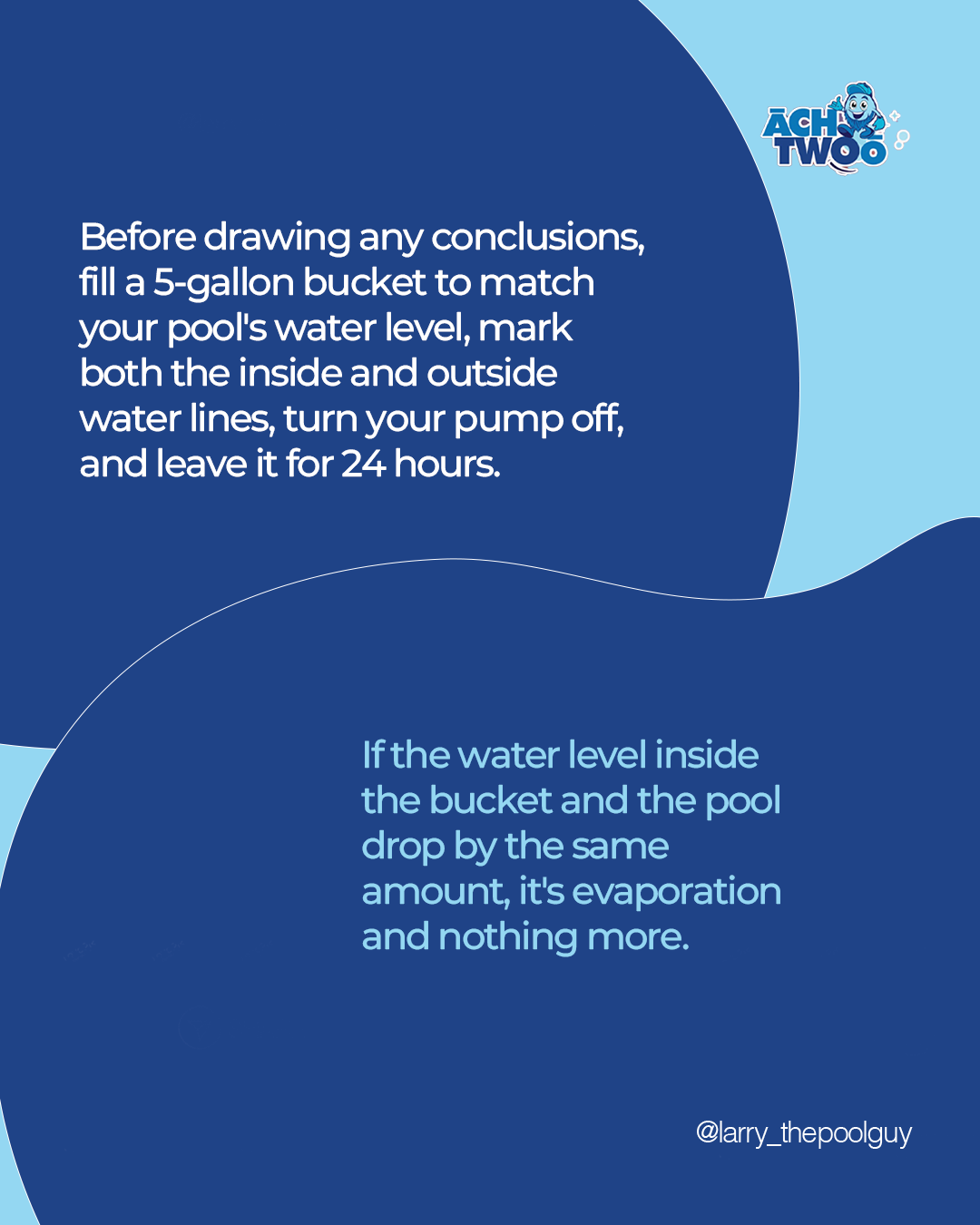
Fill a standard five-gallon bucket with pool water. Place it on the first or second step of the pool so it is partially submerged, this keeps the water temperature inside the bucket close to the pool water temperature, which ensures evaporation rates are comparable. Using tap water or placing the bucket somewhere it heats differently from the pool water will compromise the accuracy of the results.
Mark the water level inside the bucket with a waterproof marker or a piece of tape. Mark the water level of the pool at the same time on the pool wall or skimmer face wherever it is easiest to measure accurately.
Turn the pool pump off. This is important because running the pump during the test can introduce variables; pressure changes, splash from return jets, skimmer suction that affect the water level measurement independently of evaporation and leaks.
Leave both undisturbed for exactly 24 hours. Don't top up the pool. Don't use the pool. Don't run the pump. After 24 hours, measure the drop in the bucket water level and the drop in the pool water level separately, and compare them.
How to Read the Bucket Test Results
The results of the bucket test fall into two clear categories, and each one has a definitive meaning.
If the pool water level and the bucket water level have dropped by the same amount, the loss is evaporation. Both the pool and the bucket were exposed to the same temperature, sunlight, and airflow, and lost the same proportion of their surface water to evaporation. There is no leak. The water loss is normal, expected, and requires nothing more than topping up the pool to the correct operating level.
If the pool water level has dropped more than the bucket water level, there is water leaving the pool through a pathway other than evaporation. That pathway is, by definition, a leak and the gap between the two measurements gives you an early indication of its significance. A small gap between the two drops suggests a minor or slow leak. A significant gap; more than half an inch difference suggests a leak that is losing water at a meaningful rate and warrants prompt investigation.
If It Is a Leak: The Professional Two-Phase Diagnosis
A confirmed leak from the bucket test is the beginning of the investigation, not the end of it. Before any repair can be made, the leak needs to be located and locating a pool leak systematically requires a two-phase diagnostic process that identifies which part of the pool system is losing water.
This process is simple in concept, requires no specialist equipment to perform, and produces results that significantly narrow the search for the leak source before any invasive investigation begins.
Phase One: Test With the Pump Running
Once the bucket test has confirmed that water loss exceeds evaporation, refill the pool to its normal operating level. With the pump running on its normal filtration cycle, mark the water level at the pool wall or skimmer face. Leave the pump running for exactly 24 hours without adding water. After 24 hours, measure and record the water loss with the pump in operation.
Phase Two: Test With the Pump Off
Refill the pool to the same starting level as Phase One. Turn the pump off completely. Mark the water level at the same reference point. Leave everything undisturbed for exactly 24 hours. Measure and record the water loss with the pump off.
What Each Result Combination Means
The comparison between the two phases reveals which part of the pool system the leak is in and each combination of results points to a different location.
If water loss is greater with the pump running than with the pump off, the leak is on the pressure side of the system, the plumbing that carries water after it leaves the pump and filter, back toward the pool through the return jets and associated fittings. Pressure-side leaks are typically in fittings, unions, or buried return lines, and they only lose water actively when the pump is running and the system is under pressure.
If water loss is greater with the pump off than with the pump running, the leak is on the suction side of the system, the plumbing between the pool and the pump, including the skimmer line, the main drain line, and the fittings connecting them. Suction-side leaks tend to lose water through the negative pressure that draws water toward the pump.
If water loss is roughly equal in both phases, the leak is most likely structural in the pool shell itself, the liner, or the fittings that pass through the pool wall at the waterline or below it. Structural leaks are independent of pump operation and lose water at a constant rate regardless of whether the circulation system is running.
Pressure-Side Leaks vs. Suction-Side Leaks vs. Structural Leaks
Understanding the distinction between these three leak types matters because each requires a different approach to locate and repair.
Pressure-side leaks are often identifiable by wet ground near return line runs or around equipment. Because the system is under pressure when the pump runs, water is actively pushed out of the leak point during operation. Dye testing near return fittings and jets can confirm specific locations.
Suction-side leaks are frequently accompanied by air in the system, bubbles returning through the jets, air in the pump strainer basket, or a pump that loses prime. The suction created by the pump draws air into the system through the same opening that water escapes from when the pump is off.
Structural leaks in the shell, liner, or wall fittings are located using dye testing, where a small amount of coloured dye is introduced near suspected areas with the pump off. If the dye is drawn toward a specific point on the pool surface rather than dispersing evenly, the leak location is confirmed.
Why Acting Quickly on a Confirmed Leak Matters
A pool leak left unaddressed doesn't stay the same size. The ground saturation around a leaking pool increases over time, which can destabilise the soil supporting the pool shell and accelerate the growth of the leak point. Fibreglass shells subjected to sustained water pressure from saturated surrounding soil can develop additional structural stress. Vinyl liners where water has found a path through a small tear will expand that tear over time as the water force passing through it increases.
The practical costs also compound quickly. A pool losing half an inch per day to a structural leak loses roughly 500 gallons per week in a standard residential pool; a significant ongoing water bill in addition to the cost of the chemical top-ups needed to maintain chemistry in constantly refreshed water.
Early investigation and prompt repair is substantially cheaper than the consequence of leaving a confirmed leak to develop.
Suspect a Leak but Not Sure What You're Dealing With?
The bucket test tells you whether the problem is real. The two-phase pump test tells you where in the system to look. Professional leak detection takes it from there locating the specific point, assessing the repair options, and resolving it correctly the first time.
At AchtwooPool, we bring systematic diagnostic process to every leak investigation across Orange, Texas, Southeast Texas, and Southwest Louisiana. No guesswork, no unnecessary repairs, no money spent on fixing the wrong thing.
We serve Orange, Texas | Southeast Texas | Southwest Louisiana
Orange, Texas; Call: +1 409-734-7665
Beaumont, TX; Call: 409-734-POOL
Lake Charles, LA Call: 337-333-POOL
Visit www.409pool.com or click the link in our bio.
A leak diagnosed correctly costs a fraction of a leak repaired incorrectly. Let's find out exactly what you're dealing with before you spend a penny on the wrong fix.