
THE HIDDEN DANGER OF CORDLESS ROBOTIC POOL CLEANERS NOBODY IS TALKING ABOUT
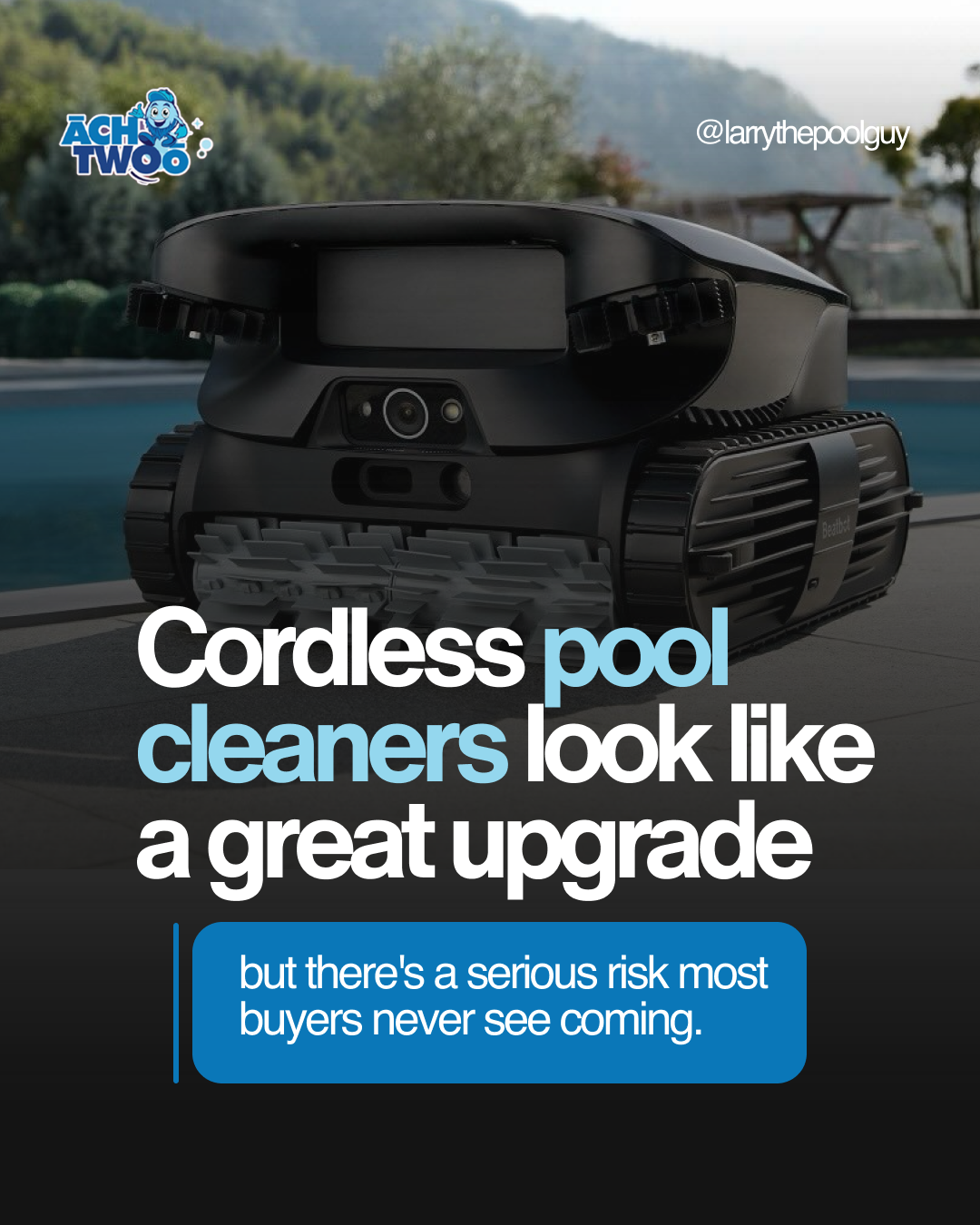
By AchtwooPool| Professional Pool Cleaning Services | Orange, Texas | Southeast Texas | Southwest Louisiana
A cordless robotic pool cleaner looks like the easiest upgrade in pool ownership. No cord to untangle, no float hose kinking across the surface; you drop it in, walk away, and let it hum around the pool while you get on with your day. For the debris on your floor, it often works beautifully. But there is a conversation the marketing does not want to have with you, and it has nothing to do with how well the machine picks up leaves. Here is the danger sitting quietly inside these cleaners, and the second danger sitting in the water while you assume the robot has it covered.
TABLE OF CONTENTS
THE POOL THAT LOOKED SPOTLESS AND STILL TURNED GREEN
THE POWER SOURCE THE MARKETING DOESN'T MENTION
WHY SOUTHEAST TEXAS HEAT IS HARD ON LITHIUM BATTERIES
THE DEGRADING BATTERY THAT SHORTENS EVERY CLEANING CYCLE
THE DEAD ZONE YOU NEVER SEE THE ROBOT SKIP
WHY A CLEAN FLOOR TELLS YOU NOTHING ABOUT YOUR WATER
THE FALSE SECURITY THAT COSTS OWNERS THE MOST
CHARGING AND STORAGE: THE HABITS THAT INVITE TROUBLE
HOW TO OWN A CORDLESS CLEANER THE RIGHT WAY
IS YOUR ROBOT DOING LESS THAN YOU THINK?
THE POOL THAT LOOKED SPOTLESS AND STILL TURNED GREEN
A homeowner in Beaumont was proud of his new cordless cleaner, and he had earned the right to be. He ran it faithfully. The floor of his pool was spotless every single morning, and for weeks he felt like he had finally solved pool maintenance. He had stopped testing his water as often, because why would he; the pool looked immaculate.
Then, over one hot weekend, the water turned. Not the floor, which the robot was still sweeping clean, but the water itself: cloudy first, then a green cast creeping in from the corners. He could not understand it. The pool had never looked cleaner, and now it was going green in front of him.
Two things had gone wrong at once, and neither one was visible from the patio. His cleaner's battery had aged enough that it was quitting before it finished the pool, so a corner never got touched. And while he was trusting a clean-looking floor, his chemistry had drifted out of range with nothing watching it. The robot had lulled him into ignoring the one job it was never built to do and the pool paid for it.
THE POWER SOURCE THE MARKETING DOESN'T MENTION
Every cordless robotic pool cleaner runs on a lithium-ion battery. That is the entire selling point; cut the cord, pack in a rechargeable cell, set the machine loose. It is also the part of the product that gets the least honest airtime.
Lithium-ion batteries are remarkably powerful for their size, which is exactly why they demand respect. When one is damaged, defective, overcharged, or pushed past its temperature limits, it can enter what engineers call thermal runaway; a fast, self-feeding overheating reaction that can lead to smoke or fire. This is the same class of battery behind the warnings you have seen about e-bikes and scooters catching fire while charging. A pool robot is not exempt from that physics just because it spends its working life in water. The danger is not that these machines are ticking bombs, millions run without incident. The danger is that owners treat them like a garden hose, with no idea the power source inside deserves real care.
WHY SOUTHEAST TEXAS HEAT IS HARD ON LITHIUM BATTERIES
Now add our climate to the equation. Lithium batteries hate heat, and Southeast Texas and Southwest Louisiana deliver it in punishing doses. A closed garage in July can climb well past a hundred degrees, and that is exactly where most people charge and store their cleaner.
Heat does two things to a lithium battery, and neither is good. It accelerates the chemical aging that shortens the battery's usable life, and it raises the baseline risk of a thermal event if the cell is already stressed or damaged. Charging a hot battery, or charging in a hot space, stacks the odds in the wrong direction. Pull a robot out of bathtub-warm pool water on a scorching afternoon, carry it straight into a sweltering garage, and plug it in and you have combined three heat sources on one battery at the worst possible moment. None of this means you cannot own one here. It means the casual, thoughtless handling the product invites is a poor fit for our summers.
THE DEGRADING BATTERY THAT SHORTENS EVERY CLEANING CYCLE
Set the fire risk aside, because there is a quieter problem that affects far more owners. Every lithium battery degrades. Over months of charge cycles the run time shrinks, and it shrinks gradually enough that you rarely notice it happening.
A cordless cleaner that used to complete a full cycle starts quitting early. It cleans the shallow half of the pool, drains its charge, and settles onto the floor before it ever reaches the deep end, the far wall, or the shaded corner where debris collects. From the patio it looks identical to a robot that finished, it is simply sitting on the bottom with the job half done. This is the trap of a cleaner you cannot watch the entire time. A corded unit that stalls is obvious. A cordless one that dies early is invisible, and the part of your pool it stopped reaching goes uncleaned day after day.
THE DEAD ZONE YOU NEVER SEE THE ROBOT SKIP
That unreached corner is more than a cosmetic issue. It becomes a dead zone, a pocket of the pool where debris accumulates, organic matter builds up, and sanitizer gets quietly overwhelmed.
Debris feeds algae. Organic material drives up chlorine demand in that one area even as the rest of the pool tests fine. And because the zone is out of the cleaner's shortened range, nothing disturbs it; the biofilm settles in, the algae takes hold, and the first green you see appears exactly there, in the corner the dying battery stopped reaching. You did everything right on paper. The robot ran every day. But it was running a shorter and shorter loop, and the pool developed a blind spot you never knew existed.
WHY A CLEAN FLOOR TELLS YOU NOTHING ABOUT YOUR WATER
Here is the distinction that undoes more pool owners than any battery ever will. A robotic cleaner moves debris. It does not balance water. Those are two entirely different jobs, and the convenience of the machine fools people into believing one covers the other.
A spotless-looking floor tells you nothing about your free chlorine, your pH, your stabilizer, or your alkalinity. You can have a pool that looks immaculate because the robot swept it this morning and water chemistry that is drifting toward an algae bloom by the weekend. The floor and the chemistry are simply not the same thing, and a machine built to handle one has no effect whatsoever on the other.
THE FALSE SECURITY THAT COSTS OWNERS THE MOST
This is the danger that actually costs most owners the most money, and it is the one nobody names. The cordless cleaner is so effective at its narrow task that it breeds complacency about everything else.
During a heat stretch, when chlorine demand climbs and free chlorine should be sitting nearer 3 to 5 ppm instead of the usual 2 to 4, a clean-looking floor lulls owners into skipping tests and stretching out service. The pool looks handled, so the water goes unwatched. By the time it turns, the chemistry has been drifting for days and the problem is well past the point a robot could ever have prevented because a robot was never going to prevent it in the first place. The cleaner is a genuinely good tool for one job. The hidden danger is believing it is doing a job it was never built to do.
CHARGING AND STORAGE: THE HABITS THAT INVITE TROUBLE
Most of the real-world risk with these cleaners comes down to a handful of everyday habits. Leaving the battery on the charger for days after it is full. Storing the unit in direct sun or in a garage that turns into an oven by noon. Charging a battery that is still hot from the pool. Ignoring a cell that has started swelling, running hot, or failing to hold a charge.
None of these feel dangerous at the moment, which is precisely why they matter. A lithium battery gives you warning signs before it fails; unusual heat, swelling, a charge that drains far faster than it used to and the owners who get into trouble are almost always the ones who nursed a struggling battery along instead of retiring it. Respecting those signals is the difference between a cleaner that serves you for years and one that becomes a hazard in your garage.
HOW TO OWN A CORDLESS CLEANER THE RIGHT WAY
You do not have to give up the convenience. You just have to respect what you are holding. Store and charge the battery in a cool, dry, ventilated space; never a baking garage, never in direct sun, never left plugged in and forgotten. Follow the manufacturer's charging guidance to the letter, and retire any battery that swells, overheats, or stops holding a charge rather than pushing it through one more season.
And treat the robot as one part of a system, not the whole of it. Test your water on a real schedule, no matter how clean the floor looks. Watch that the cleaner is actually finishing its cycle and reaching every zone. Brush the surfaces a machine cannot, and keep your chemistry balanced for the heat you live in because that, not a clean-looking floor, is what actually keeps a pool safe.
IS YOUR ROBOT DOING LESS THAN YOU THINK?
A cordless cleaner can make your floor look perfect while a dying battery skips a corner and your chemistry drifts unwatched. It is a fine tool for a narrow job, and a poor substitute for the care a pool actually needs.
At AchtwooPool, we help pool owners across Orange, Texas, Southeast Texas, and Southwest Louisiana manage the chemistry, surfaces, and equipment a cordless robot was never designed to handle, so a clean-looking pool is actually a healthy one underneath.
WE SERVE ORANGE, TEXAS | SOUTHEAST TEXAS | SOUTHWEST LOUISIANA
ORANGE, TEXAS — Call: +1 409-734-7665
BEAUMONT, TX — Call: 409-734-POOL
LAKE CHARLES, LA — Call: 337-333-POOL
Visit www.409pool.com or click the link in our bio.
Is your robot doing less than you think? The fix isn't trusting the machine more, it's watching what it can't reach, respecting the battery inside it, and never mistaking a clean floor for balanced water.