
THE LANGELIER SATURATION INDEX: THE PROFESSIONAL TOOL THAT TELLS YOU IF YOUR WATER IS SILENTLY DESTROYING YOUR POOL
By Achtwoo Pool | Professional Pool Cleaning Services | Orange, Texas | Southeast Texas | Southwest Louisiana
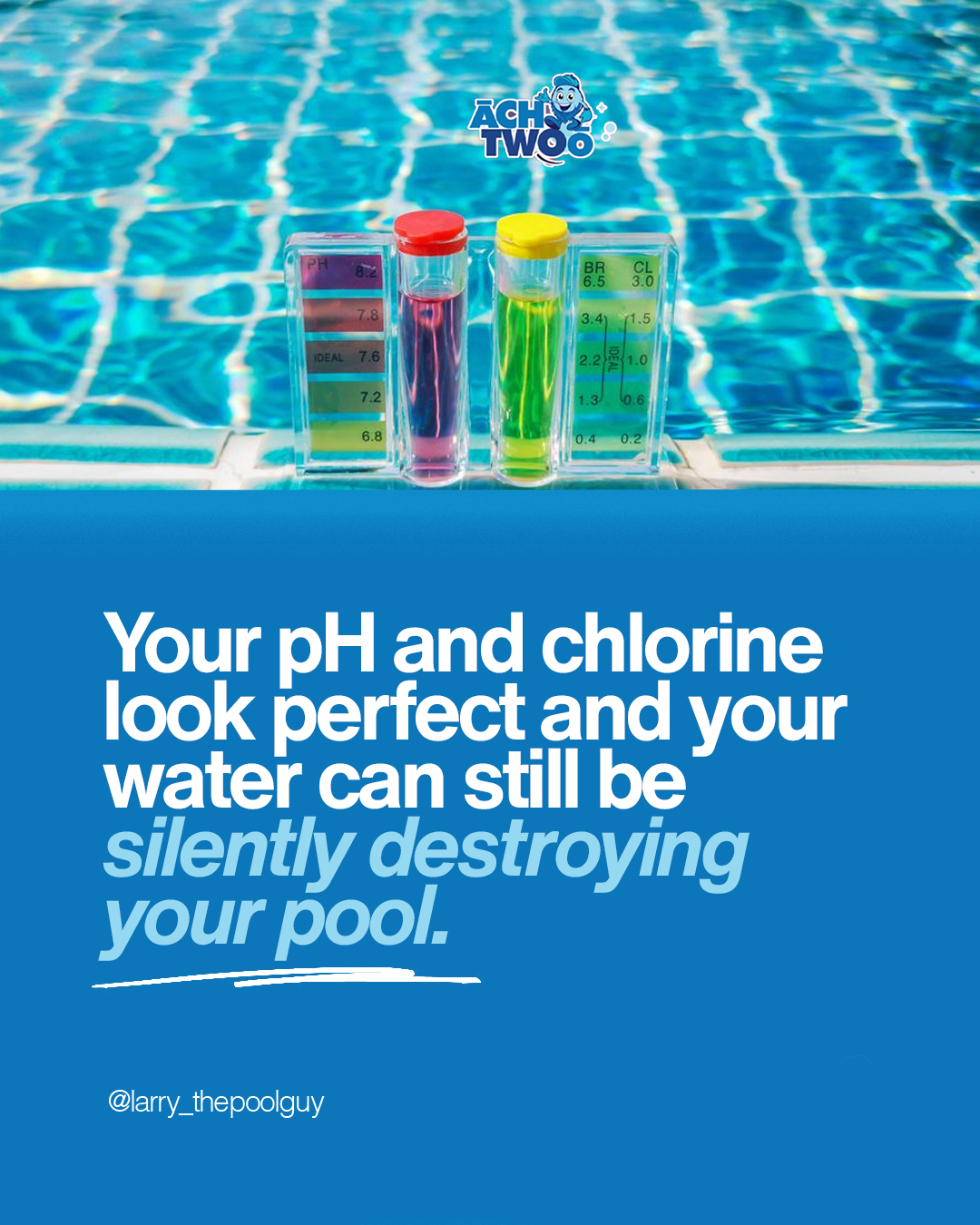
Your pH looks perfect. Your chlorine is in range. And your water can still be silently destroying your pool's plaster and corroding your equipment right now. The tool that reveals this and that professional pool technicians use to prevent it, is called the Langelier Saturation Index. Here is what it is, what it measures, and why it changes the way you understand pool water balance.
Table of Contents
The Pool Owner Who Did Everything Right and Still Had a Damaged Surface
Why pH and Chlorine Alone Are Not Enough
What the Langelier Saturation Index Actually Is
The Five Parameters the LSI Considers Simultaneously
What a Negative LSI Means for Your Pool
What a Positive LSI Means for Your Pool
Why Zero Is the Professional Target
How pH and LSI Can Tell Very Different Stories About the Same Water
The Orenda Calculator: Free, Online, and Used by Professionals
How to Use the Calculator and What to Do With the Result
What LSI Management Prevents Over a Pool's Lifetime
Want Your Pool Water Managed to the Professional Standard?
The Pool Owner Who Did Everything Right and Still Had a Damaged Surface
He had maintained his pool meticulously for six years. Weekly testing. Consistent chemical additions. pH always between 7.4 and 7.6. Chlorine reliably in range. Alkalinity managed carefully. The water was clear, the chemistry was balanced by every measure he knew to apply, and the pool looked good throughout pool season every year.
When the pool was resurfaced at year seven earlier than the installer's estimate of ten to twelve years for a well-maintained surface, the contractor pointed out something unexpected. The surface deterioration wasn't from algae, from staining, or from any of the visible problems that indicate poor maintenance. It was consistent, low-level etching across the plaster, the kind produced by water that had been subtly corrosive for years. Not dramatically corrosive. Not obviously imbalanced. Just slightly, persistently, invisibly aggressive toward the surface it was in contact with.
His pH had been correct. His chlorine had been correct. But his water temperature, calcium hardness, total dissolved solids, and the interaction between all of these parameters together had produced a water balance score that was slightly negative corrosive consistently, throughout the six years of otherwise diligent maintenance. He had been managing three parameters well while five parameters operating together told a different story.
The Langelier Saturation Index would have caught it in year one. The resurfacing cost several thousand dollars that it would have prevented.
Why pH and Chlorine Alone Are Not Enough
Standard residential pool maintenance focuses on a small set of parameters: chlorine, pH, alkalinity, cyanuric acid, and calcium hardness. Managed individually and kept within target ranges, these parameters provide a reasonable foundation for water quality and surface protection.
The limitation is the word "individually." Pool water chemistry is not a set of isolated parameters that operate independently. It is an interconnected system where every parameter influences how others behave and what the water does to the surfaces and equipment it contacts. Managing each parameter within its own acceptable range does not guarantee that the combination of all parameters is producing water that is in balance with its environment.
A pool can have pH at 7.5 perfectly in range while the combination of temperature, calcium hardness, alkalinity, and total dissolved solids at their respective levels produces water chemistry that is net corrosive or net scale-forming. The pH test cannot reveal this. The chlorine test cannot reveal this. Only a calculation that considers all relevant parameters simultaneously produces a meaningful assessment of whether the water is truly balanced.
This is what the Langelier Saturation Index does.
What the Langelier Saturation Index Actually Is
The Langelier Saturation Index commonly abbreviated as LSI is a formula developed by Dr. Wilfred Langelier in 1936 to assess the corrosive or scale-forming tendency of water in contact with calcium carbonate surfaces. It was originally developed for drinking water distribution systems and has been adopted by the pool industry as the standard tool for assessing true water balance.
The LSI produces a single numerical value that expresses whether pool water is in equilibrium with the pool's calcium carbonate surfaces; plaster, concrete, grout or whether the water is either attacking those surfaces or depositing onto them.
An LSI value of zero means the water is in perfect equilibrium neither corrosive nor scale-forming. A negative LSI value means the water is undersaturated and corrosive, it will attack calcium carbonate surfaces to satisfy its chemical requirements. A positive LSI value means the water is oversaturated and scale-forming, it will deposit calcium carbonate onto surfaces and equipment.
This single number, calculated from five parameters simultaneously, tells pool owners and professionals something that no individual parameter measurement can: what is the water actually doing to the pool right now?
The Five Parameters the LSI Considers Simultaneously
The LSI formula incorporates five pool water parameters, each of which contributes to the overall saturation state of the water. Managing any four of them correctly while the fifth is significantly off can produce a corrosive or scale-forming LSI despite otherwise acceptable individual readings.
pH is the most influential single parameter in the LSI calculation. The formula is highly sensitive to pH changes, a shift of 0.3 pH units produces a significant change in the LSI value. This is one of the reasons pH is so central to pool management, but it also illustrates why pH alone is insufficient: its effect in the LSI is modulated by all of the other parameters.
Water temperature directly influences the solubility of calcium carbonate in water. Warmer water holds calcium carbonate in solution less readily which means a pool at 90°F is more likely to be scale-forming at a given calcium and alkalinity level than the same pool at 75°F. In Southeast Texas and Southwest Louisiana, where pool water temperatures routinely exceed 85°F during summer, the temperature contribution to the LSI is higher than in cooler climates meaning pools in this region need to manage calcium and alkalinity more carefully to avoid pushing the LSI into scale-forming positive territory.
Calcium hardness represents the dissolved calcium available in the water. Low calcium hardness contributes to a negative LSI by increasing the water's calcium-seeking tendency. High calcium hardness pushes the LSI positive toward scale formation.
Total alkalinity provides the buffering capacity that influences how calcium carbonate behaves in solution. Alkalinity within range contributes to a stable LSI. Alkalinity significantly above range pushes the LSI toward positive and increases scale-forming tendency.
Total dissolved solids; the accumulated concentration of all dissolved compounds in the water contributes to the ionic strength of the water, which affects calcium carbonate solubility. As TDS increases over a pool season through chemical additions, evaporation, and contamination, it subtly shifts the LSI. Pools that have not had significant water dilution in an extended period will have higher TDS than freshly filled pools, affecting the LSI calculation.
What a Negative LSI Means for Your Pool
An LSI value below zero even a small negative value like minus 0.3 or minus 0.5 means the water is corrosive. It is undersaturated with respect to calcium carbonate and is actively seeking calcium from the most available source in its environment.
In a pool, the most available source is the pool's own surfaces and equipment. Plaster, concrete, and grout all contain calcium carbonate. Corrosive water attacks these surfaces, dissolving calcium from the surface matrix, a process called etching that produces the roughening, pitting, and surface degradation described in the opening story. Metal equipment; heat exchangers, pump impellers, fittings is also vulnerable to corrosive water, experiencing accelerated wear and shortened service life.
Corrosive water does not announce itself visibly in the early stages. The water looks clear. The chemistry tests as acceptable on standard parameters. The etching is microscopic for months before it becomes visible as roughness or discolouration. By the time the surface damage is apparent, the corrosive water has been at work for a significant period and the damage is cumulative and permanent.
What a Positive LSI Means for Your Pool
An LSI above zero means the water is oversaturated, it contains more dissolved calcium carbonate than the water chemistry can hold in solution at the current temperature and pH conditions. The excess precipitates out of solution and deposits onto surfaces.
The familiar result is calcium scaling: the white, chalky, or crystalline deposits that form along the waterline, on tile grout, on pool equipment, and inside plumbing and filter media. Scaling reduces the efficiency of heat exchangers, reduces flow through plumbing, and creates a progressively rougher surface on pool walls and floor.
A moderately positive LSI between 0.3 and 0.5 produces gradual scaling that is manageable with periodic acid washing and chemical treatment. A significantly positive LSI accelerates scaling rapidly, producing buildup that is increasingly difficult and expensive to address and that shortens equipment life through reduced heat transfer efficiency and flow restriction.
Why Zero Is the Professional Target
Professional pool management aims for an LSI as close to zero as possible typically within a range of minus 0.3 to plus 0.3, which represents a practically neutral balance that is neither causing measurable corrosion nor significant scaling.
Within this range, pool surfaces are protected. Equipment operates within its designed parameters. The chemistry is balanced not just within individual parameter ranges but in the holistic sense, what the water is actually doing to everything it contacts is neutral rather than destructive.
This is the standard that pool professionals apply when managing pools for clients who want maximum surface and equipment longevity and it is achievable with accurate testing and the calculation tools that are now freely available.
How pH and LSI Can Tell Very Different Stories About the Same Water
Consider two pools. Both have a pH of 7.5 perfectly in range. Pool A has a water temperature of 68°F, calcium hardness of 300 ppm, alkalinity of 100 ppm, and TDS of 800 ppm. Pool B has a water temperature of 92°F, calcium hardness of 150 ppm, alkalinity of 70 ppm, and TDS of 2,400 ppm.
The pH test on both pools returns the same reading. The standard parameters for both pools might appear acceptable. But the LSI calculation for Pool A returns approximately positive 0.1 essentially neutral. Pool B's LSI calculates to approximately minus 0.7 meaningfully corrosive, despite identical pH.
Pool B's warmer temperature reduces calcium carbonate solubility. Its lower calcium hardness increases the water's calcium-seeking tendency. Its lower alkalinity reduces buffering. Its higher TDS shifts the ionic equilibrium. Together, these factors produce water that is attacking its own surfaces despite a pH reading that looks perfectly managed.
The standard chemistry check misses this completely. The LSI catches it immediately.
The Orenda Calculator: Free, Online, and Used by Professionals
The mathematics of the Langelier Saturation Index formula are not difficult but are tedious to perform manually, particularly with multiple parameters and the logarithmic relationship between them. For practical use, pool professionals rely on digital calculators that perform the calculation automatically from entered test results.
The Orenda Calculator available free at orenadatech.com is the most widely used LSI calculation tool in the professional pool industry. It accepts input for pH, temperature, calcium hardness, total alkalinity, cyanuric acid, and TDS, and returns an LSI value along with an indication of whether the water is balanced, corrosive, or scale-forming.
It also provides adjustment guidance indicating which parameter changes will move the LSI toward neutral and by how much, allowing targeted corrections rather than broad adjustments across multiple parameters.
How to Use the Calculator and What to Do With the Result
Performing an LSI calculation requires a full water test that includes all five relevant parameters; pH, temperature, calcium hardness, total alkalinity, and TDS. Standard pool test kits cover the first four. TDS requires a separate digital TDS meter, an inexpensive device available from pool supply retailers or can be estimated from the pool's history if a recent measurement is not available.
Enter all values into the Orenda Calculator. The returned LSI value tells you whether the water is balanced, and if not, in which direction and by approximately how much. The calculator's adjustment guidance identifies the most efficient parameter corrections to bring the LSI toward zero.
For most residential pools tested regularly and managed with attention to all five parameters, LSI corrections are minor small alkalinity adjustments, a calcium hardness addition, or a temperature-aware pH target that shifts slightly with seasonal water temperature changes. The calculation takes five minutes. The protection it provides is ongoing.
What LSI Management Prevents Over a Pool's Lifetime
A pool managed to a consistently neutral LSI will arrive at resurfacing time in significantly better condition than one managed exclusively on individual parameter ranges. The plaster retains its original texture and integrity longer. Equipment experiences less corrosive wear. Scaling events are minimised. The investment in the pool surface which represents a significant portion of original pool construction cost is protected by a five-minute calculation that most pool owners have never been told exists.
This is the professional standard. It is accessible to any pool owner willing to perform a complete water test and use a free calculator. And it is one of the most impactful single additions to a pool maintenance routine that most residential pool owners have never heard of.
Want Your Pool Water Managed to the Professional Standard?
The difference between water that looks balanced and water that is balanced requires looking beyond the basic parameters to the single number that accounts for all of them together and tells you what the water is actually doing to your pool.
At Achtwoo Pool, LSI assessment is part of how we manage water chemistry for clients across Orange, Texas, Southeast Texas, and Southwest Louisiana because protecting the pool surface and equipment that our clients have invested in means managing the water to the standard that professional pool chemistry demands.
We serve Orange, Texas | Southeast Texas | Southwest Louisiana
Orange, Texas; Call: +1 409-734-7665
Beaumont, TX; Call: 409-734-POOL
Lake Charles, LA; Call: 337-333-POOL
Visit www.409pool.com or click the link in our bio.
Want your pool water managed to the professional standard? The LSI tells the full story. Let's make sure yours is telling the right one.