
THE SIGNS YOUR INGROUND POOL URGENTLY NEEDS A DEEP CLEAN
By Achtwoo Pool | Professional Pool Cleaning Services | Orange, Texas | Southeast Texas | Southwest Louisiana
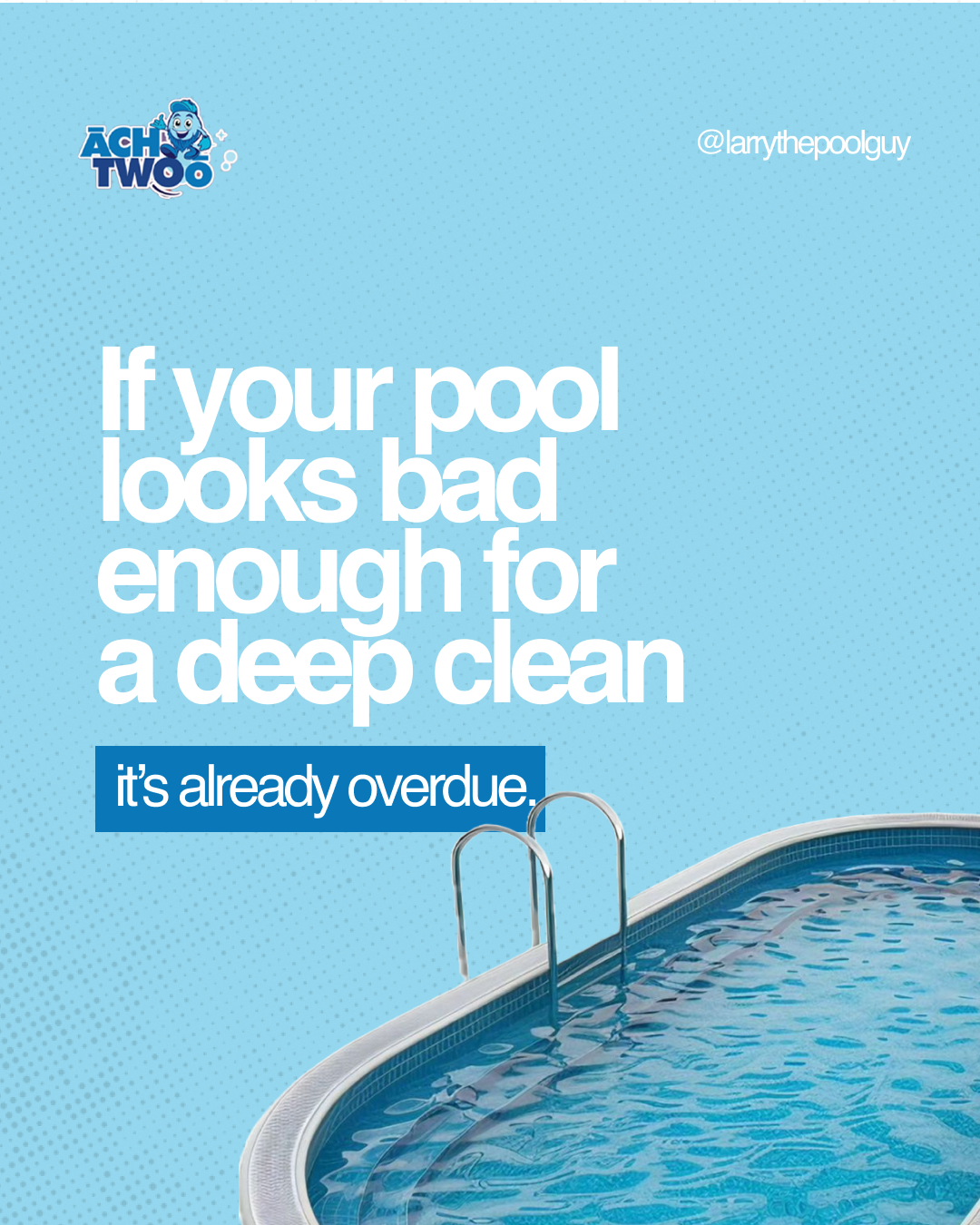
By the time your pool looks bad enough to deep clean, it was needed one week ago. The visible signs that prompt the call; the algae on the walls, the cloudy water, the smell are not the beginning of the problem. They are where the problem ends up after weeks of quiet progression. Here is what to watch for before it gets there.
TABLE OF CONTENTS
THE PROBLEM THAT WAS ALREADY WEEKS OLD WHEN YOU NOTICED IT
WHAT A DEEP CLEAN ACTUALLY IS AND WHY IT'S DIFFERENT FROM ROUTINE MAINTENANCE
VISIBLE SIGN ONE: ALGAE ON WALLS AND FLOOR
VISIBLE SIGN TWO: PERSISTENT CLOUDINESS DESPITE REGULAR TREATMENT
VISIBLE SIGN THREE: STRONG ODOUR FROM THE WATER
VISIBLE SIGN FOUR: SLIMY SURFACES ON STEPS AND LADDERS
THE PROFESSIONAL INDICATOR MOST OWNERS MISS: FILTER PRESSURE SPIKING TOO FAST
WHY FASTER-THAN-NORMAL PRESSURE RISE IS A WATER QUALITY WARNING
THE HAIR AND LINT POT: THE DEEP CLEAN STEP MOST PEOPLE SKIP
HOW TO CLEAR THE HAIR AND LINT POT CORRECTLY AND SAFELY
AFTER A STORM: WHY THE FILTER ALWAYS NEEDS IMMEDIATE ATTENTION
POOL SHOWING SIGNS IT NEEDS A PROPER DEEP CLEAN?
THE PROBLEM THAT WAS ALREADY WEEKS OLD WHEN YOU NOTICED IT
There is a moment every pool owner recognises; the morning you walk outside, look at the water, and realise that something has gone significantly wrong. The walls have a greenish tint. The water isn't quite clearing the way it should. There's a smell that wasn't there before. The steps feel different underfoot.
A pool owner in Southeast Texas described this moment with a clarity that is entirely common among people who have been through it. She had been maintaining her pool throughout the summer, testing weekly, adding chemicals, skimming the surface regularly. The pool looked fine. Then, seemingly overnight, it didn't.
She called assuming the problem had developed quickly. The assessment told her otherwise. The conditions that produced the visible signs she was looking at had been building for three to four weeks.
The pressure in her filter had been climbing faster than normal for the past month, a signal she hadn't known to watch for. The slimy texture developing on the ladder rungs had been building gradually, invisible against the metal until it became significant enough to feel. The cloudiness that seemed to appear suddenly had been a slow drift, masked by the fact that she was assessing the water casually rather than measuring it precisely.
By the time a pool looks bad enough to prompt action, the deterioration has usually been underway long enough that routine maintenance cannot resolve it. What is needed at that point is a deep clean; a systematic, comprehensive restoration of the pool to a state where routine maintenance can be effective again.
WHAT A DEEP CLEAN ACTUALLY IS AND WHY IT'S DIFFERENT FROM ROUTINE MAINTENANCE
A routine maintenance visit, testing, adjusting chemistry, skimming, brushing, vacuuming, checking the filter pressure is designed to maintain a pool that is in good condition. It manages the ongoing inputs and prevents the gradual drift that would occur without attention.
A deep clean is a different category of service. It is performed when a pool has drifted beyond the state where routine maintenance can restore it within a normal service cycle when contamination has accumulated in the filtration system, when algae has established on multiple surfaces, when the water chemistry has drifted to the point where chemistry alone won't resolve it without intensive physical intervention alongside it.
The distinction matters because applying routine maintenance to a pool that needs a deep clean produces inadequate results not because the technique is wrong, but because the condition requires more intervention than routine maintenance is designed to deliver. Recognising which category a pool's condition falls into is the skill that determines whether the next service call resolves the problem or merely manages it.
VISIBLE SIGN ONE: ALGAE ON WALLS AND FLOOR
Algae visible on the pool walls and floor is not a maintenance problem. It is a maintenance failure specifically, the visible end result of a period during which chlorine levels were insufficient to suppress algae establishment, brushing was infrequent enough to allow algae to bond to surfaces, or both conditions applied simultaneously for long enough for algae to colonise.
By the time algae is clearly visible as a green, black, or yellow coating on pool surfaces, it has been present in a less visible form for a significant period prior. The colony visible now is the established result of growth that began weeks earlier at a level too thin to see but already bonded to the surface and building toward the point of visibility.
The significance of this for deep cleaning is that visible algae cannot be addressed by chemistry alone. The algae must be mechanically dislodged from surfaces through thorough brushing before chemical treatment can reach and kill the colony beneath the surface biofilm. A deep clean that includes comprehensive brushing before shock treatment produces results that chemical treatment without brushing cannot because the treatment can only work on what it can contact, and surface algae protects itself from chemical contact through the biofilm layer that bonds it to the pool surface.
VISIBLE SIGN TWO: PERSISTENT CLOUDINESS DESPITE REGULAR TREATMENT
Cloudiness that persists despite correct chemistry, regular shock treatments, and consistent filter operation is one of the clearest signals that the contamination load in the pool has exceeded what the routine maintenance system can process on its current schedule.
There are several causes of persistent cloudiness, but the common thread between them is that the pool's filtration and chemical systems are no longer keeping pace with the contamination they are being asked to manage. Either the filter is carrying a debris load that has significantly reduced its processing efficiency, or the organic and particulate load in the water has reached a concentration that requires more intensive treatment than weekly shock can address, or both.
Persistent cloudiness that doesn't respond to correct chemistry adjustment and shock treatment within 48 hours is a deep clean indicator not a chemistry adjustment problem. Adding more chemicals to a pool whose filtration system is operating at reduced efficiency recirculates the contamination faster than it removes it. The filter must be deep cleaned as part of the water clarity restoration, not treated as a secondary follow-up to the chemical treatment.
VISIBLE SIGN THREE: STRONG ODOUR FROM THE WATER
As covered extensively in earlier guides on this site, the strong chemical odour that pool owners associate with too much chlorine is in fact the smell of chloramines, the combined chlorine compounds formed when free chlorine bonds with nitrogen contaminants from swimmers, organic debris, and environmental sources.
Chloramines smell. Free chlorine, at correct levels in balanced water, produces almost no odour. A pool that smells strongly of chemicals is a pool where the sanitiser has been substantially consumed and converted to inactive combined form not one where too much chlorine is present. The smell is the water indicating a deep clean need: the combined chlorine load has accumulated to a point where breakpoint oxidation through a single shock treatment may not fully resolve it without addressing the underlying contamination source through physical cleaning as well.
If the odour has been present consistently across multiple service visits without resolving after shock treatment, the pool needs a deep clean that addresses the organic contamination contributing to the ongoing chloramine formation not simply more shock.
VISIBLE SIGN FOUR: SLIMY SURFACES ON STEPS AND LADDERS
Slimy or slippery surfaces on pool steps, ladders, and the shallow end floor are a tactile indicator of early-stage biological fouling, the development of biofilm on surfaces that are either insufficiently brushed or in areas with reduced water circulation.
Biofilm is a thin layer of organic material and microorganisms that adheres to surfaces and creates the slippery feel that swimmers notice on steps and ladders before any visible discolouration appears. It is the precursor to visible algae, the established foothold from which algae colonies develop. By the time steps feel noticeably slimy, the biofilm is developed enough that standard brushing during a routine maintenance visit may not fully remove it without the more intensive scrubbing and targeted chemical application that a deep clean includes.
THE PROFESSIONAL INDICATOR MOST OWNERS MISS: FILTER PRESSURE SPIKING TOO FAST
Of all the signs that a deep clean is needed, the one that professional pool technicians identify most reliably and most pool owners overlook is filter pressure that climbs significantly faster than normal between backwash events.
Under normal, well-managed pool conditions, a sand filter will take approximately seven to fourteen days of operation to climb from its clean baseline pressure to the 8 to 10 PSI above baseline that indicates it is time to backwash. This rate reflects a pool's normal contamination load being processed at a rate the filtration system can manage without becoming overloaded.
WHY FASTER-THAN-NORMAL PRESSURE RISE IS A WATER QUALITY WARNING
When a filter reaches backwash pressure significantly faster than its normal interval in three to four days rather than the usual seven to fourteen, it is communicating that the contamination load it is processing has increased substantially above the normal level. The filter is not failing. It is working harder than usual because the pool is generating more contamination than usual.
This faster pressure rise is one of the earliest objective indicators of developing water quality problems appearing before any visible sign manifests in the water. A pool owner who tracks how long each filter cycle lasts between backwash events will see this signal days to weeks before the water shows any visible change.
If the filter is reaching backwash pressure twice as fast as normal for two or more consecutive cycles, a deep clean assessment is warranted. The pool is generating contamination faster than routine maintenance is managing it, and the trend will produce visible water quality problems if not addressed.
THE HAIR AND LINT POT: THE DEEP CLEAN STEP MOST PEOPLE SKIP
Every pool pump contains a hair and lint pot, the strainer basket housed in the transparent casing on the front of the pump body, upstream of the impeller. Its function is to catch hair, fibre, and fine debris before it reaches the impeller, protecting the mechanical components of the pump from blockage and damage.
During a routine service, the pump strainer basket is checked and cleared as a standard step. What is less commonly addressed in routine maintenance but is essential to any thorough deep clean is the interior of the pot itself, the condition of the basket, and the seal around the pot lid.
HOW TO CLEAR THE HAIR AND LINT POT CORRECTLY AND SAFELY
Clearing the hair and lint pot requires a specific sequence to avoid damaging the pump or creating a pressure release event.
Turn off the pump at the circuit breaker not just at the timer before touching any component. Allow two minutes for the system pressure to equalise. Open the air relief valve on the filter to confirm the system is depressurised before opening the pump lid.
Remove the pot lid by turning it counterclockwise, lift out the basket, and clear it completely including the fine debris and slime that accumulates on the basket mesh rather than sitting loosely inside it.
Inspect the O-ring seal on the pot lid. A cracked, dry, or deformed O-ring allows air into the system when the pump restarts, causing the air bubbles at the return jets that indicate suction-side air ingress.
Replace the O-ring if any damage or deterioration is visible. A replacement O-ring costs a negligible amount and prevents the air ingress problem that causes pump priming issues and circulation inefficiency.
A blocked hair and lint pot restricts flow to the pump impeller, forces the motor to work harder to maintain circulation, and accelerates wear on motor bearings and windings with every operating hour. Clearing it thoroughly as part of every deep clean protects the pump's mechanical life in a way that no chemical treatment can replicate.
AFTER A STORM: WHY THE FILTER ALWAYS NEEDS IMMEDIATE ATTENTION
Storm events are the single largest source of sudden contamination loading on a pool filtration system. Heavy rainfall, flooding, and wind-driven debris introduce a volume and variety of organic and particulate contamination that overwhelms normal filter capacity faster than any other single pool event.
After any significant storm, inspect and clean the filter immediately not at the next scheduled maintenance visit, and not when the pressure gauge reaches the normal backwash trigger. A filter processing storm contamination will reach backwash pressure significantly faster than normal, and a filter that is allowed to remain at above-normal pressure while processing the full storm contamination load is working under conditions that reduce its filtration efficiency and accelerate mechanical wear.
Backwash the filter within 24 hours of any significant storm event. Recheck pressure after 24 hours of post-storm operation. If pressure has climbed back to backwash level within that window, backwash again. The storm contamination load requires more frequent filtration attention than the normal schedule provides, and recognising that is part of managing pool recovery after a weather event correctly.
POOL SHOWING SIGNS IT NEEDS A PROPER DEEP CLEAN?
The signs in this article are not emergencies that require panic, they are a clear communication from the pool about its current condition and what it needs next. Responding promptly to these signals with a proper deep clean resolves the situation before it escalates to the kind of remediation that takes days and costs significantly more.
At Achtwoo Pool, deep clean services across Orange, Texas, Southeast Texas, and Southwest Louisiana address the full range of indicators described in this guide from visible algae to filter pressure patterns to hair pot condition because a deep clean that leaves any of these unaddressed leaves the problem partially unresolved.
WE SERVE ORANGE, TEXAS | SOUTHEAST TEXAS | SOUTHWEST LOUISIANA
ORANGE, TEXAS — Call: +1 409-734-7665
BEAUMONT, TX — Call: 409-734-POOL
LAKE CHARLES, LA — Call: 337-333-POOL
Visit www.409pool.com or click the link in our bio.
Pool showing signs it needs a proper deep clean? The problem started weeks before you noticed it. Let's address it fully before it goes further.