
WHY POOL TEST STRIPS DON'T ALWAYS GIVE ACCURATE RESULTS
By AchtwooPool | Professional Pool Cleaning Services | Orange, Texas | Southeast Texas | Southwest Louisiana
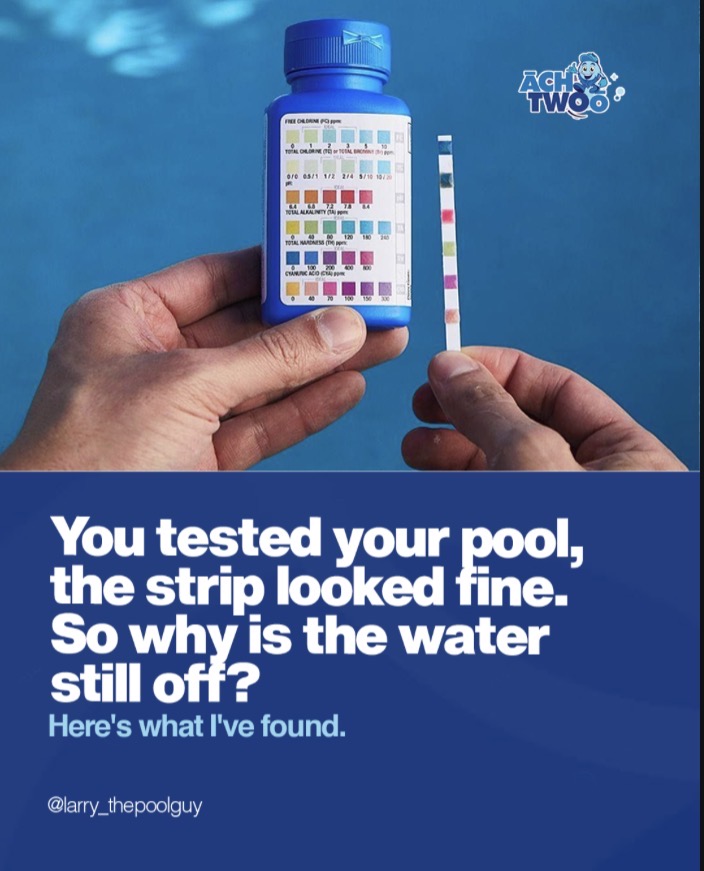
You tested your pool. The strip looked fine. So why is the water still off? It's a question that comes up constantly in pool maintenance and the answer almost always points to the same place. The problem isn't the chemicals you're adding. It's the data you're basing those decisions on. Here's what's actually happening when test strips give you the wrong reading, and what to use instead.
Table of Contents
- When the Strip Says Fine but the Pool Disagrees
- How Test Strips Actually Work
- The Four Ways Test Strips Fail in Real-World Conditions
- Why Inaccurate Test Data Is Worse Than No Test Data
- The Compounding Problem: How One Wrong Reading Leads to Many
- What Reliable Testing Actually Looks Like
- Liquid Reagent Test Kits: Why They Remove the Guesswork
- Digital Testers: When Precision Matters Most
- What a Predictable, Easy-to-Maintain Pool Actually Requires
- If Your Pool Never Quite Balances No Matter What You Add
When the Strip Says Fine but the Pool Disagrees
There is a particular frustration familiar to many pool owners: the test strip shows everything in range, the water looks clear enough, so you leave it alone and within a day or two the water is cloudy, or algae is appearing on the walls, or the chemistry is visibly off in a way that contradicts what the strip told you. You test again. The strip still looks more or less acceptable. And yet the pool keeps telling a different story.
This disconnect is not a mystery, and it is not bad luck. It is the predictable outcome of relying on a testing method that has significant, well-documented limitations in the real-world conditions where pools operate. Test strips are convenient. They are inexpensive. They are widely available. And in the specific conditions where they work accurately, they provide useful directional information. The problem is that those conditions; consistent lighting, low humidity, fresh strips, careful colour matching are rarely the conditions in which pool owners are actually testing their water.
Understanding why test strips fail, and what happens when pool chemistry decisions are built on inaccurate test data, is the first step toward breaking the cycle of persistent imbalance that accurate testing resolves.
How Test Strips Actually Work
To understand why test strips fail, it helps to understand what they are doing when they work correctly.
A pool test strip is a small piece of treated paper or plastic embedded with chemical reagents at specific zones along its length. Each zone is designed to react to a different parameter in the water; chlorine, pH, alkalinity, cyanuric acid, calcium hardness and change colour in proportion to the concentration of that parameter in the water sample.
The result of the test is determined by comparing the colours produced on the strip against a colour chart printed on the product packaging. The pool owner holds the reacted strip next to the chart, matches each zone to the closest corresponding colour block, and reads off the value associated with that block.
This process works with acceptable accuracy when all the variables are controlled: the strip is fresh and has been stored correctly, the lighting is consistent and neutral, the strip is held at the correct viewing angle and compared immediately after the prescribed reaction time, and the water sample is representative of the pool as a whole. In a laboratory or controlled testing environment, these conditions are achievable. In a backyard, in sunlight, with a tube of strips that has been sitting open in a pool equipment box since last season, they rarely are.
The Four Ways Test Strips Fail in Real-World Conditions
Each of the limitations below represents a separate pathway to an inaccurate reading and pool owners routinely encounter several of them simultaneously without realising it.
One: Lighting changes the colour read. The colour comparison that produces a test strip result is a subjective visual judgement made by the person holding the strip. Human colour perception is significantly affected by ambient lighting conditions. A strip compared under bright direct sunlight will appear different from the same strip compared under shade, indoor lighting, or the yellow-tinted light common in covered outdoor areas. The colour blocks on the comparison chart are printed once, under standardised conditions. The actual strip is read under whatever lighting happens to be available, and the result shifts accordingly.
There is no objective reference point in the test strip system to account for this. Two people testing the same water sample under different lighting conditions will frequently report different readings from the same strip. Both will believe their reading is correct.
Two: Viewing angle affects the result. The colour reaction on a test strip is not perfectly uniform across the surface of the pad. Viewed straight-on versus at an angle, the perceived colour can shift enough to move the reading from one value to an adjacent one on the comparison chart. For parameters like pH, where the target range spans only 0.4 units, the difference between reading the strip straight-on and at a slight angle can be the difference between "in range" and "needs correction."
Three: Strip degradation produces distorted results without any visible sign. Test strips have a shelf life. The chemical reagents embedded in the pads degrade over time when exposed to humidity, heat, and air. A strip taken from a tube that has been sitting open in a pool equipment box or outdoor storage unit particularly in the warm, humid conditions common during pool season may already be chemically compromised before it touches the water. Crucially, degraded strips do not look degraded. They appear identical to fresh strips until they react with pool water and produce a distorted colour that the user has no reason to mistrust.
This is one of the most significant failure modes of test strips, because it requires no user error to produce an incorrect result. A pool owner can follow every instruction correctly, test carefully, and still receive a reading that does not reflect the actual chemistry of the water.
Four: The colour blocks on comparison charts represent ranges, not points. Most test strip colour charts are designed to identify broad categories of chemical concentration rather than precise values. A pH colour block might represent "approximately 7.2 to 7.4"; a range wide enough that two readings on opposite ends of the same block require different corrective actions. For a parameter like free chlorine, where the difference between 1 ppm and 0.5 ppm determines whether the pool is adequately sanitised or under-protected, this level of resolution is insufficient for confident decision-making.
Why Inaccurate Test Data Is Worse Than No Test Data
This is the counterintuitive consequence of test strip inaccuracy that pool owners don't immediately recognise: acting on a wrong test result is, in many cases, more damaging than not testing at all.
A pool owner who doesn't test the water and adds no chemicals leaves the pool in whatever state it's in which may deteriorate, but will do so naturally and gradually in a direction that reflects the actual chemistry.
A pool owner who tests with an inaccurate strip and acts on the result can actively worsen the chemistry in multiple directions simultaneously. If the strip under-reports the pH reads it as lower than it actually is; the pool owner adds a pH increaser, pushing a pH that was already elevated even higher. Chlorine at high pH loses the majority of its sanitising power. The pool becomes increasingly under-protected while the owner believes they have corrected the imbalance.
If the strip over-reports the chlorine level reads it as adequate when it has actually fallen, the owner adds nothing, leaving a pool that is genuinely under-sanitised while believing it is protected.
Each of these scenarios leaves the pool in a worse chemical state than before the test was performed. The test didn't just fail to help, it actively created a problem through the corrective action it prompted.
The Compounding Problem: How One Wrong Reading Leads to Many
Pool chemistry doesn't exist as a set of independent parameters. pH affects chlorine effectiveness. Alkalinity affects pH stability. Calcium hardness affects the way all other parameters behave at the surfaces they contact. When one parameter reading is wrong and an inappropriate correction is applied, the effect cascades through the other parameters and compounds with each subsequent incorrect adjustment.
A pool owner who consistently acts on inaccurate strip data will find that the water never quite settles into balance. Each week's adjustments seem logical based on the test results, but the pool keeps drifting. Algae keeps appearing. The water keeps going slightly hazy. Chemistry that should stabilise between service visits doesn't. The owner adds more chemicals, tests more frequently, and the cycle continues not because of the pool, not because of the products, but because the test data driving every decision has been unreliable from the start.
This cycle is one of the most common causes of chronically unbalanced pools. And it is one of the most straightforward to break not by changing chemicals, not by shocking more aggressively, but by switching to a testing method that reliably produces accurate data.
What Reliable Testing Actually Looks Like
Reliable pool testing removes the subjective colour-matching element from the result and replaces it with either a chemical reaction that produces an objective colour endpoint, or a direct electronic measurement of the parameter being tested.
There are two tools that consistently achieve this in residential pool settings: liquid reagent test kits and digital testers. Each has its appropriate application, and understanding the difference between them helps pool owners choose the right approach for their situation.
Liquid Reagent Test Kits: Why They Remove the Guesswork
A liquid reagent test kit sometimes called a drop test kit or a Taylor kit, after one of the most widely used brands works by adding precise measured drops of liquid reagent to a water sample in a standardised test tube, then comparing the resulting colour against a printed comparator built into the kit.
The key differences from test strips are significant. The chemical reaction in a liquid kit is more defined and produces a more distinct colour endpoint than the gradient-based reaction on a test strip pad. The colour comparator is viewed directly alongside the test tube rather than held up to a printed chart, reducing the effect of ambient lighting variation. The reagents in a properly stored liquid kit are more stable than strip reagent pads and less susceptible to humidity degradation. And the test procedure itself measuring a specific volume of water, adding a specific number of drops is more controlled and repeatable than dipping a strip.
Liquid reagent kits test pH, free chlorine, combined chlorine, total alkalinity, cyanuric acid, and calcium hardness with a level of accuracy and resolution that strip tests cannot match. For pool owners who want to manage their own chemistry reliably without professional testing at every visit, a quality liquid reagent kit is the minimum appropriate standard.
They require slightly more time per test than strips, perhaps five to ten minutes for a full panel versus two minutes for a strip but the accuracy they provide transforms that time investment into genuinely useful information rather than directional guesswork.
Digital Testers: When Precision Matters Most
Digital photometers and electronic testers take reliable testing a step further, replacing even the visual colour judgement of a liquid kit with a direct electronic measurement.
A digital photometer works by shining a beam of light through a treated water sample and measuring the amount of light absorbed which corresponds directly to the concentration of the parameter being measured. The result is displayed as a number on a screen, with no colour comparison involved. The readings are objective, repeatable, and accurate to a level of resolution that neither strips nor liquid kits can match.
Digital testers are the tool of choice for pool professionals, for pool owners who want to manage their chemistry with the highest level of precision, and for situations where accurate data is particularly important such as during a pool restoration following an algae bloom, when establishing baseline chemistry for a new season, or when diagnosing a persistent imbalance that hasn't responded to standard treatment.
The upfront cost of a quality digital tester is higher than a liquid kit, and the testing procedure requires clean equipment and careful technique to maintain accuracy. For pool owners managing a single residential pool, a quality liquid kit is usually sufficient. For anyone managing multiple pools, or dealing with persistent chemistry challenges that haven't resolved with other approaches, a digital tester is the appropriate tool.
What a Predictable, Easy-to-Maintain Pool Actually Requires
When test data is reliable, pool management becomes what it should be: a straightforward, predictable process of small, informed adjustments that keep all parameters within range. You make fewer adjustments, because each one is accurate and moves the chemistry where it needs to go without overshooting or pushing another parameter out of range. You use fewer chemicals, because you're adding what is actually needed rather than compensating for the invisible errors created by inaccurate data. And your water stays consistently in range, because each week's test is providing an honest picture of where the chemistry actually is.
The pool becomes predictable. And a predictable pool is, in the best sense of the phrase, an easy pool to maintain. Not because pool chemistry is simple, it isn't but because when you're working with accurate information, the complexity resolves into a manageable, logical routine rather than a cycle of adjustments that never quite arrives at balance.
If Your Pool Never Quite Balances No Matter What You Add
If your pool has been chronically difficult to balance despite regular testing and consistent chemical additions, the first question worth asking is not what you're adding; it's how accurate the data driving those decisions actually is. Inaccurate test data is one of the most common causes of persistent pool chemistry problems, and it is one of the most consistently overlooked.
The solution doesn't require more products, more frequent treatment, or professional intervention every time the chemistry drifts. It requires better information and better information starts with a testing method that gives you an honest read of what the water is actually doing.
For our business services, accurate water chemistry diagnosis is the foundation of every service call we make. We test properly so that every adjustment we make is the right one, applied in the right direction, in the right amount. Because a pool that's treated based on accurate data is a pool that stays in balance and a pool that stays in balance is a pool that's genuinely easy to own.
We serve Orange, Texas | Southeast Texas | Southwest Louisiana
Orange, Texas; Call:
Beaumont, TX; Call:
Lake Charles, LA; Call:
Visit www.409pool.com or click the link in our bio.
If your water never quite cooperates no matter what you add, the problem might not be your chemicals, it might be the strip you're trusting to guide them.