
WHY YOUR POOL CHLORINE KEEPS ZEROING OUT (AND HOW TO FIX IT)
By Achtwoo Pool | Professional Pool Cleaning Services | Orange, Texas | Southeast Texas | Southwest Louisiana
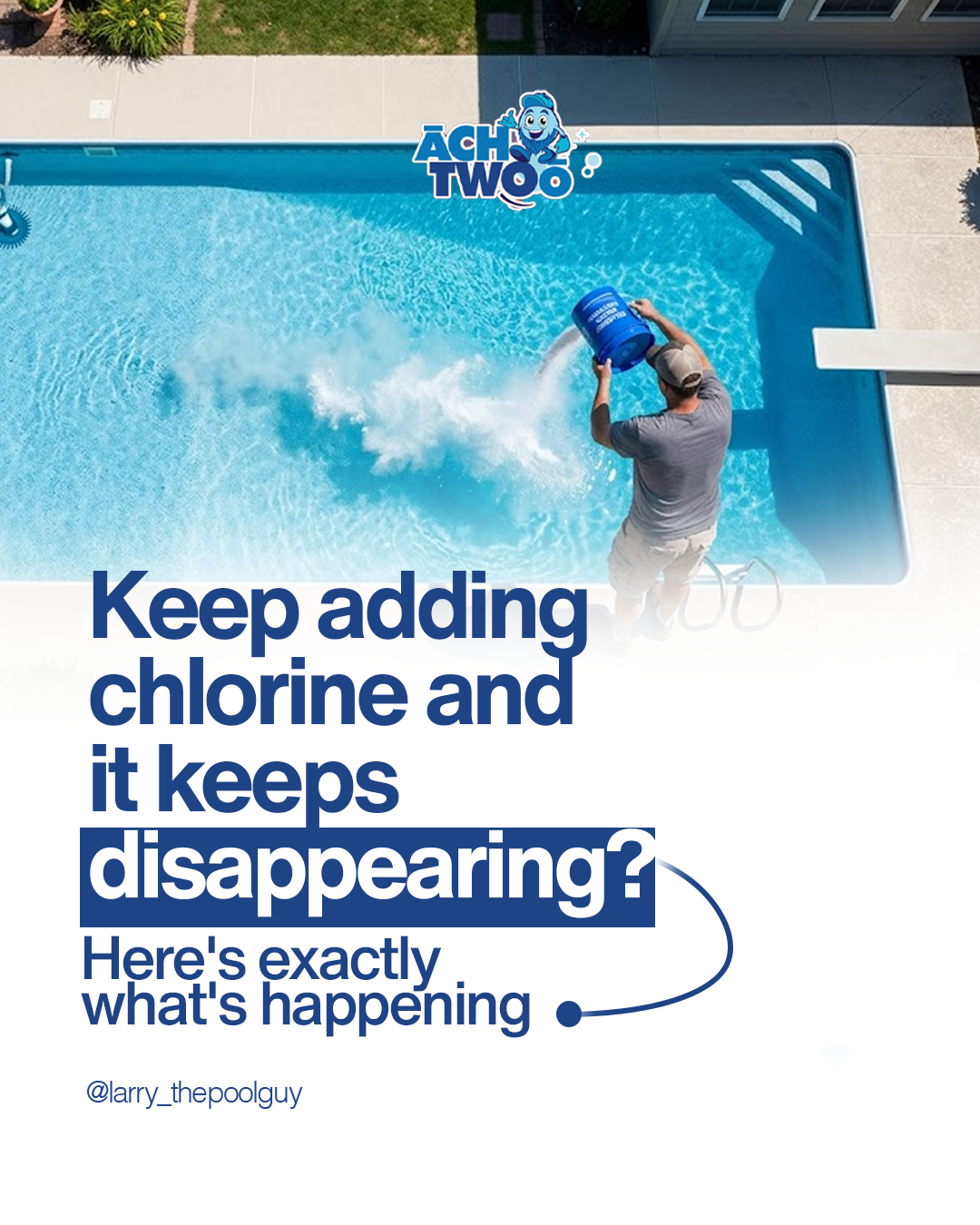
Keep adding chlorine and it keeps disappearing? You are not using the wrong product. You are not underdosing. Something in your pool is consuming chlorine faster than you can replace it and until that something is identified and addressed, no amount of chlorine will hold. Here is exactly what is happening and the direct fix for each cause.
Table of Contents
When Chlorine Keeps Disappearing, the Problem Is Never the Chlorine
The Three Causes Behind Every Persistent Chlorine Loss
Cause One: The Sun Is Destroying Your Chlorine Faster Than You Realise
How Cyanuric Acid Protects Chlorine From UV And What Happens When It's Wrong
Cause Two: Too Much Combined Chlorine Is Competing With Your Free Chlorine
What Combined Chlorine Is and Why It Makes the Problem Worse
How Non-Chlorine Shock Breaks the Combined Chlorine Cycle
Cause Three: Organic Debris Is Silently Consuming Your Sanitiser
Why a Full Skimmer Basket Makes the Problem Significantly Worse
How to Confirm Which Cause Is Driving Your Chlorine Loss
Chlorine Levels That Won't Hold No Matter What You Do?
When Chlorine Keeps Disappearing, the Problem Is Never the Chlorine
A pool owner once described his summer as a full-time job he hadn't applied for. Every two days he was adding chlorine. Testing would show zero. He would add more. Two days later, zero again. He tried a different brand. He tried a higher dose. He tried adding it at different times of day. The result was always the same chlorine that registered briefly and then disappeared as though the water was consuming it deliberately.
He had spent weeks treating this as a dosing problem, adjusting the quantity and frequency, when the chlorine was never the issue at all. His pool had a cyanuric acid level of nearly zero; the result of a partial drain and refill earlier in the season that had diluted the stabiliser out of the water without him realising it. In the intense Southeast Texas summer sun, chlorine without cyanuric acid protection was being destroyed by UV radiation within hours of addition. He could have added three times the product and achieved the same result.
A single cyanuric acid correction resolved a problem he had been fighting for over a month.
This is the pattern that plays out in pools across Southeast Texas and Southwest Louisiana every season: persistent chlorine loss treated as a volume problem when it is actually a system problem. Something in the pool is consuming or destroying chlorine faster than it is being replaced. Identifying what that something is and fixing it directly is the only approach that produces a lasting result.
The Three Causes Behind Every Persistent Chlorine Loss
In professional pool maintenance, chlorine that consistently zeros out despite regular addition almost always traces back to one of three specific causes. Each one creates a different mechanism of chlorine loss. Each one has a direct, targeted fix. And each one requires a different diagnosis before the appropriate correction can be applied.
Understanding all three and knowing how to identify which one is operating in your pool is what turns a frustrating, open-ended chlorine problem into a solvable one.
Cause One: The Sun Is Destroying Your Chlorine Faster Than You Realise
Of the three causes, UV degradation of unstabilised chlorine is both the most common and the most dramatically underestimated by pool owners who have never been told about it.
Research on chlorine photodegradation has produced a figure that consistently surprises pool owners when they hear it for the first time: direct sunlight can eliminate half of a pool's free chlorine in as little as 17 minutes. In the conditions of a peak Southeast Texas summer day; intense UV, long daylight hours, pool water temperatures that accelerate chemical reactions, this degradation rate is near its maximum. A pool treated with chlorine in the morning can be effectively unsanitised by midday if cyanuric acid stabiliser is not present in the water to shield it.
The compound responsible for protecting chlorine from this UV destruction is cyanuric acid also sold as pool stabiliser or conditioner. Cyanuric acid forms a temporary protective bond with free chlorine that dramatically extends its working life under sunlight exposure, allowing it to sanitise throughout the day rather than being burned off within hours of addition.
How Cyanuric Acid Protects Chlorine From UV And What Happens When It's Wrong
Cyanuric acid works because the bond it forms with chlorine slows the rate at which UV radiation can break down the chlorine molecule. The protected chlorine is still available to sanitise, it releases from the bond as needed to kill bacteria and algae but it is no longer being destroyed by sunlight at the rate it would be without protection.
The target range for cyanuric acid is 30 to 50 ppm. Within this range, chlorine is effectively shielded from UV degradation while remaining active enough to sanitise at the performance level the pool requires.
What happens outside this range matters in both directions.
Too low below 30 ppm and the UV protection is insufficient. Chlorine burns off rapidly in sunlight, creating the persistent zero-reading pattern that prompted this article. This is the most common scenario and typically results from a dilution event: significant rainfall or a partial drain and refill that reduced the stabiliser concentration without replacement.
Too high above 80 ppm and particularly above 100 ppm creates the opposite but equally serious problem: chlorine lock. At excessive cyanuric acid levels, the bond between the acid and chlorine becomes too strong. The chlorine is held in the bond rather than releasing to sanitise. The pool tests positive for chlorine but the water is effectively unprotected, a condition that is chemically invisible without a specific cyanuric acid test but entirely predictable once the reading is known.
Test cyanuric acid whenever chlorine consistently zeros out despite regular addition. If it is below 30 ppm, add a cyanuric acid increaser. If it is above 80 ppm, a partial drain and refill with fresh water is required to dilute it back into range.
Cause Two: Too Much Combined Chlorine Is Competing With Your Free Chlorine
The second cause of persistent chlorine loss is less visible than UV degradation but equally disruptive to pool chemistry and it is the cause most frequently overlooked because combined chlorine does not appear on basic test kits that only measure total or free chlorine.
When free chlorine in pool water contacts nitrogen-containing contaminants; ammonia, urea, and the organic compounds introduced by swimmers through sweat, body oils, and other biological matter, it bonds with those contaminants chemically. The resulting compound is combined chlorine, also called chloramines.
Combined chlorine is not free chlorine. It does not sanitise. It is a spent form of chlorine that remains dissolved in the water but contributes nothing to the pool's protective capacity. More importantly, it actively competes with free chlorine for the test readings that pool owners use to assess their sanitiser level. A pool that shows a total chlorine reading of 3 ppm but has 2 ppm of combined chlorine has only 1 ppm of actually active free chlorine below the effective threshold for reliable sanitisation in a residential pool.
What Combined Chlorine Is and Why It Makes the Problem Worse
The presence of significant combined chlorine in pool water creates a chlorine demand that perpetuates itself. The combined chlorine compounds are chemically stable, they do not break down on their own and are not removed by standard filtration. They remain in the water indefinitely, continuing to register on total chlorine tests, giving pool owners the impression that chlorine is present when the active fraction is inadequate.
The familiar signs of high combined chlorine are the ones most pool owners incorrectly attribute to over-chlorination: the strong chemical smell, the eye irritation, the skin discomfort. These are not caused by too much chlorine. They are caused by too much combined chlorine in water that is simultaneously under-protected by free chlorine. A pool that smells strongly of chemicals and irritates swimmers is a pool where the sanitiser has been largely consumed and converted, not one where too much has been added.
How Non-Chlorine Shock Breaks the Combined Chlorine Cycle
The correct treatment for excessive combined chlorine is oxidation shock specifically, a non-chlorine shock product based on potassium monopersulfate.
Non-chlorine shock works by oxidising the combined chlorine compounds, breaking the chemical bonds that hold chloramine molecules together and releasing the nitrogen components from the water. This process is called breakpoint oxidation, and it frees the chlorine that was locked in combined form, either converting it back to usable free chlorine or eliminating it entirely through oxidation.
Unlike standard chlorine shock, non-chlorine shock does not raise the pool's chlorine level directly. Its function is specifically to destroy combined chlorine and restore the ratio of free to combined chlorine to levels where the free chlorine can sanitise effectively again. Applied weekly during heavy use periods when the bather load introducing nitrogen compounds to the water is highest, it prevents combined chlorine from accumulating to levels where it compromises pool chemistry.
To confirm whether combined chlorine is the cause of persistent chlorine loss, test total chlorine and free chlorine separately. Subtract the free chlorine reading from the total chlorine reading, the difference is your combined chlorine. A combined chlorine reading above 0.5 ppm indicates a level that is affecting sanitiser performance and warrants oxidation treatment.
Cause Three: Organic Debris Is Silently Consuming Your Sanitiser
The third cause of chlorine loss is the most physically visible of the three yet it is consistently underestimated as a source of ongoing chlorine demand because individual pieces of debris seem too minor to create a meaningful impact.
Organic matter consumes chlorine. This is a fundamental chemical reality of pool maintenance. Leaves, twigs, insects, pollen, grass clippings, dirt, and any other organic material that enters pool water creates immediate chlorine demand, the chlorine reacts with the organic compounds in the debris, oxidising them and being consumed in the process. The more organic material present in the water at any given time, the higher the chlorine demand and the faster the free chlorine level drops.
In Southeast Texas and Southwest Louisiana, where pools are surrounded by abundant vegetation, where pollen loads are heavy in spring and autumn, and where wind carries organic debris into open water regularly throughout the season, the organic chlorine demand in an unattended pool can be substantial.
Why a Full Skimmer Basket Makes the Problem Significantly Worse
The pool's skimmer is designed to capture surface debris before it sinks and begins decomposing on the floor which would create significantly higher chlorine demand than debris floating at the surface. A functioning skimmer, checked and emptied regularly, removes the majority of incoming organic matter before it can impose meaningful chlorine demand on the water.
A full skimmer basket does the opposite. When the basket is at capacity, water bypasses it rather than flowing through it, the path of least resistance. Debris that should be captured continues past the skimmer and into the pool water, where it begins decomposing and consuming chlorine. At the same time, the restricted flow through the clogged basket reduces the overall circulation rate of the pool, which means chemical distribution is less effective and debris stays in contact with the water longer.
Skim the pool surface every other day during periods of active vegetation nearby. Check and empty the skimmer basket and the pump strainer basket at every visit to the pool equipment, not on a weekly schedule, but based on actual basket condition. In high-debris periods, these baskets can reach capacity within two to three days. Leaving them full for a week creates sustained organic chlorine demand that no dosing adjustment can compensate for.
How to Confirm Which Cause Is Driving Your Chlorine Loss
Each of the three causes produces a slightly different pattern that helps identify it before investing in the wrong correction.
If chlorine zeros out rapidly in sunlight but holds better when added in the evening or during low-UV periods, and if the pool is otherwise reasonably clean, suspect UV degradation from insufficient cyanuric acid. Test cyanuric acid first.
If chlorine appears present on a total chlorine test but the pool still shows algae, cloudiness, or persistent odour; suspect combined chlorine. Test total and free chlorine separately and calculate the difference.
If chlorine consumption has increased alongside an increase in visible debris, recent heavy wind or rainfall, or a period of high pool use without increased skimmer maintenance, suspect organic demand. Increase debris removal frequency and confirm skimmer baskets are being cleared before assuming a chemistry problem.
In many cases, more than one cause is operating simultaneously. A pool with low cyanuric acid, high combined chlorine, and a full skimmer basket is fighting on all three fronts and resolving only one will produce only partial improvement.
Chlorine Levels That Won't Hold No Matter What You Do?
Persistent chlorine loss is always a system problem, not a product problem. The solution is identifying which part of the system is consuming or destroying the chlorine before it can work and correcting that specific cause directly rather than adding more chlorine to an environment that will continue to consume it.
At Achtwoo Pool, diagnosing chlorine demand issues is a routine part of service calls across Orange, Texas, Southeast Texas, and Southwest Louisiana. We identify the cause, apply the targeted fix, and restore the chemical balance that allows chlorine to do its job properly without the ongoing frustration of adding product that disappears before it can protect anything.
We serve Orange, Texas | Southeast Texas | Southwest Louisiana
Orange, Texas; Call: +1 409-734-7665
Beaumont, TX; Call: 409-734-POOL
Lake Charles, LA; Call: 337-333-POOL
Visit www.409pool.com or click the link in our bio.
Chlorine levels that won't hold no matter what you do? The answer is in the system and we know exactly where to look.