
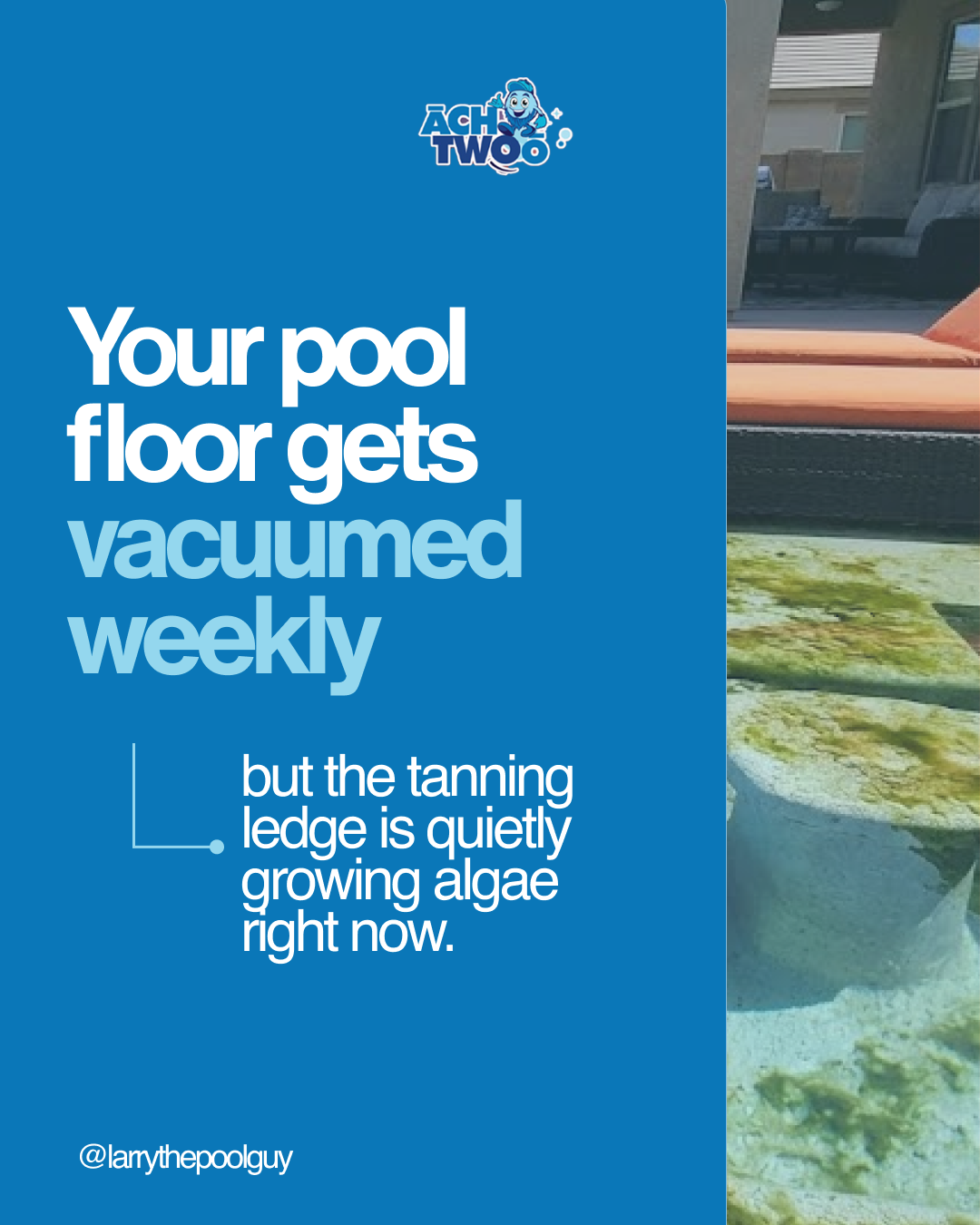
WHY YOUR POOL'S TANNING LEDGE AND BAJA SHELF NEED MORE ATTENTION THAN YOUR POOL FLOOR
By AchtwooPool| Professional Pool Cleaning Services | Orange, Texas | Southeast Texas | Southwest Louisiana
The tanning ledge is the feature everyone falls in love with and nobody thinks to maintain. It looks like a luxury, a shallow shelf to lounge on, to sit the kids on, to wade into on a hot afternoon. What it actually is, in the Southeast Texas and Southwest Louisiana heat, is the most fragile stretch of water in your entire pool. Here is why the shallowest part of your pool needs more of your attention than the deep floor ever will and what happens when it does not get it.
TABLE OF CONTENTS
THE LEDGE THAT KEPT TURNING GREEN WHILE THE REST OF THE POOL STAYED CLEAR
WHY A TANNING LEDGE IS NOT JUST A SHALLOW VERSION OF YOUR POOL
THE HEAT PROBLEM: WHY SHALLOW WATER RUNS HOTTER AND HARDER
SUNLIGHT WITH NOWHERE TO HIDE: THE UV DRAIN ON YOUR CHLORINE
WHY YOUR AUTOMATIC CLEANER KEEPS SKIPPING THE SHELF
THE TEXTURED FINISH THAT HOLDS ONTO EVERYTHING
HOW ALGAE GETS ITS HEAD START ON THE LEDGE
WHY TESTING THE DEEP END GIVES YOU A FALSE READING
WHAT PROPER TANNING LEDGE CARE ACTUALLY INVOLVES
IS YOUR TANNING LEDGE ALWAYS A STEP BEHIND?
THE LEDGE THAT KEPT TURNING GREEN WHILE THE REST OF THE POOL STAYED CLEAR
A homeowner in Orange called us at the end of a long summer, frustrated to the point of giving up on his pool. The deep end, he said, looked perfect. Glass-clear, balanced, exactly the pool he wanted. But the tanning ledge near the steps, the spot where his kids sat for hours every afternoon had a tint to it he could never get rid of, and a slickness on the surface he could feel every time he brushed it with his hand.
He had been doing everything by the book. Vacuuming the floor, running his cleaner, testing his water, keeping his numbers in range. And every reading he took came back fine, because every reading he took came from the deep end. The ledge stayed slick and green no matter what he did, and he had started to assume the finish was simply stained for good.
It was not stained. It was the warmest, sunniest, least-circulated, most-used water in his pool, and it had been quietly running out of chlorine every afternoon while the deep end tested perfectly. Once he understood that the shelf was a different body of water with different rules, the problem that had beaten him for a whole season became one of the easiest parts of his pool to keep clean.
WHY A TANNING LEDGE IS NOT JUST A SHALLOW VERSION OF YOUR POOL
The mistake almost every homeowner makes is treating the tanning ledge as a smaller, shallower piece of the same pool. It is not. It behaves like a completely separate body of water, and it fails in ways the deep end never will.
The reason comes down to volume. Water volume is what gives pool chemistry its stability. The deep end holds thousands of gallons, and all that water acts as a buffer, it absorbs change slowly, so chlorine drifts down gradually and pH moves at a manageable pace. A Baja shelf holds a thin sheet of water, usually somewhere between six and twelve inches deep, sitting directly under the sun. With so little volume to buffer it, that shelf swings fast and hard. Chemistry that would take the deep end all day to lose, the ledge can lose in a few hours. This is the single fact that explains almost every ledge problem a homeowner runs into.
THE HEAT PROBLEM: WHY SHALLOW WATER RUNS HOTTER AND HARDER
Shallow water heats up dramatically faster than deep water, and in this region that is not a small effect. Summer pool temperatures across Southeast Texas and Southwest Louisiana routinely sit above 85 degrees in the main pool. On a tanning ledge, in a few inches of water under full afternoon sun, the temperature climbs well beyond that.
Warmer water burns through chlorine faster. It speeds up the chemical reactions your sanitizer drives, and it is a far friendlier environment for the algae and bacteria that chlorine is there to fight. So the ledge is hit twice at once, it runs short on chlorine faster than the rest of the pool, and it generates more demand for chlorine at the same time. By mid-afternoon, the shelf can be running low on sanitizer while your deep-end test still reads a comfortable 2 to 4 ppm. The pool is not balanced. Only the part you measured is.
SUNLIGHT WITH NOWHERE TO HIDE: THE UV DRAIN ON YOUR CHLORINE
Depth protects chlorine, and the ledge has almost no depth to offer. In the deep end, ultraviolet light weakens as it travels down through the water, so the chlorine lower in the pool is partly shielded. On a tanning ledge, sunlight reaches all the way to the bottom with almost nothing to slow it down, and ultraviolet light destroys free chlorine on contact.
This is where your stabilizer earns its keep. Cyanuric acid, held in the 30 to 50 ppm range, shields chlorine from UV and slows that burn-off. But even properly stabilized water struggles when it is this warm, this shallow, and this exposed. If your cyanuric acid has drifted low, the chlorine on your ledge can be stripped to nothing by early afternoon, long before you would ever suspect it, because the deep end is still holding steady.
WHY YOUR AUTOMATIC CLEANER KEEPS SKIPPING THE SHELF
Here is the part that drives homeowners up the wall. They buy a quality robotic or suction cleaner, run it faithfully, and the ledge stays dirty anyway. That is not a defect in the machine. It is a limitation built into how these cleaners work.
Most automatic cleaners are designed to operate submerged. They need enough water depth to hold position and keep suction or traction. A Baja shelf in six to twelve inches of water is often too shallow for a cleaner to climb onto, stay planted, or clean effectively. So the machine does a beautiful job on the floor and the walls, bumps up against the shelf, and moves on leaving the dirtiest, warmest, most algae-prone water in the pool completely untouched. You watch the cleaner run, you assume the whole pool got cleaned, and the one zone that needed it most got skipped entirely.
THE TEXTURED FINISH THAT HOLDS ONTO EVERYTHING
Builders love a textured finish on a tanning ledge, and for good reason, pebble and rough plaster give bare feet grip on a surface people stand and sit on constantly. But that same texture is a gift to everything you are trying to keep out of your water.
A smooth plaster floor sheds dirt relatively easily. A textured ledge grabs it and holds on. Body oils, sunscreen, sweat, fine debris, and the early biofilm that algae builds all settle into the texture and lodge there, where light rinsing and a cleaner that can barely reach the shelf will never dislodge them. The rougher the finish, the more stubbornly it holds contamination which is exactly why the ledge so often looks and feels dirty even when the rest of the pool is spotless.
HOW ALGAE GETS ITS HEAD START ON THE LEDGE
Algae needs four things to establish: warmth, sunlight, low sanitizer, and a surface to grip. Your tanning ledge hands it all four at once. By early afternoon on a hot day, the shelf is warmer than the main pool, sitting in direct sun, running short on chlorine, and coated in a fine film of sunscreen and body oil that gives algae a foothold on that textured finish.
This is why the first green or mustard tint in a pool so often appears right at the ledge and the steps, not on the floor. That slickness you feel underfoot is usually early biofilm, the stage where algae and bacteria begin colonizing the surface. Left alone through a single hot weekend, a barely-there film can bloom into a fully green ledge by Monday while the deep end still looks like a postcard.
WHY TESTING THE DEEP END GIVES YOU A FALSE READING
Almost everyone tests their water at the same convenient spot every time, usually near the deep end or the skimmer, and treats that number as the truth for the whole pool. During a heat stretch, on a pool with a tanning ledge, that single reading can be genuinely misleading.
The deep end is the most stable, best-circulated, most-shaded water you have. The ledge is the opposite on every count. A test that shows a comfortable chlorine level in the deep end tells you very little about a shelf that has been baking in a few inches of sunlit water all afternoon. If you only ever sample the calm, stable part of the pool, you will keep getting reassuring numbers while the most vulnerable zone quietly slides out of protection and you will keep being surprised by a ledge that goes green for no reason you can see.
WHAT PROPER TANNING LEDGE CARE ACTUALLY INVOLVES
The fix is not complicated, but it does mean treating the ledge as its own priority instead of an afterthought once the floor is done. It starts with brushing, that textured surface needs a brush worked across it by hand, regularly, to lift the film before it becomes a bloom, because no floor cleaner is going to do it for you.
It means sampling the water at the shelf, not just the deep end, especially during hot weather, so you are actually reading the chemistry of the zone most likely to fail. It means keeping free chlorine toward the higher end of the range closer to 3 to 5 ppm when the heat is peaking rather than the usual 2 to 4 so the ledge has a buffer against the extra demand that sun and warmth create, and never letting it fall toward the 1 ppm mark where protection gets unreliable. And it means keeping your cyanuric acid in the 30 to 50 ppm range so the chlorine you add actually survives the afternoon instead of burning off by lunch. Done consistently, the most vulnerable part of your pool stays as clean as the part you admire from the patio.
IS YOUR TANNING LEDGE ALWAYS A STEP BEHIND?
A tanning ledge that keeps turning slick or green is not a stained finish and it is not bad luck. It is the warmest, sunniest, least-circulated, most-used water in your pool being managed as if it were the same as the deep end when it never has been.
At AchtwooPool, we help pool owners across Orange, Texas, Southeast Texas, and Southwest Louisiana keep every part of the pool in balance, including the shallow shelf your family spends the most time in and standard care most often skips.
WE SERVE ORANGE, TEXAS | SOUTHEAST TEXAS | SOUTHWEST LOUISIANA
ORANGE, TEXAS — Call: +1 409-734-7665
BEAUMONT, TX — Call: 409-734-POOL
LAKE CHARLES, LA — Call: 337-333-POOL
Visit www.409pool.com or click the link in our bio.