
YOUR POOL'S GFCI KEEPS TRIPPING: HERE'S WHY YOU SHOULD NEVER IGNORE IT
By AchtwooPool | Professional Pool Cleaning Services | Orange, Texas | Southeast Texas | Southwest Louisiana
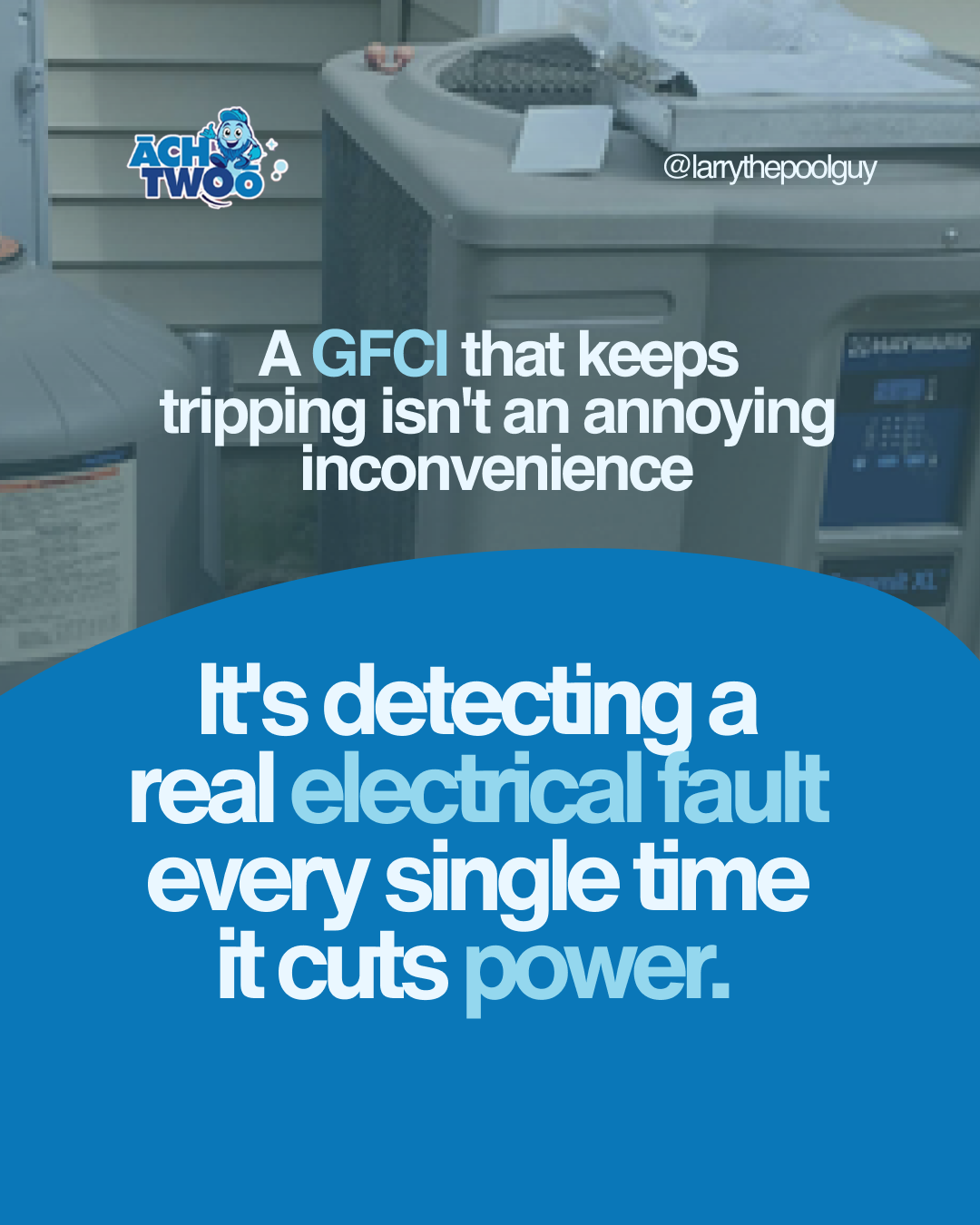
A GFCI that keeps tripping isn't an annoying inconvenience. It is detecting a real electrical fault every single time it cuts power. Every reset is not a solution, it is a delay in addressing something that poses a genuine risk to anyone near that pool. Here is what a GFCI actually does, why a tripping one demands immediate attention, and what must never be done to silence it.
TABLE OF CONTENTS
THE RESET THAT FEELS LIKE A FIX BUT ISN'T
WHAT A GFCI ACTUALLY IS AND WHAT IT PROTECTS AGAINST
HOW A GFCI SHUTS OFF POWER AND WHY MILLISECONDS MATTER
WHY POOL ENVIRONMENTS REQUIRE GFCI PROTECTION SPECIFICALLY
WHAT IT MEANS WHEN A GFCI TRIPS ONCE
WHAT IT MEANS WHEN A GFCI KEEPS TRIPPING
THE FOUR MOST COMMON CAUSES OF PERSISTENT GFCI TRIPPING AROUND POOLS
CAUSE ONE: MOISTURE INTRUSION INTO ELECTRICAL COMPONENTS
CAUSE TWO: DAMAGED OR DETERIORATING WIRING
CAUSE THREE: A FAILING PUMP MOTOR
CAUSE FOUR: A POOL BONDING OR GROUNDING ISSUE
THE ONE THING YOU MUST NEVER DO TO A TRIPPING GFCI
WHY ONLY A LICENSED POOL ELECTRICIAN SHOULD DIAGNOSE A PERSISTENT TRIP
GFCI KEEPS TRIPPING? DON'T IGNORE THE WARNING
THE RESET THAT FEELS LIKE A FIX BUT ISN'T
It starts with an inconvenience. The pump isn't running. The pool light is out. The equipment pad is silent. The pool owner walks to the breaker panel or the outdoor electrical outlet, finds the GFCI tripped, and resets it. Everything comes back on. The problem appears to be solved.
A week later it trips again. Reset. Two days after that, again. Reset again. By the fourth or fifth trip, the pattern has been established, the GFCI trips occasionally, it resets, everything runs normally in between, and it begins to feel like a quirk of the system rather than a warning. Some pool owners begin resetting it automatically each time it trips, the same way they reset any minor inconvenience, without registering that the device is communicating something specific and serious each time it fires.
This is the pattern that creates dangerous situations around pool environments, not dramatic failures, not obvious hazards, but a safety mechanism that is working correctly and being repeatedly overridden by an owner who has come to treat it as a nuisance rather than a warning.
WHAT A GFCI ACTUALLY IS AND WHAT IT PROTECTS AGAINST
A Ground Fault Circuit Interrupter (GFCI) is a safety device designed to protect people from electrical shock by detecting imbalances between the electrical current flowing out of a circuit and the current returning through it. Under normal operating conditions, the current leaving a device through the hot wire and returning through the neutral wire is equal. When those currents are unequal, it means current is flowing somewhere it shouldn't be through a person, through water, through a damaged component, through a path that bypasses the intended circuit.
The GFCI detects this imbalance measured in milliamperes, far below the threshold detectable by a standard circuit breaker and interrupts the circuit within milliseconds. The speed of this interruption is the mechanism of protection. Electrical current at the levels that cause cardiac arrest and death flows through the human body in a fraction of a second. A GFCI's response time is faster than the current can cause lethal harm.
Standard circuit breakers do not provide this protection.
They are designed to detect the much larger current imbalances that cause fires and equipment damage, not the small imbalances that cause electrocution. A pool environment protected only by standard breakers, without GFCI devices, is not electrically safe for swimmers and bystanders by any professional standard.
HOW A GFCI SHUTS OFF POWER AND WHY MILLISECONDS MATTER
The speed of a GFCI's response is what separates it from every other electrical protection mechanism in a pool environment. Standard breakers respond to overcurrent conditions in fractions of a second to several seconds depending on the severity of the fault. For an electrocution event, that response time is too slow.
A GFCI detects ground fault current as small as 4 to 6 milliamperes, a level that can cause loss of muscle control in a person in contact with the current and interrupts the circuit in approximately 1/40th of a second. This response time is faster than the heart's vulnerability window for ventricular fibrillation caused by electrical current. It is the difference between a shock and a cardiac event.
In a pool environment where water and electrical equipment coexist, where the ground is often wet, where people of all ages are in contact with a conductive medium, this response time is the entire basis of electrical safety. And it only works when the GFCI is allowed to do its job rather than being repeatedly reset.
WHY POOL ENVIRONMENTS REQUIRE GFCI PROTECTION SPECIFICALLY
Pool environments present a combination of electrical and water exposure conditions that make ground fault protection not just recommended but mandatory under the National Electrical Code and the electrical codes adopted in Texas and Louisiana.
Water is an effective electrical conductor when it contains dissolved minerals which pool water always does. A person in pool water who comes into contact with a live electrical current has essentially no resistance between the current source and their body. The electrical circuit that would cause a ground fault detector to trip in a dry environment becomes a direct path through a swimmer in pool water.
Pool electrical systems typically include pumps, heaters, lights, chlorinators, automation systems, and various accessories, all operating near and often partially submerged in the same water that swimmers occupy. The exposure of each of these components to moisture, vibration, temperature cycling, and the corrosive environment that pool chemicals create means that electrical faults are not a remote possibility over the lifespan of a pool system. They are a predictable maintenance reality. GFCI protection is what makes those faults safe rather than lethal.
WHAT IT MEANS WHEN A GFCI TRIPS ONCE
A single GFCI trip is the device doing exactly what it was installed to do. Something in the circuit created a ground fault, a current imbalance that the GFCI detected and interrupted. The trip prevented that ground fault current from completing its path, which may have been through a person, through water, or through a compromised component.
A single trip may have been caused by a transient event, a power surge, a momentary water contact with an electrical component, a brief insulation breakdown during startup. Resetting after a single trip and monitoring the circuit for recurrence is a reasonable initial response. If the GFCI does not trip again over the following days and weeks of normal operation, the transient event was likely the cause and the system may be functioning normally.
But a GFCI reset after a single trip is an observation point, not a resolution. If the circuit trips again, the interpretation changes entirely.
WHAT IT MEANS WHEN A GFCI KEEPS TRIPPING
A GFCI that trips repeatedly, on multiple occasions, on a regular pattern, or immediately after being reset is not malfunctioning and it is not being oversensitive. It is detecting a persistent ground fault that exists in the circuit. Every trip is the detection of the same fault, or a fault that is present and recurring because its cause has not been addressed.
There is no acceptable interpretation of a repeatedly tripping GFCI other than this: there is an electrical problem in the circuit that requires professional diagnosis and repair. The GFCI is working correctly. The circuit is not.
This distinction is critical because the most common responses to a repeatedly tripping GFCI resetting it repeatedly in the hope that it will eventually hold, or replacing it with a different device, address neither the device nor the circuit correctly. They delay diagnosis of an electrical fault that is present and active in a pool environment.
THE FOUR MOST COMMON CAUSES OF PERSISTENT GFCI TRIPPING AROUND POOLS
Professional pool electricians who diagnose repeatedly tripping GFCIs encounter a consistent set of causes, each of which requires a specific diagnostic approach and resolution.
CAUSE ONE: MOISTURE INTRUSION INTO ELECTRICAL COMPONENTS
Pool environments are inherently wet, and the electrical components that service them; junction boxes, conduit connections, pump motor housings, light fixtures are exposed to humidity, splash, and in flood-prone areas like Southeast Texas and Southwest Louisiana, direct water intrusion during storm events.
Moisture inside an electrical enclosure creates current pathways that weren't designed into the system. A junction box that has accumulated water over months of humidity exposure, a light fixture whose seal has deteriorated allowing water entry, or a pump housing with compromised weatherproofing will all produce the ground fault current that triggers a GFCI. The moisture is the fault. Removing the moisture and restoring the integrity of the enclosure is the repair.
CAUSE TWO: DAMAGED OR DETERIORATING WIRING
Wiring buried in pool deck conduit, routed through exposure to pool chemicals, UV radiation, and temperature cycling over years of service can develop insulation deterioration that creates ground fault conditions. A wire whose insulation has cracked, abraded, or been compromised allows current to flow to ground through paths that bypass the intended circuit.
Wiring faults in buried conduit or within equipment enclosures are not visible without professional inspection and in some cases require testing with specialised equipment to locate the specific fault point. They do not self-resolve and they do not improve with time.
CAUSE THREE: A FAILING PUMP MOTOR
Pool pump motors age, and as they age, their internal windings, the copper wire coils that create the motor's electromagnetic field can develop insulation breakdown that allows current to contact the motor's metal housing. This is one of the most common causes of persistent GFCI tripping in residential pool systems and is typically a sign that the pump motor is approaching end of service life.
A pump motor producing GFCI trips will often continue running normally between trips which is exactly why the repeated reset pattern develops. The motor appears fine. The GFCI trips. Reset. The motor runs. Trip again. The motor's internal fault is intermittent or temperature-dependent, appearing when the motor reaches operating temperature and resolving when it cools. Professional testing identifies the insulation resistance breakdown that produces this pattern.
CAUSE FOUR: A POOL BONDING OR GROUNDING ISSUE
Pool bonding is the system of conductive connections that links all metallic components in and around a pool; the pump, the light housings, the handrails, the ladder, the water itself through a bonding wire to a common equipotential reference. Bonding does not prevent electrical faults. It ensures that if a fault occurs, all metallic surfaces in the pool environment are at the same electrical potential, preventing current from flowing through a person who bridges two objects at different potentials.
A bonding system that has developed a fault, a connection that has corroded through, a bonding wire that has been cut or damaged during landscaping or renovation, a connection point that has failed can produce GFCI trips by creating the unexpected current paths that the bonding system was designed to prevent. Bonding faults are particularly concerning because their consequences include voltage gradients in pool water; the condition in which current flows through the water itself, creating risk for anyone in the pool.
THE ONE THING YOU MUST NEVER DO TO A TRIPPING GFCI
The most dangerous response to a repeatedly tripping GFCI and the one that removes the pool's primary electrical protection in the most absolute way is bypassing or replacing it with a standard circuit breaker.
A standard breaker cannot detect ground faults at the milliampere level that protects against electrocution. Replacing a GFCI with a standard breaker because the GFCI keeps tripping eliminates the protection entirely while leaving the underlying fault in place. The circuit will run without tripping because the standard breaker cannot detect the fault the GFCI was interrupting. The fault is still there. The protection is not.
This substitution has caused deaths. It is prohibited by electrical code and by every professional standard for pool electrical systems. Under no circumstances should a tripping GFCI be replaced with a standard breaker or bypassed in any form.
WHY ONLY A LICENSED POOL ELECTRICIAN SHOULD DIAGNOSE A PERSISTENT TRIP
The causes of persistent GFCI tripping in pool environments; moisture intrusion, wiring deterioration, motor insulation breakdown, bonding faults require professional diagnostic equipment, licensed electrical knowledge, and in many jurisdictions, licensed electrical permit work to address legally and safely.
Pool electrical systems operate in a uniquely hazardous environment where the consequences of an unresolved fault are not limited to equipment damage. They include the risk of electrocution in water, a risk that is serious enough to justify professional diagnosis regardless of how minor the repeated tripping seems.
When a pool GFCI trips repeatedly, the correct response is not to reset it and monitor. It is to stop using the affected electrical circuit and contact a licensed pool electrician for assessment.
GFCI KEEPS TRIPPING? DON'T IGNORE THE WARNING
Every trip is the device telling you something specific. Every reset without a diagnosis is a delay in addressing it. In a pool environment, that delay is not just an inconvenience risk, it is a safety risk for every person who uses the pool while the underlying fault remains unresolved.
At AchtwooPool, electrical safety around pool systems is taken seriously across every service we provide in Orange, Texas, Southeast Texas, and Southwest Louisiana. We identify, report, and coordinate professional resolution of electrical concerns because pool safety is never just a chemistry issue.
WE SERVE ORANGE, TEXAS | SOUTHEAST TEXAS | SOUTHWEST LOUISIANA
ORANGE, TEXAS — Call: +1 409-734-7665
BEAUMONT, TX — Call: 409-734-POOL
LAKE CHARLES, LA — Call: 337-333-POOL
Visit www.409pool.com or click the link in our bio.